Free template
Free Tutoring Contract Template

What Is a Tutoring Contract?
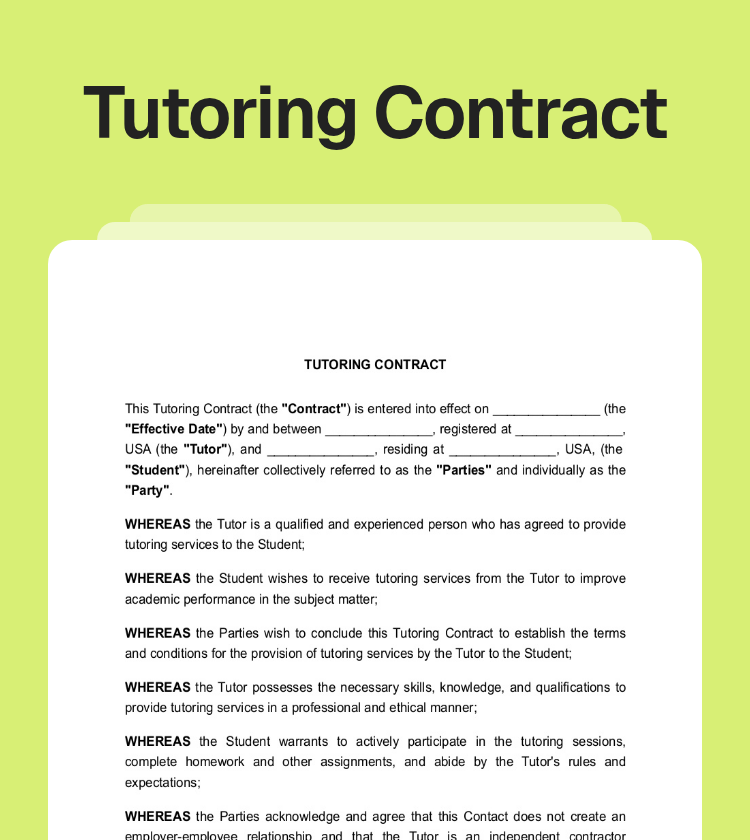
Copy section linkA tutoring contract template provides a written framework for private tutoring services. It records what the tutor will teach, how sessions will work, what the student will pay, and when either party may end the arrangement.
Tutoring contracts can cover academic subjects, test preparation, individual or group lessons, and recurring tutoring sessions. They can also be adapted for remote or in-person instruction.
When to Use a Tutoring Contract
Copy section linkA tutoring contract is useful when:
A private tutor provides academic instruction or test preparation;
The student attends recurring lessons;
Tutoring is provided individually or in group sessions;
The parties want clear fees and cancellation rules;
The tutor provides personalized lesson plans, materials, feedback, or progress reports;
The student must pay separately for textbooks, supplies, or other materials;
The parties want clear accountability for scheduling, attendance, and payment;
Tutoring takes place online or at an agreed physical location.
A different agreement may be appropriate if the tutor is hired as an employee rather than an independent contractor. A school or tutoring company may also need a contract adapted to its own hiring, privacy, and student-protection requirements.
Parties to the Tutoring Contract
Copy section linkThe current Loio tutoring contract template identifies 2 parties:
Tutor: The person providing tutoring services. Under the template, the tutor prepares lessons and materials, provides feedback and progress reports, and operates as an independent contractor.
Student: The person receiving the tutoring services and assuming the payment and other contractual obligations stated in the template.
If the student cannot enter into the agreement independently under applicable state law, the contract should be adapted so that a parent or legal guardian assumes the appropriate contractual obligations.
A school, tutoring agency, or other organization may sometimes hire the tutor or purchase tutoring services for students. The current form is structured for a Tutor–Student arrangement, so it should be modified when an organization rather than the student is the contracting client.
Key Components of a Tutoring Contract
Copy section linkA complete tutoring agreement should address the following:
Parties and effective date: Identify the tutor and student, provide their addresses, and state when the agreement takes effect.
Tutoring services: Describe the subject, session type, location, frequency, duration, and any other agreed details. The template also addresses personalized lesson plans, teaching materials, feedback, and progress reports.
Payment and cancellation: State the tutoring fee, payment period and method, cancellation notice, treatment of missed sessions, additional expenses, and procedure for changing the fee.
Term and termination: Specify when the contract begins, how long it continues, the notice required to terminate it, and how refunds and outstanding payments are handled.
Liability and indemnification: Explain how certain risks and claims are allocated between the parties and identify the agreed limit on the tutor's liability.
Confidentiality: Establish how information disclosed during the tutoring relationship may be used and shared.
Governing law and dispute resolution: Identify the state law governing the contract and the courts designated to resolve disputes.
Lesson materials and intellectual property: The tutoring contract template states that the tutor may prepare personalized teaching materials but does not contain a dedicated intellectual property clause. Add one if ownership, copying, reuse, or distribution of tutor-created materials matters to the parties.
Amendments and signatures: State how the contract may be modified and provide signature fields for the parties.
Key Clauses in a Tutoring Contract
Copy section linkServices clause
It defines the tutoring services and how they will be delivered. The template covers the subject, session type, location, frequency, duration, lesson plans, materials, feedback, and progress reports.
Sample language: “The Tutor agrees to provide the Student with tutoring services according to the terms and conditions stated in this Contract.”
Include this clause in every tutoring agreement. Customize it so the subject, schedule, and session format match the actual arrangement, including whether lessons are individual, group, remote, or in person.
Payment and cancellation clause
It states the tutoring fee, payment schedule, payment method, cancellation window, additional expenses, and rules for changing the fee.
Sample language: “If the Student is unable to attend a scheduled lesson, the Student agrees to notify the Tutor at least [24 hours] before the beginning of the lesson.”
Include this clause whenever tutoring is paid by the lesson, hour, period, package, or another arrangement. The current template specifies cash payment, so change the method if the parties intend to pay another way.
Term and termination clause
It establishes when the contract begins and how either party may end it. It also addresses refunds for unused services and payment for services already provided.
Sample language: “Either Party may terminate this Contract at any time, with or without reason, by giving [30 days] written notice to the other Party.”
Include this clause for recurring or ongoing tutoring. Customize the notice period and confirm that the refund provisions match the chosen payment arrangement.
Liability and indemnification clause
It allocates certain risks between the parties. The template limits the tutor's liability, contains exceptions for gross negligence or willful misconduct, and includes mutual indemnification language.
Sample language: “The Tutor shall not be liable to the Student or any third party for damages or losses arising from the Services, except in cases of gross negligence or willful misconduct.”
Include or customize this provision when the parties want to allocate financial risk. Liability limitations and indemnification terms can be affected by applicable law, particularly if the arrangement involves significant risk or third-party claims.
Confidentiality clause
It requires the parties to protect information disclosed during the tutoring relationship and use it only as necessary to perform the contract. The confidentiality obligation continues after the agreement ends.
Sample language: “The Parties agree to keep all information disclosed during this Contract confidential and not to share such information with any third party unless required by law.”
Include this clause when the tutor may receive academic records, test results, accommodation information, login details, contact information, or other nonpublic information.
Governing law and dispute resolution clause
It identifies which state's law applies to the agreement and where covered court proceedings will take place.
Sample language: “This Contract shall be governed by and construed in accordance with the laws of the State of [State].”
Include this provision when the parties want to establish governing law and venue in advance. Review it particularly carefully when online tutoring involves parties in different states.
Independent contractor clause
It records the parties' intention that the tutor provide services as an independent contractor rather than as an employee.
Sample language: “The Parties acknowledge that this Contract does not create an employer-employee relationship and that the Tutor is an independent contractor.”
Include this clause only when the actual working relationship supports independent-contractor treatment. The wording of the contract does not determine worker status by itself. Federal and state authorities look at the real relationship between the parties.
State variation: State classification tests differ. Massachusetts generally presumes that a person performing services is an employee unless all 3 statutory conditions in § 148B are satisfied. California also has detailed worker-classification rules and specific exceptions for qualifying business and referral relationships.
Key Terms
Copy section linkTutoring session: A scheduled period during which the tutor provides the agreed educational services to the student.
Tutoring package: A payment arrangement under which a student purchases multiple tutoring sessions together. The current template does not contain a dedicated package provision, so the payment terms should be adapted if packages are offered.
Retainer: An agreed advance or recurring payment used to reserve a tutor's availability or cover ongoing services. The current template does not provide a separate retainer structure.
Cancellation window: The amount of advance notice a student must give to cancel a scheduled session without triggering the contract's late-cancellation consequences.
Minor consent: Authorization or contractual involvement of a parent or guardian when the student cannot independently enter the agreement under applicable law.
Individualized Education Program (IEP): A written educational program developed for an eligible child with a disability under the Individuals with Disabilities Education Act. A private tutoring agreement does not itself amend an IEP or transfer a public agency's IDEA responsibilities to a private tutor.
Independent contractor: A person providing services independently rather than as an employee when the actual working relationship satisfies applicable federal and state classification rules.
Confidential information: Nonpublic information that the parties agree to protect and use only for purposes permitted by the contract.
Limitation of liability: A contractual provision that restricts the amount or types of damages a party may be responsible for, subject to applicable law.
Tutoring Session Fees and Expectations
Copy section linkBefore signing, the parties should decide exactly how tutoring will be priced. The template allows them to state the tutoring fee, what it covers, when payment is due, and which additional materials or supplies the student must pay for separately.
If a tutor uses packages, prepaid lessons, retainers, or another payment model, the payment section should be adapted accordingly. The agreement should also explain what happens to unused prepaid sessions if the tutoring relationship ends.
The parties should set expectations for cancellations at the same time. Specify the required notice period, whether a late-cancelled or missed lesson remains payable, and when rescheduling is available.
Tutors should also avoid creating an unintended promise of a particular grade, test score, admission result, or other academic outcome. The current template does not contain a dedicated academic-results disclaimer, so one can be added when that expectation needs to be addressed expressly.
Legal Considerations for Tutoring Contracts
Copy section linkPrivate tutoring operates primarily within the legal framework of state contract law. Depending on the arrangement, worker-classification, tax, child-protection, education, and privacy rules may also apply.
Tutor licensing: Licensing and permit requirements for tutoring businesses can vary by state and locality, depending on the services offered and where the business operates. Tutors working through schools or other regulated programs may also face separate credentialing, clearance, or program requirements.
Students who are minors: Contractual-capacity rules can differ by state. For example, Alabama generally sets the age of majority at 19, subject to statutory exceptions. When a student lacks capacity to assume the contract obligations, adapt the agreement so the appropriate parent or guardian contracts with the tutor.
Independent contractor classification: Describing the tutor as an independent contractor does not settle the classification question. State standards may be stricter than the parties expect. Massachusetts, for example, uses a statutory 3-part test for services covered by § 148B.
School records and FERPA: FERPA does not automatically apply to every private tutor hired by a family. However, a school may disclose education records to an outside tutoring provider under the school-official exception when the applicable conditions are satisfied, including requirements concerning control, use, and redisclosure of records.
Online tutoring and children's privacy: COPPA can apply when a covered commercial website or online service collects personal information online from children under 13. Covered operators generally must provide notice and obtain verifiable parental consent, subject to the rule's exceptions.
How to Fill Out a Tutoring Contract
Copy section link- Identify the parties and effective date. Enter the contract date and the tutor's and student's legal names and addresses. Adapt the party information if a parent, guardian, school, or organization will assume the contractual obligations.
- Describe the tutoring services. Enter the subject and specify whether sessions will be individual or group, remote or in person. Add the location, frequency, duration, and other service details.
- Complete the payment terms. State the tutoring fee, what it covers, the payment period, and the payment method. Review additional expenses and the procedure for future fee changes.
- Set the cancellation rules. Enter the number of hours of advance notice required to cancel a scheduled session. Confirm when missed or late-cancelled lessons are nonrefundable.
- Complete the term and termination section. Add the contract start date and required termination notice. Review the rules for refunds of unused services and payment of outstanding fees.
- Review the risk and confidentiality provisions. Check the liability, indemnification, and confidentiality clauses against the actual tutoring arrangement. Add privacy, intellectual property, or academic-outcome language if needed.
- Select governing law and sign. Enter the applicable state and venue. Review all blanks before the tutor and the student, or other appropriate contracting party, sign. The template requires later amendments to be in writing and signed by both parties.
Frequently Asked Questions
Copy section linkCan this tutoring contract be used for both remote and in-person tutoring?
Yes. Customize the services section to identify the session format, location, frequency, and duration. For online tutoring, the parties can also add any important platform or technology requirements.
Who should sign a tutoring contract when the student is a minor?
It depends on applicable state law and the student's capacity to contract. If the student cannot independently assume the obligations in the agreement, adapt the contract so a parent or legal guardian is the contracting client. Alabama, for example, generally sets its age of majority at 19 rather than 18.
What should a tutoring refund policy cover?
The contract should explain when prepaid amounts are refundable and what happens to unused sessions when the agreement ends. The current template provides for refunds of payments for services not yet provided when the student terminates the contract.
If packages or advance payments are used, customize the clause so it clearly addresses unused sessions rather than relying on general refund language.
What happens if the student cancels or misses a tutoring session?
The template lets the parties choose an advance cancellation window. It also states that the lesson fee is nonrefundable when the student fails to provide the required prior notice.
Enter a realistic notice period and make sure the written rule matches the tutor's actual cancellation practice.
Does a tutoring contract guarantee better grades or test scores?
No academic result should be assumed merely because the parties sign a tutoring agreement. The current Loio template describes tutoring as educational support but does not contain a dedicated clause disclaiming guarantees of grades, scores, admission decisions, or similar results.
If that issue matters, add a clear academic-outcome provision rather than relying on the general liability clause.
Does a tutor need a background check?
There is no single background-check rule that applies to every private tutoring arrangement. Requirements can depend on the state and the setting in which the tutor works.
For example, Pennsylvania's Act 168 employment-history review rules apply in the school context to covered positions involving direct contact with children. Pennsylvania Department of Education guidance explains the scope of those requirements for school entities and independent contractors.
Can a tutor change the tutoring fee?
The current tutoring contract template permits the tutor to modify the fee after giving advance written notice. The parties must specify the required notice period and should document the new amount and its effective date.
Can either party terminate the tutoring contract early?
Yes. The template allows either party to terminate the contract with the agreed written notice. It also allows the tutor to terminate immediately for certain contract violations and addresses outstanding fees and refunds for services not yet provided.
This template is intended for general use across all 50 U.S. states+DC. Local procedures — such as notarization, witnessing, or filing requirements — may still apply, so check your state's specific rules before signing.
Sources
Related Documents
Also Read