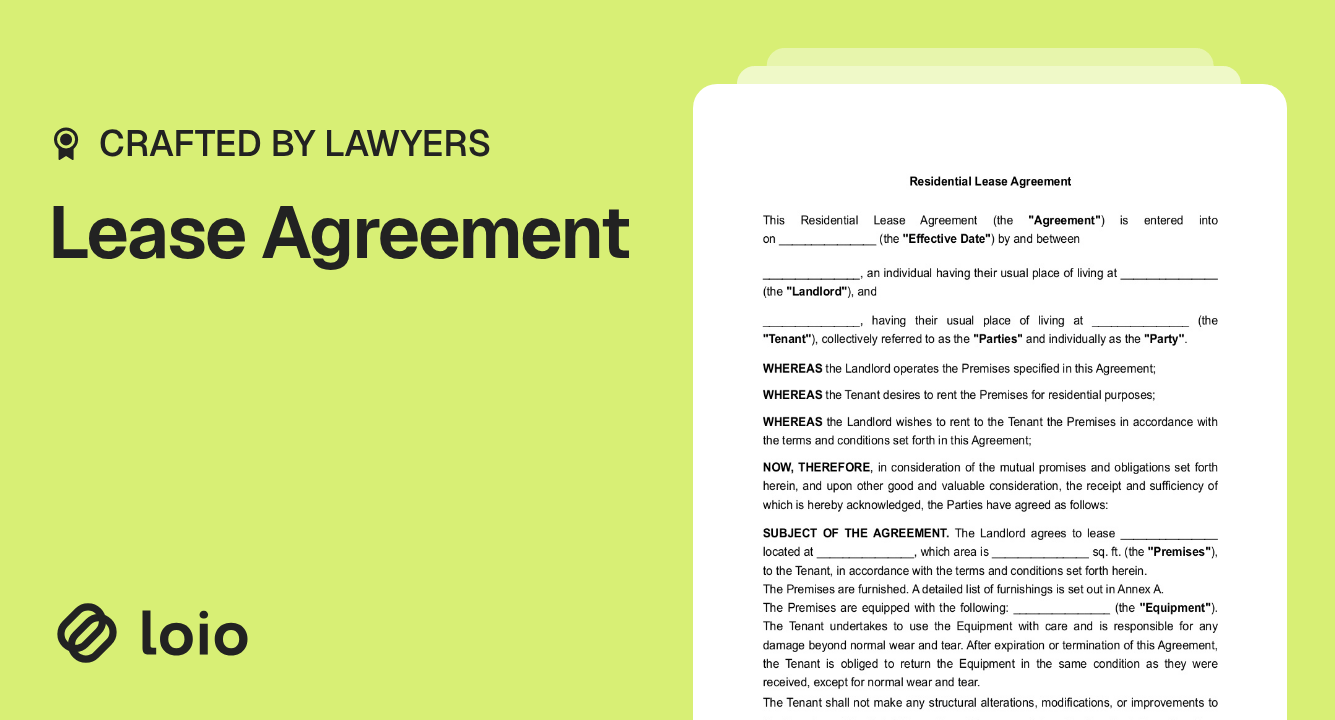
Lease Agreement Template

4.6 (120 reviews)
All states | 17 types
Updated Aug 27, 2025
~ 8 pages
PDF
8.3K downloads
A Lease Agreement is a legal contract between a landlord and a tenant that defines terms for renting residential or commercial property. It is used to establish rights, rent terms, and responsibilities for both parties.
Residential Lease Agreement

This Residential Lease Agreement (the "Agreement") is entered into on   (the "Effective Date") by and between

 , an individual having their usual place of living at   (the "Landlord"), and

 , having their usual place of living at   (the "Tenant"), collectively referred to as the "Parties" and individually as the "Party".

WHEREAS the Landlord operates the Premises specified in this Agreement;

WHEREAS the Tenant desires to rent the Premises for residential purposes;

WHEREAS the Landlord wishes to rent to the Tenant the Premises in accordance with the terms and conditions set forth in this Agreement;

NOW, THEREFORE, in consideration of the mutual promises and obligations set forth herein, and upon other good and valuable consideration, the receipt and sufficiency of which is hereby acknowledged, the Parties have agreed as follows:

SUBJECT OF THE AGREEMENT. The Landlord agrees to lease   located at  , which area is   sq. ft. (the "Premises"), to the Tenant, in accordance with the terms and conditions set forth herein.

The Premises are furnished. A detailed list of furnishings is set out in Annex A.

The Premises are equipped with the following:   (the "Equipment"). The Tenant undertakes to use the Equipment with care and is responsible for any damage beyond normal wear and tear. After expiration or termination of this Agreement, the Tenant is obliged to return the Equipment in the same condition as they were received, except for normal wear and tear. 

The Tenant shall not make any structural alterations, modifications, or improvements to the Premises without obtaining prior written consent from the Landlord. Any alterations or improvements made with the Landlord's approval shall remain on the Premises and may not be removed by the Tenant at the end of the lease term.

The Tenant is entitled to sublease the Premises based on the Landlord's prior written consent.

TENANT'S RIGHTS AND OBLIGATIONS. During the lease term, the Tenant undertakes to use the Premises under the following rules:

• Quiet hours. The Tenant agrees to observe the quiet hours between   and   daily. During these hours, the Tenant shall not disturb the quiet enjoyment of the Landlord or other residents of the surrounding area of the Premises and shall not make excessive noise, including but not limited to loud music, parties, or shouting.

• Occupants. The number of occupants is limited to   individuals. Person permitted to reside on the premises :


If the number of occupants exceeds the limit, the Landlord has the right to take any necessary actions, including but not limited to charging additional fees or evicting the occupants.

• Pets. The Tenant is entitled to keep   (the "Pets") on the Premises. The Tenant is responsible for cleaning up after the Pets inside and outside the Premises, and the Tenant shall keep the Pets under control and shall not allow them to disturb peaceful enjoyment of the neighbors.

• Parking. The Tenant agrees to park only in designated areas and not obstruct driveways or sidewalks. The Tenant has access to   parking spaces on the Premises.

• Trash. The Tenant shall dispose of all trash and recyclables in the designated containers and follow any recycling guidelines provided. Trash or debris must not be left outside designated containers or in common areas.

• No smoking. Smoking and using electronic cigarettes on the Premises and common areas of the Premises is prohibited.

• Other.  .

The Tenant shall not use the Premises for any illegal activity or permit any illegal activity on the Premises. The Tenant shall be responsible for ensuring that all people visiting the Premises with the consent of the Tenant also comply with the terms of this Agreement.

LEASE TERM. The lease term is a period from the start date to the end date specified in this Agreement.

The first day of the lease under this Agreement should be   (the "Start Date") and the last day of the lease under this Agreement should be   (the "End Date")

TERMINATION OF THE AGREEMENT. This Agreement shall commence on the Effective Date and shall continue until the End Date unless terminated earlier in accordance with the terms of this Agreement.

Either Party may terminate this Agreement without cause upon  -day prior written notice. This Agreement may be terminated immediately for cause if either Party fails to perform under the terms of this Agreement. 

In addition, either Party may terminate this Agreement immediately upon written notice to the other Party if the other Party becomes insolvent or files for bankruptcy.

If the Landlord fails to provide the Tenant with full possession of the Premises on the Start Date, the Tenant may terminate this Agreement immediately upon written notice to the Landlord, and the Landlord must return to the Tenant all the amounts paid by the Tenant under this Agreement, including any advance payment, security deposit, and pay to the Tenant a penalty of  . Such payments should be made within   days following the termination date using the payment method specified in this Agreement. 

 .

Upon termination of this Agreement, the Tenant shall pay the Landlord for all days of actual use of the Premises.

LEASE FEE AND PAYMENT PROCEDURE. The lease fee is   per month (the "Lease Fee"). The payments should be made on the last day of each month (the "Due Date").

All payments will be made on or before the Due Date by cash.

The Tenant shall make the advance payment of   within   days following the Effective Date. 

In addition to the Lease Fee, the Tenant shall be responsible for any damage or loss of the Premises caused by the Tenant or their guests while on the Premises. The Tenant shall also be responsible for paying any fines or penalties imposed on them by any governmental authority for any violation of law that occurs on the Premises during the Tenant's stay. Any fees or charges incurred by the Landlord due to the Tenant's breach of this Agreement shall be the Tenant's responsibility and paid immediately on the Landlord's demand.

LATE PAYMENT. In case of payment delay of the Lease Fee for more than   days, the Tenant shall pay the Landlord a late fee of   per day.

SECURITY DEPOSIT. The Tenant shall pay   as security for the successful performance of this Agreement (the "Security Deposit"). The Security Deposit should be paid within   days following the Effective Date, but anyway, before the commencement of the use of the Premises using the payment method specified above. The Security Deposit shall be returned to the Tenant within   days after the end of the Lease Term or the termination date, except for unpaid rent, damage beyond normal wear and tear, or any other amounts payable to the Landlord under this Agreement. The deductions, if any, shall be documented and communicated to the Tenant along with the return of the Security Deposit.

UTILITIES. The Tenant shall pay for the following utility bills:


These payments are included in the Lease Fee.

PREMISES INSURANCE. The Landlord agrees to provide insurance for the Premises. The Tenant acknowledges that the Landlord's insurance policy does not cover any personal property belonging to the Tenant and that the Landlord shall not be liable for any loss or damage to the Tenant's personal property.

POSSESSION. The Tenant shall have full possession of the Premises during the Lease Term specified in this Agreement, subject to the terms and conditions set forth herein.

If the Landlord fails to provide the Tenant with full possession of the Premises on the Start Date, the lease term shall be reduced for the duration of the delay.

Upon the End Date, the Tenant shall remove the personal property and return the Premises in good condition, except for normal wear and tear. 

The Tenant should pay for factual possession of the Premises for each day the Tenant retains possession after the End Date if the Tenant fails to return the Premises on the End Date. The payment for factual possession shall be calculated at a rate of   per day. 

If the Tenant fails to return the Premises to the Landlord on the End Date, the Tenant shall be liable to pay the Landlord a penalty equal to  .

MOVE-IN INSPECTION. The Tenant acknowledges, represents, and warrants that the Premises have been inspected and the Tenant is fully satisfied with its present condition. 

NOTICE. Any notice, request, demand, or other communication required under this Agreement shall be sufficiently given if delivered personally or by certified mail, return receipt requested, to the address set forth in the opening paragraph or to such other address as one Party may have furnished to the other in writing, or to emails specified this Agreement.

Either Party may change the registered mail or email address for receipt of notices by giving written notice to the other Party.

The notices shall be deemed received on the day of delivery if sent by hand or courier service or after a period of   business days from the date of posting if sent by registered mail or email.

WARRANTY. The Landlord represents and warrants that the Landlord has the lawful right and authority to enter into this Agreement and lease the Premises. 

The Tenant warrants to maintain the Premises in a clean, safe, sanitary, and tenantable condition, except for normal wear and tear. The Tenant shall promptly notify the Landlord of any necessary repairs or maintenance issues that may arise. The Landlord shall have the right to remedy the reported issues or may authorize the Tenant, in writing, to make minor repairs and routine replacements. If so, the Landlord shall compensate the Tenant's expense spent for the repairs. 

LIMITATION OF LIABILITY. The Landlord is obliged to maintain, repair, and change exterior and interior structural components of the Premises, perform major repairs, and change all major building systems, such as heating, ventilation, air conditioning, electricity, water, and gas.

If the Premises are accidentally destroyed or rendered uninhabitable due to fire, flood, natural disaster, or any other unforeseen circumstances beyond the Parties' control (the "Accidental Destruction"), and the Accidental Destruction is not caused by the Tenant's negligence or willful misconduct, the Tenant shall not be held liable for the damages. 

FORCE MAJEURE. Neither Party shall be liable for any failure to perform or delay in performing the obligations under this Agreement if such failure or delay is caused by events of force majeure, including but not limited to acts of God, war, terrorism, strikes, lockouts, labor disputes, pandemics, epidemics, governmental regulations, or any other similar cause beyond the reasonable control of the affected Party.

In the case of force majeure, the affected Party shall immediately notify the other Party in writing and provide reasonable proof of the cause of the delay or inability to perform the obligations. The Party affected by force majeure shall endeavor to mitigate the consequences of such circumstances and resume the performance of obligations as soon as possible after the circumstances cease to exist.

If the force majeure circumstances last more than   days, either Party may terminate this Agreement by giving written notice to the other Party. In this case, neither Party shall be liable to the other Party for any damages arising from the termination of this Agreement.

ENTIRE AGREEMENT. This Agreement represents the entire understanding between the Parties and supersedes any prior oral or written agreements.

GOVERNING LAW AND DISPUTE RESOLUTION. This Agreement shall be governed by and interpreted in accordance with the laws of the State of  , and any disputes arising out of or in connection with this Agreement shall be exclusively resolved by the courts of the State of  .

CONFIDENTIALITY. The Parties agree to keep all information disclosed during this Agreement confidential and not to share such information with any third party unless required by law. The Parties agree not to use the confidential information for any purpose other than what is necessary to fulfill their obligations under this Agreement. This confidentiality clause shall remain in effect after the termination or expiration of this Agreement.

WAIVER. The failure of any Party to enforce a particular provision of this Agreement shall not constitute a waiver of their right to enforce that provision in the future.

SEVERABILITY. If any provision of this Agreement is found to be invalid or unenforceable, the remaining provisions shall still be valid and enforceable.

AMENDMENTS. This Agreement may be amended or modified only by a written agreement signed by both Parties. 

BINDING EFFECT. This Agreement shall be binding upon the Parties and their respective successors and assigns. 

ANNEXES. Annex A: List of furnishing.  .

IN WITNESS WHEREOF, the Parties have executed this Agreement as of the Effective Date.

THE LANDLORD

THE TENANT


 , USA

Phone number:  

Email:  


_________________________

(Place for signature)


 , USA

Phone number:  

Email:  


_________________________

(Place for signature)


ANNEX A

to the Lease Agreement dated  

The Premises are furnished with the following:


THE LANDLORD


_______________________________

(Place for signature)

THE TENANT


_______________________________

(Place for signature)


Written by Megan Thompson - Reviewed by Jonathan McGill

Template Types

Tenant Estoppel Certificate
This form verifies key details of a tenant’s lease for third parties.
Condominium Lease Agreement
This contract outlines the terms and conditions under which a tenant rents a condominium.
Venue Rental Agreement
This contract defines the terms for renting an event space between tenants and owners.
Vehicle Lease Agreement
This document helps clients lease a car for the necessary time and pay for leasing.
Month-to-Month Lease Agreement
This agreement is used when a fixed-term lease ends but the tenants wish to stay on.
Office Space Lease Agreement
This form outlines the terms and conditions under which the lease of an office space occurs.
Room Rental Agreement
This agreement lays out the terms and conditions that govern the room rental action.
Oil and Gas Lease Form
This form legalizes the exploration, production, and distribution of natural sources.
Storage Space Lease Agreement
This document allows renters to store objects in a commercial storage facility.
Short-Term/Vacation Lease Agreement
This document between a landlord and tenant outlines the terms for the tenant's stay.
Horse Lease Form
This lease form is designed to define the terms of the horse's use and treatment.
Photo Booth Contract
This document outlines the terms and conditions of a photo booth rental service.
Rent-to-Own Agreement
This agreement helps the tenant lease the property with an option to buy it in the future.
Garage (Parking) Lease Agreement
This document outlines the terms and conditions of renting a parking spot or garage.
Warehouse Lease Agreement
This document helps to formalize the agreement between a warehouse owner and a tenant.
Roommate Agreement
This contract is made between residents detailing house rules and mutual duties.

What Is a Residential Lease Agreement?

Copy section link

A residential lease agreement is a legal contract that officially establishes a landlord-tenant relationship. This crucial written document grants a tenant a "leasehold estate"— the legal right to occupy a specific property, such as an apartment, condominium, or house. In exchange for this right, the tenant provides regular payment of rent to the landlord. The lease agreement is the central document governing the entire tenancy.

While the terms are often used interchangeably, there's a subtle difference between a lease and a rental agreement. A lease agreement typically covers a fixed term, such as one year. This provides stability for both the tenant and the landlord. 

Conversely, a standard rental agreement often refers to a month-to-month lease. This type offers more flexibility, as either party can typically terminate the tenancy with proper notice (usually 30 days). Understanding which type of lease you're entering into is a key aspect of land tenure and will define the entire lease experience for the tenant. Every lease should clearly state its term.

Key Components of a Strong Lease Agreement

Copy section link

A well-crafted lease is detailed and unambiguous. To be effective, the lease agreement must outline the terms of the tenancy with precision, leaving no room for misinterpretation. An effective lease includes several critical sections that cover all essential information. A weak lease can cause problems for the tenant. Strong lease agreements are vital.

  • Parties of the lease

    The lease must clearly identify every tenant and the landlord — the primary parties of the lease — by their full legal names. Anyone living in the property who is over 18 should be named on the lease agreement and sign it. This ensures that every adult occupant is legally responsible for the terms of the lease, including the full payment of rent. 

  • Property details
    The lease needs to include the full property address and a description of the property being rented. This should specify the exact unit, including any parking spots, storage units, or other amenities that are part of the lease agreement.

  • The lease term
    This section defines the lease duration. A fixed-term lease will have a specific start and end date. For example, the term of the lease might run for 12 months. In contrast, a month-to-month lease renews automatically each month until either the tenant or landlord gives notice to terminate the lease. 

  • Rent and payment details
    This is one of the most important clauses in any lease agreement. It must state the exact rental amount. The lease should also detail when rent is due each month, the acceptable methods of payment, and where the payment should be sent. Furthermore, this section of the lease should clearly outline any fees for late rent payments or returned checks. 

  • The security deposit
    This clause should explain the purpose of the security deposit: to cover any potential property damage beyond normal wear and tear or to cover unpaid rent after the tenant moves out. The lease must state the exact amount of the security deposit and the conditions for its full or partial return. This process is governed by state law. For instance, in Florida, a landlord generally has 15 to 60 days to return the security deposit after lease termination, while in North Carolina, the deadline is typically 30 days from lease termination. 
    The tenant must pay the security deposit before the tenancy begins. The return of the security deposit is a frequent point of contention, so this part of the lease must be clear.

  • Rights and responsibilities
    A good lease clearly outlines the rights and responsibilities of both the tenant and landlord. This includes the tenant's responsibility to keep the property clean and the landlord's duty to make necessary repairs to ensure the unit is habitable. This section of the lease should also specify the notice a landlord must provide before they enter the property for inspections or repairs.

  • Rules and regulations
    This part of the lease agreement details specific policies for the residential property. This can include rules on pets, noise levels, long-term guests, smoking, and any alterations the tenant can make to the property. These terms and conditions are a critical part of the lease.

How to Create a Lease Using a Lease Agreement Template

Copy section link

You don't need a lawyer to create a lease, especially for a standard residential property. Using a lease agreement template is a smart, efficient way to draft a comprehensive legal document. A good lease agreement template ensures that all critical clauses are included. This makes it easy to create anything from a simple one-page lease agreement to a more detailed, customizable rental lease agreement.

The process typically starts long before you sign the lease agreement. A landlord should first find a prospective tenant to fill out a rental application. This allows the landlord to collect information and permission to run a background check and review the applicant's credit history and employment.

Once a tenant is approved, the landlord can use a PDF lease agreement template to generate the final document. It is vital that both the landlord and the tenant read the entire lease carefully to ensure they understand their obligations. Once all parties agree, they can sign the lease. In today's digital world, an electronic signature is typically just as legally binding as a handwritten one, which makes the process of finalizing the lease faster and more convenient. 

1. Understand the lease terms

If adult tenants are going to live in the property — like roommates or a couple — each person should sign the document individually. The lease gains legal power only when both parties add their signatures. In case any of them wants to change the terms of the contract, they should sign another document.

Tenants’ duties
  • Pay rent on time.
  • Keep the property clean and safe.
  • Report problems like leaks or pests.
  • Follow all rules listed in the lease.
  • Repair damage they cause through misuse or neglect.
Landlords’ duties
  • Provide a safe, habitable living space.
  • Make necessary repairs.
  • Give proper notice before they plan to enter the property (usually 24 hours).
  • Follow Fair Housing laws.
  • Return the security deposit on time, with a list of deductions if needed.

A signed lease agreement form protects both the landlord and renter. If one party breaks it — for example, if a tenant doesn’t pay rent or a landlord refuses to fix plumbing problems — the other party can take legal action and go to court.

2. How to fill out a lease agreement form

You can complete a rental agreement form yourself, without involving legal experts. Use a reliable lease agreement template and add all the necessary information.

1. Who’s involved?

free printable lease agreement

This part names the landlord and the tenant.

Example:

This Residential Lease Agreement is entered into on April 15, 2025 (the "Effective Date") by and between James Turner, an individual having their usual place of living at 500 Elm St, Austin, TX (the "Landlord"), and Maria Gomez, having their usual place of living at 822 Lakeview Ave, Austin, TX (the "Tenant").

2. What’s being rented?

free lease agreement

Here, you can see the subject section of the agreement. It describes the property being leased.

Example:

The Landlord agrees to lease Apartment 3B located at 822 Lakeview Ave, Austin, TX, which area is 950 sq. ft. (the "Premises"), to the Tenant.

3. Lease term (How long?)

rental agreement template free

You’ll enter the start and end dates of the lease.

Example:

The first day of the lease under this Agreement should be May 1, 2025 (the "Start Date") and the last day of the lease under this Agreement should be April 30, 2026 (the "End Date")

4. Rent and how it’s paid

free rental agreement

State how much rent is and when it’s due.

Example:

 The lease fee is $1,200 per month. Payments are due on the last day of each month.
 The Tenant shall make the advance payment of $1,200 within 5 days following the Effective Date.

5. Security deposit

lease agreement template free

A deposit is usually collected to cover damages or missed rent.

Example:

The Tenant shall pay $1,200 as a Security Deposit within 5 days following the Effective Date.
It will be returned within 30 days after the end of the lease, unless deductions apply.

6. Who pays utilities?

lease agreement template free

List which utility bills the tenant will pay.

Example:

 The Tenant shall pay for the following utility bills: electricity, water, internet.

7. Ending the rental lease agreement PDF

free lease agreement template

Explain how either party can end the lease.

Example:

 Either Party may terminate this Agreement without cause upon 30-day prior written notice.

Once the rental agreement template is complete, both the landlord and tenant need to sign and date it to make it official. You can do this directly on Loio using the eSign feature, so you don’t even need to print anything out.

Managing and Terminating the Lease

Copy section link

The lease lifecycle doesn't end after it's signed. Managing lease agreements is an ongoing process.

  • Renewing a lease: As the end of the lease term approaches, the landlord may offer the tenant an opportunity to renew the lease. This often involves signing a new lease agreement, potentially with an updated rental amount or other revised terms. It's best to handle the offer to renew the lease well before the existing lease expires.

  • Terminating a lease: The lease outlines how the tenancy can end. For a month-to-month lease, either party can terminate the tenancy by providing written notice, usually 30 days. For a fixed-term lease, the tenancy ends on the specified date unless it is renewed. A tenant who needs to break the lease early should сheck the contract to understand the penalties, which can include forfeiting the security deposit and being responsible for rent until the landlord finds a new tenant. A formal lease termination letter is the proper way to provide notice.

  • Eviction: Eviction is the formal legal process a landlord must use to remove a tenant from a rental property. A landlord cannot simply change the locks. Eviction is strictly regulated by landlord-tenant law, and a landlord must have a valid reason (like non-payment of rent or a serious lease violation) and obtain a court order. The lease itself is the key evidence in these proceedings.

Special Considerations for Your Lease

Copy section link

While a good template covers the essentials, there are a few other things to keep in mind when finalizing your lease agreement.

  • State laws: Landlord-tenant law varies significantly across the United States. A lease agreement is a legally binding contract, and it must comply with all state and local laws, including any rent regulations. What's required in a Florida lease might differ from a lease in another state.

  • Commercial vs. residential leases: Unlike a residential lease, a commercial lease for a business is a far more complex document with different legal considerations. A commercial lease agreement requires a different template and often the review of a lawyer.

  • Addenda: Sometimes, you need to add specific terms to a standard lease. This is done with an addendum. Common examples include a pet addendum, which outlines the rules for a tenant's animal, or a sublease agreement, which allows a tenant to rent out part or all of the property to another person.

Landlord and Tenant Laws by State

Copy section link

When a home or apartment is under rent, both a tenant and a landlord are granted certain rights and responsibilities. Some of these come from federal law, and others depend on the state or city in which the property is located.

Across the country, the Fair Housing Act is the main law that regulates landlord-tenant relationships. It protects renters from discrimination based on race, religion, gender, disability, and other factors. Besides, the so-called “implied warranty of habitability” requires rental properties to be safe, clean, and livable.

Beyond these rules, rental laws may differ from one state to another:

California
  • Security deposits can’t be more than two months’ rent (three if the unit is furnished).  
  • Deposits must be returned within 21 days.  
  • After landlords receive a written notice about the need for repairs, they must fix everything within a reasonable time.
Texas
  • No limit on security deposit amounts.  
  • The deposit must be returned within 30 days after move-out.
  • Landlords can begin the eviction process after giving a 3-day written notice.
New York
  • A landlord must inform the tenant about raising the rent 30 days before it.  
  • Rental units must be kept in good, safe condition at all times.
Florida
  • Landlords must give 12 hours’ notice before entering the rental for repairs or inspection.  
  • If a tenant breaks lease terms, they have 7 days to fix the issue.
  • Security deposits must be returned within 15 to 30 days.
Illinois
  • In Chicago, landlords must give 30 days’ notice to evict the tenant.  
  • No limit on security deposits.
  • Some cities require landlords to register their rental units.

How Much Does It Cost to Write a Lease Agreement?

Copy section link

The sum one pays for a ready residential lease agreement may vary from $0 to $500 depending on how one prefers to get it. Here are the most popular options:

  • Free: You can find a free lease agreement template online. However, such forms require special attention because their relevance and correctness cannot be guaranteed. If you choose this option, it’s always better to find several templates and compare them to ensure they contain all necessary clauses. 

  • Forms on legal platforms: Professional platforms typically charge $30–$50 for a rental agreement template. Loio users can use an unlimited number of templates for $29.95/month. The main benefit of these forms is that they are drafted and reviewed by professional lawyers and have user-friendly drafting systems that guide users through the process of document creation. 

  • Property managers: If you lease a house through a real estate agency, document prep is included in the service. However, the fees of the company can be rather high. 

  • Lawyer: Hiring an attorney can cost $200–$500 or more. This works well in cases where there are some problems with the property or if the latter is in the premium class segment. 

Do I Need a Lawyer to Create a Lease Agreement?

Copy section link

In most cases, you don’t need an attorney to create a rental lease agreement PDF, especially if you have a reliable template from a trusted source. However, there are situations where legal help can be required:

  • The lease involves multiple tenants or unusual terms.

  • You rent out a property with legal restrictions, like in a rent-controlled area. 

  • You have had disputes with previous tenants or landlords.

  • You want to customize the lease beyond standard clauses.

  • You’re unsure if your lease follows state or local laws.

A lawyer can help you avoid mistakes, protect your interests, and make sure your lease is valid and fair. For most simple rentals, though, a lawyer is not required.

Lease Agreement Preview