Employment Offer Letter Template

Pro template

4.6 (37 reviews)
All states | 2 types
Updated Jul 7, 2026
~ 2 pages
PDF
3.9K downloads
An employment offer letter is a written document between an employer and a candidate that confirms the main terms of a job offer. It is used to outline the position, salary, benefits, start date, work conditions, and deadline for accepting the offer.
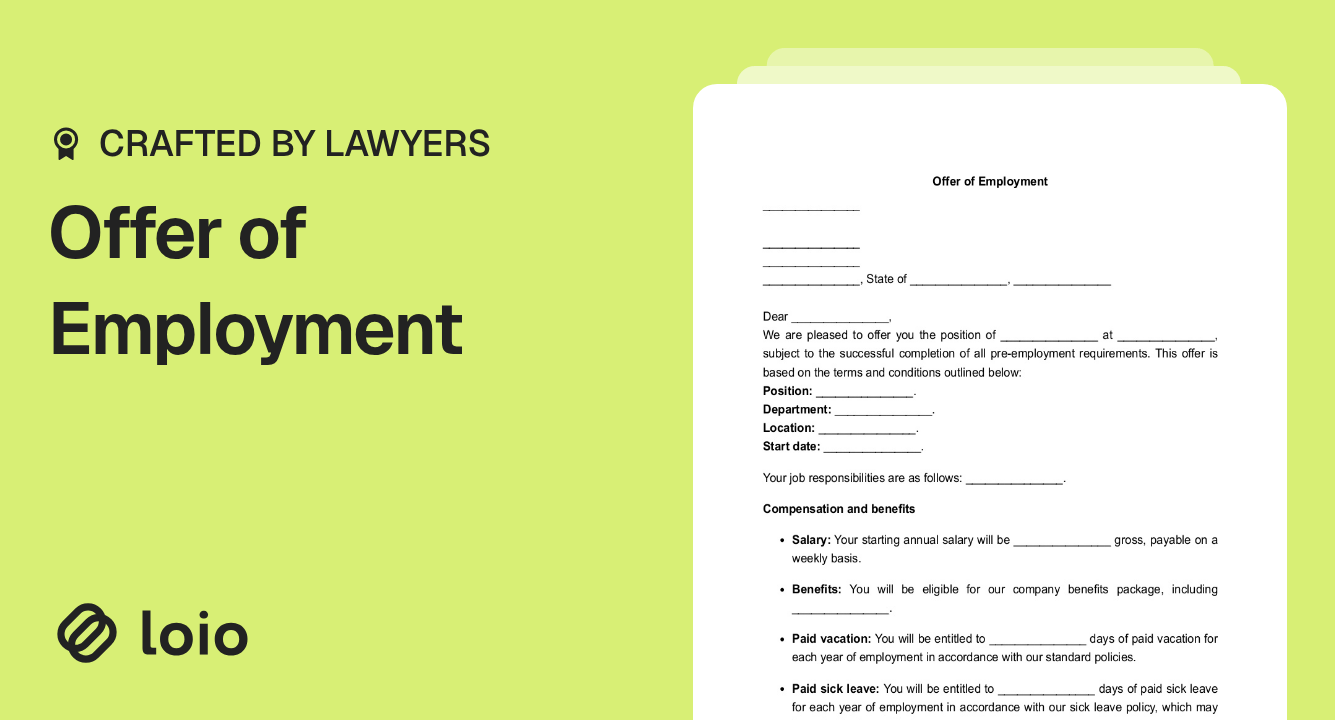
Offer of Employment Page 1
Preview
Written by Megan Thompson, LLB - Reviewed by Jonathan McGill, JD

Template Types

Independent Contractor Offer Letter
This letter is used to formalize working relations with an independent contractor.

What Is an Employment Offer Letter?

Copy section link

An employment offer letter is a formal offer letter from employer to the candidate that confirms a job offer. It typically outlines the position, compensation, start date, reporting structure, and other key employment terms before onboarding begins.

An offer letter template helps employers present job offers clearly and consistently. Some companies also call this document an offer of employment letter template or an offer letter of employment template when they use it as a reusable HR format. It is generally shorter than an employment contract and summarizes the main terms of employment rather than providing extensive legal details.

A well-written offer letter should clearly state whether employment is at-will, identify any pre-employment requirements, and note any additional documents the candidate must sign, such as a non-disclosure agreement or employment contract.

When to Use an Employment Offer Letter Template?

Copy section link

Use an employment offer letter for employment when:

  • An employer wants to offer a job to a selected candidate formally.

  • A hiring manager needs written confirmation of salary, job title, start date, and reporting structure.

  • HR needs a standard offer letter and an employment process in place before onboarding.

  • A company wants the candidate to accept the role by a specific deadline.

  • The offer is contingent on a background check, a reference check, a drug test, a work authorization review, or other pre-employment requirements.

  • The employer wants to explain compensation, benefits, sick leave, annual leave, insurance, and retirement plan eligibility.

  • A remote or hybrid role requires written details on the work location, schedule, equipment, or onboarding steps.

  • The employer wants the candidate to sign the offer electronically as a PDF.

When not to use an employment offer letter for employment:

  • Use an employment contract if the role needs detailed legal obligations, fixed-term employment, severance, restrictive covenants, or termination procedures.

  • Use an independent contractor agreement if the person will work as a freelancer or contractor rather than as an employee.

  • Use a non-disclosure agreement if the main goal is to protect confidential business information.

  • Use an employee handbook if the goal is to explain company-wide policies, workplace rules, leave policies, and benefits procedures.

What are the Parties to the Employment Offer Letter?

Copy section link
  • Employer: The company or organization offering the job.

  • Hiring manager: The person responsible for selecting the candidate and confirming the role details.

  • HR representative: The person who prepares, sends, or manages the offer letter and onboarding process.

  • Candidate: The person receiving the job offer and deciding whether to accept it.

  • Authorized signer: The company officer, HR manager, recruiter, or hiring manager who signs the offer letter for the employer.

  • Witness: A witness is usually not required, but may be used if company policy calls for one.

What are the Key Components of the Employment Offer Letter?

Copy section link
  • Employer information: Add the company name, address, and contact details so the candidate knows who is making the offer.
  • Candidate information: Include the candidate’s full legal name and contact details.
  • Position title: State the job title clearly so the candidate understands the role being offered.
  • Department and reporting line: Identify the department and the manager or supervisor the candidate will report to.
  • Start date: Add the expected first day of work or explain that the date will be confirmed later.
  • Work location: State whether the role is onsite, remote, hybrid, or tied to a specific office.
  • Employment status: Explain whether the role is full-time, part-time, temporary, seasonal, exempt, nonexempt, or at-will, if applicable.
  • Salary or wage: State the salary, hourly rate, pay frequency, and any important compensation details.
  • Bonus or commission terms: Include bonus, commission, equity, or incentive details only if they are part of the offer.
  • Benefits: Summarize health insurance, retirement plans, paid time off, sick leave, annual leave, or other benefits available to the candidate.
  • Pre-employment requirements: List any background check, reference check, drug test, work authorization review, or other conditions that must be completed.
  • Confidentiality or NDA requirements: State whether the candidate must sign a non-disclosure agreement or other confidentiality document.
  • Acceptance window: Add the deadline by which the candidate must accept, decline, or ask questions about the offer.
  • At-will statement: If the role is at-will, state that either party may end the employment relationship as allowed by law.
  • Signature block: Include signature lines for the employer and candidate, along with dates.

What are the Key Terms in an Employment Offer Letter?

Copy section link
  • At-will employment: An employment relationship that either the employer or employee may usually end at any time, with or without cause or notice, subject to applicable law.

  • Probationary period: An initial employment period used to review performance, fit, or training progress.

  • Contingent offer: A job offer that becomes final only after certain conditions are met, such as a background check or work authorization review.

  • Rescission: The employer’s withdrawal of a job offer before the candidate starts work.

  • Pre-employment requirements: Conditions the candidate must satisfy before starting work, such as references, background checks, drug screening, or Form I-9 work authorization.

  • Compensation: The salary, hourly wage, bonus, commission, equity, or other pay the candidate may receive.

  • Benefits: Non-wage employment terms, such as health insurance, retirement plans, paid time off, sick leave, annual leave, or other employee programs.

  • Exempt employee: An employee who may be exempt from overtime rules if the role and pay meet legal requirements.

  • Nonexempt employee: An employee who is generally eligible for overtime pay under wage and hour rules.

  • Non-disclosure agreement: A contract that limits how confidential business information may be used or shared.

How to Fill Out an Employment Offer Letter Template?

Copy section link
  1. Enter the employer's information.
  2. Add the candidate's information.
  3. Enter the date. 
  4. State the position title.
  5. Identify the department and reporting line. 
  6. Enter the start date. 
  7. Specify the work location. 
  8. Select the employment status.
  9. Enter the salary or wage.
  10. Add bonus or commission terms, if applicable. 
  11. Summarize the benefits. 
  12. List pre-employment requirements. 
  13. State confidentiality or NDA requirements. 
  14. Add the acceptance deadline. 
  15. Include the at-will statement, if applicable. 
  16. Complete the signature block. 
  17. Sign the offer letter  (by hand or with eSign) and send it for review and acceptance.

How State Laws Affect Employment Offer Letters

Copy section link

Employment offer letters are not heavily regulated at the federal level, but several states have rules that directly affect what an offer letter must or should include.

Pay transparency. California, Colorado, New York, Washington, and a growing number of other states require employers to disclose a salary range in job postings and, in some cases, in the offer itself. Failing to include a range where required can expose the employer to compliance risk.

At-will exceptions. Every state except Montana follows at-will employment by default. Montana law generally requires cause for termination after a probationary period, so offer letters for Montana-based employees should not include standard at-will language without legal review.

Non-compete disclosure. Several states, including California, Minnesota, and Oklahoma, prohibit most non-compete agreements entirely. Others, such as Illinois and Colorado, require advance written notice before asking a candidate to sign a non-compete. If the offer references any post-employment restrictions, confirm they are enforceable in the candidate's state.

Commission plan disclosure. California requires employers to provide a written commission agreement before a commissioned employee begins work. An offer letter alone does not satisfy this requirement.

Offer letter requirements change as states update their employment laws. Employers hiring across multiple states should review applicable rules for each work location before sending an offer.

Requirements for this document vary by state. Review your state's laws and procedures — or consult a licensed attorney — before using this template to ensure it's valid and enforceable where you live.

Statutory references

Offer of Employment Preview