Free template
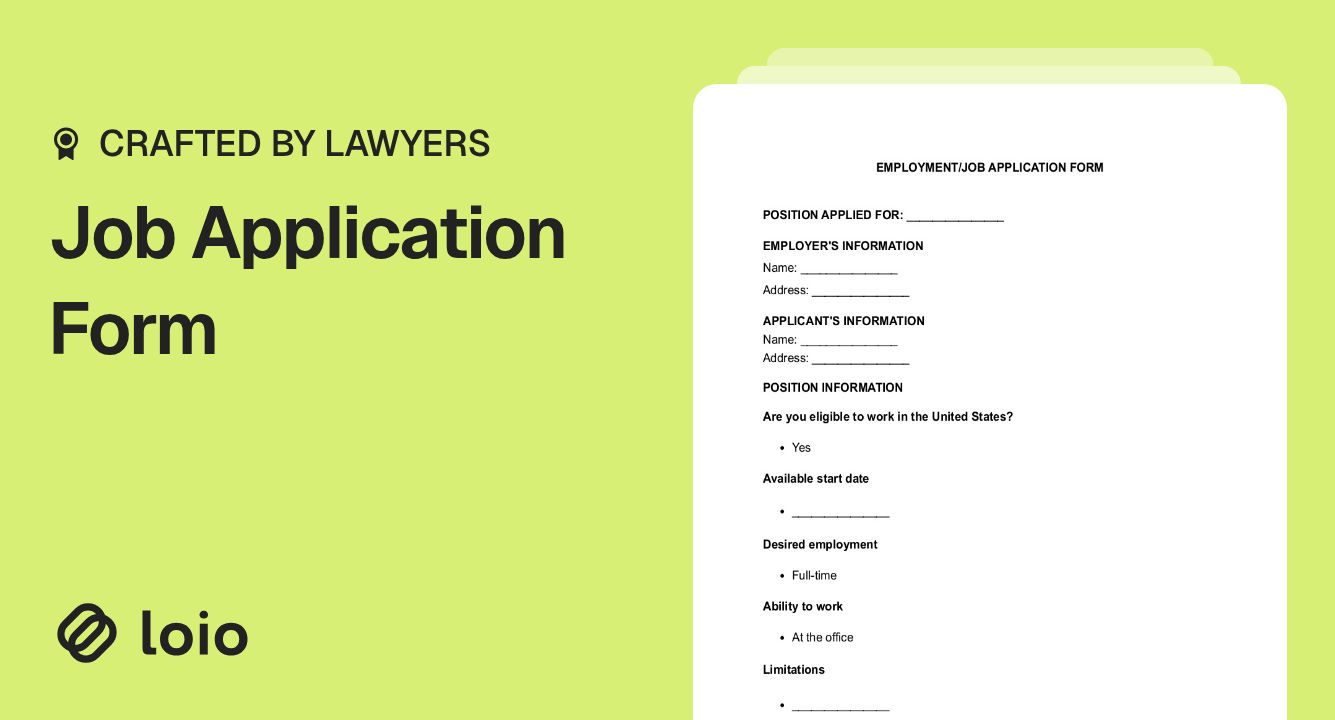
Free Job Application Form Template

What Is a Job Application Form?
Copy section linkAn employment application form is a document employers use to gather key information from people who want a particular job. It includes all the information relevant to the employer's decision on whether the applicant fits the position: personal facts, work history, education, skills, and references. Unlike a résumé, which may have any format, a job application template has a standard form and asks every applicant the same questions.
A properly completed employment application template helps employers easily compare candidates. It also creates a written record that may be used for background checks or future HR needs. Though some companies still require a printable job application, most employers prefer online forms with electronic signatures to simplify document management.
When to Use a Job Application Form?
Copy section linkHiring employees for full-time, part-time, or temporary positions.
Conducting background or reference checks.
Keeping records for legal and HR purposes.
Hiring entry-level or seasonal workers for a generic job.
When not to use a job application form:
Hiring independent contractors (an independent contractor agreement is used instead).
Hiring employees for creative positions (a letter of recommendation and a portfolio are more useful).
What Are the Parties to the Job Application Form?
Copy section linkEmployer: The company or organization offering the job and reviewing applications.
Applicant: The person applying for the job and completing the form.
What Are the Key Components of a Job Application Form?
Copy section linkA generic job application includes:
Personal information: Your full name, address, phone number, and email.
Position: The job title you're applying for, the available start date, and the desired salary.
Work authorization: Confirmation that you're legally allowed to work in the country. The Department of Labor has restrictions for foreign employees and workers under 18.
Education: Schools attended, degrees, and certifications.
Employment history: List of past employers, job titles, duties, and dates of employment.
Skills: Relevant abilities related to the job.
Criminal record disclosure: Information about felony convictions, if the form legally requires it. Pay attention that the Fair Chance to Compete for Jobs Act prohibits federal agencies and contractors from asking applicants to disclose their criminal history record information before they provide an offer of employment. In the private sector, local “ban the box” policies are applied. So, always check your local jurisdiction.
References: Names and contact details of people who can recommend you.
Background check consent: Your written permission for the employer to conduct a background check. According to the Fair Credit Reporting Act, employers are not allowed to add a background check disclosure to the application form. Instead, they should provide a separate background check authorization form and have it signed by the applicant.
Applicant's signature: Your confirmation that all information is true and complete.
What Are the Key Terms in a Job Application Form?
Copy section linkAt-will employment: A work relationship that can be ended by the employer or employee at any time, within the limits of the law.
Equal employment opportunity (EEO): Laws that protect applicants from discrimination based on race, gender, religion, age, disability, and other protected traits.
Background check: A review of your criminal, employment, education, or credit history conducted to verify the information you provided. Employers may request your identifying details, such as your Social Security number, to confirm your identity and ensure accurate results.
Reference check: When an employer contacts the people you listed as references.
Felony: A serious criminal offense that may need to be disclosed if the form asks about it.
How to Fill Out a Job Application Template?
Copy section link- Enter your full legal name, address, and contact information.
- Name the position you are applying for.
- State your availability and salary expectations, if requested.
- Specify the desired work location.
- Confirm that you are of legal age and allowed to work in the U.S.
- Add your education details and certifications.
- List your previous jobs, starting with the most recent one.
- Include accurate dates of employment and main duties.
- List your key skills related to the job.
- Disclose any criminal record if the employer asks for it.
- Provide contact details for your references.
- Attach your résumé and make sure it matches the information in the form.
- Proofread the entire employment application for errors.
- Sign and date the form (by hand or with an electronic signature).
What Mistakes to Avoid When Completing a Job Application Template?
Copy section linkLeaving sections of the application for employment form blank.
Providing incorrect dates or job titles.
Making spelling or grammar mistakes.
Giving false information.
Forgetting to sign the form.
Not attaching a résumé and references when required.
Is a job application form legally binding?
An employee application form is not an employment contract and does not oblige you to anything, but it confirms that the information you provide is true. If you provide false information, it can have legal consequences.
Do I need to notarize a job application form?
No, notarization is not required for a standard application for employment.
How long is a job application form valid?
It depends on the employer’s policy. Some keep applications for employment on file for several months or up to a year.
Should I attach a résumé to an employment application?
Yes, a well-written and proofread résumé helps the employer understand more about your experience and skills.
Requirements for this document vary by state. Review your state's laws and procedures — or consult a licensed attorney — before using this template to ensure it's valid and enforceable where you live.
State Requirements for a Job Application Form
Copy section linkEmployers may request prior compensation information, subject to federal anti‑discrimination protections. However, if the employee refuses to promote it, they cannot refuse to interview or hire this employee.
No statewide salary history ban applies to private employers. Compensation inquiries remain subject to federal equal pay and anti‑discrimination laws.
No statewide prohibition on salary history inquiries. Employers may request prior pay information consistent with federal anti‑discrimination requirements.
No statewide restriction prevents employers from requesting salary history. Federal equal pay and anti‑discrimination protections apply.
Employers may not request or rely on salary history when determining pay (Cal. Lab. Code § 432.3). Job postings must include pay scale information under SB 1162.
The Equal Pay for Equal Work Act (C.R.S. § 8‑5‑102) prohibits salary history inquiries and requires disclosure of pay ranges and benefits in job postings.
Employers may not inquire about salary history unless voluntarily disclosed. However, they are obliged to disclose the wage range in internal and external job postings.
Employers may not seek compensation history from applicants. Verification is permitted only after an offer with compensation terms.
No statewide salary history ban applies to private employers. Compensation inquiries remain subject to federal anti‑discrimination protections.
No statewide prohibition on salary history inquiries for private employers. Federal equal pay protections apply.
Employers may not inquire into salary history during hiring. The law aims to prevent wage discrimination.
No statewide restriction on salary history inquiries. Federal equal pay and anti‑discrimination laws govern compensation decisions.
Employers may not request salary history. Pay scale and benefits information must be included in job postings.
No statewide law prohibits salary history inquiries for private employers. Federal anti‑discrimination laws apply.
No statewide salary history restriction applies. Employers must comply with federal equal pay protections.
No statewide prohibition on requesting salary history. Federal anti‑discrimination protections govern compensation practices.
No statewide restriction on salary history inquiries for private employers. Federal equal pay laws apply.
No statewide salary history ban applies. Employers remain subject to federal anti‑discrimination requirements.
Employers may not inquire about salary history until after an offer with compensation terms.
Employers may not seek salary history. Wage range disclosure is required upon request.
Salary history inquiries are prohibited before an offer under the Equal Pay Act.
No statewide law prohibits private employers from requesting salary history. Federal equal pay and anti‑discrimination laws apply.
No statewide prohibition on salary history inquiries for private employers. Compensation practices remain subject to federal equal pay protections.
No statewide restriction on requesting salary history. Employers must comply with federal anti‑discrimination laws.
No statewide salary history ban applies to private employers. Federal equal pay protections govern compensation decisions.
No statewide prohibition on salary history inquiries for private employers. Federal anti‑discrimination requirements apply.
No statewide law restricts salary history inquiries. Employers remain subject to federal equal pay protections.
Employers may not seek salary history and must provide wage range information after an interview.
Employers may not inquire about salary history and may not use prior pay in determining compensation.
Employers may not request or rely on salary history, except when voluntarily disclosed.
No statewide salary history ban applies to private employers. Federal anti‑discrimination and equal pay laws govern compensation practices.
Employers may not request or rely on salary history. Job postings must include good‑faith pay ranges.
No statewide prohibition on salary history inquiries for private employers. Federal equal pay protections apply.
No statewide salary history restriction applies. Employers must comply with federal anti‑discrimination laws.
No statewide ban on salary history inquiries for private employers. Federal equal pay and anti‑discrimination protections apply.
No statewide restriction on salary history inquiries. Employers remain subject to federal anti‑discrimination requirements.
Employers may not request or rely on salary history. Applicants may request pay range information after an interview.
No statewide salary history ban applies to private employers. Federal equal pay protections govern compensation decisions.
Employers may not request salary history before an offer and must provide pay range information upon request.
No statewide prohibition on salary history inquiries. Federal anti‑discrimination laws apply.
No statewide salary history restriction applies to private employers. Federal equal pay protections govern compensation practices.
No statewide ban on salary history inquiries for private employers. Employers must comply with federal anti‑discrimination laws.
No statewide restriction on requesting salary history. Federal equal pay and anti‑discrimination protections apply.
No statewide salary history ban applies to private employers. Federal equal pay laws govern compensation decisions.
Employers may not inquire about salary history and must provide wage range information upon request.
No statewide prohibition on salary history inquiries for private employers. Federal anti‑discrimination protections apply.
Employers may not seek wage or salary history and must disclose salary ranges and benefits in job postings for covered employers.
No statewide salary history restriction applies to private employers. Federal equal pay and anti‑discrimination protections govern compensation practices.
No statewide prohibition on salary history inquiries for private employers. Federal equal pay laws apply.
No statewide salary history restriction applies. Employers must comply with federal anti‑discrimination protections.
Sources
Related documents
Also read