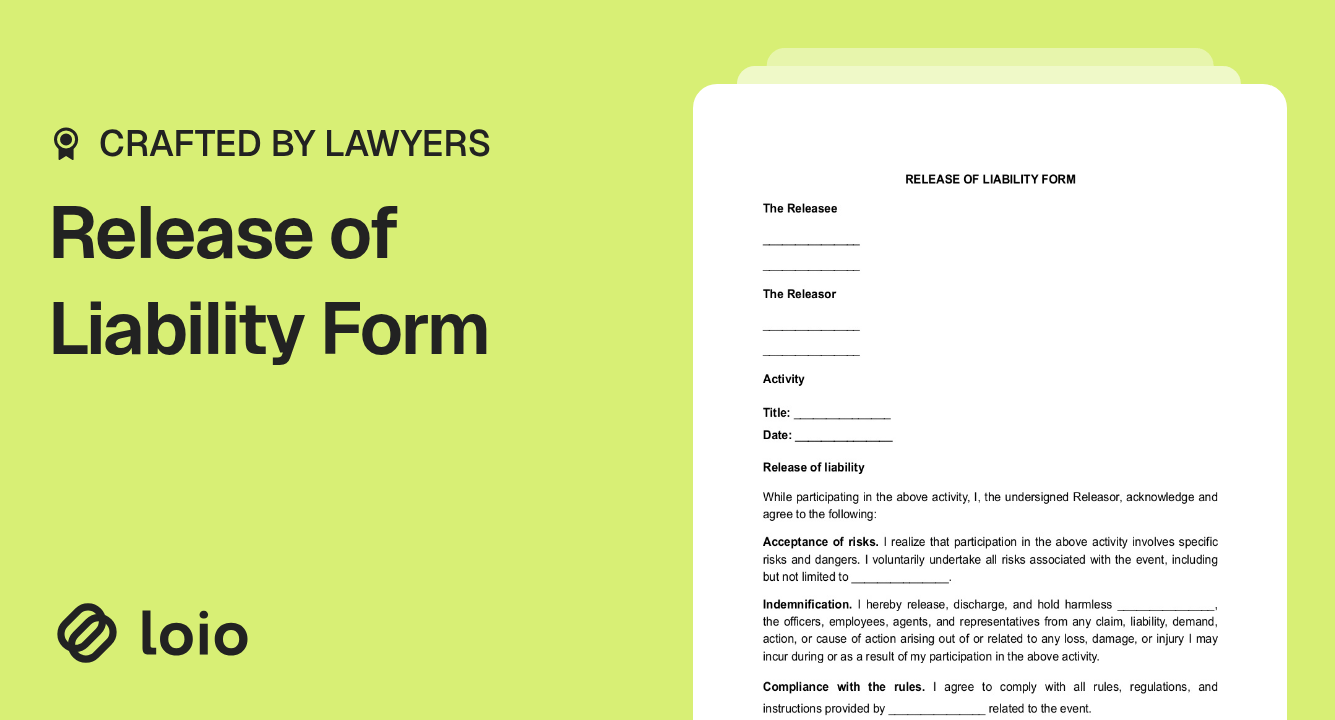
Free Release of Liability (Waiver) Form Template

Free template

4.8 (222 reviews)
All states | 10 types
Updated Jul 3, 2026
~ 2 pages
PDF
5.4K downloads
A Release of Liability Form is a legal document between two parties where one agrees not to hold the other responsible for injuries or damages. It is used to minimize legal risks before engaging in activities or services.
Release of Liability Form Page 1
Preview
Written by Karyna Pukaniuk - Reviewed by Jonathan McGill, JD

Template Types

SAV-RX Prior (Rx) Authorization Form
This document outlines the terms for obtaining prior authorization for prescription medications.
Talent Release Form
This form is impeccable in the daily work of content creators and talented persons.
Pregnancy Verification Form
This form confirms pregnancy status and can be added to medical records for verification.
Medical Records Release Form
This form enables sharing of a patient's medical information between healthcare providers.
Car Accident Release of Liability Form
This form becomes essential whenever there's a settlement following a car accident.
Lease Agreement Release Form
A lease release form discontinues the landlord and tenant relationship.
Release of Lien
This form removes any encumbrances on the property, permitting its sale or refinancing.
Photo Release Form
This document provides the model’s permission to use their photos in public.
Media (Video) Release Form
This form protects the rights of parties involved in the production and use of video content.

What Is a Release of Liability Form?

Copy section link

A release of liability form is a document in which one party agrees not to hold another party responsible for certain injuries, damages, or losses that may occur during a specific activity, event, or transaction. It is commonly used when a person voluntarily participates in activities that involve some level of risk.

The purpose of a liability waiver form is to inform participants about potential risks and document their acknowledgment of those risks before the activity takes place. The enforceability of this document depends on state law and the specific language used in the document. In general, courts are more likely to enforce forms that clearly explain the risks involved and are signed voluntarily by the participant.

A general release of liability form is a document through which one party agrees not to hold another party responsible for any potential injuries, damages, or losses that may take place during a specific activity or transaction. 

When to Use a Release of Liability Form

Copy section link

A general liability release form is often used when someone participates in an event or activity that could be risky.

Use a release of liability form when:

  • Sports and recreational activities — Participants acknowledge the risks associated with activities such as hiking, cycling, rock climbing, or organized sports.

  • Fitness programs and gym memberships — A gym, trainer, or fitness instructor wants participants to recognize the risks of physical exercise.

  • Volunteer events — Volunteers agree to participate in an event while acknowledging potential risks.

  • Youth activities and camps — Parents or guardians provide consent and acknowledge risks on behalf of a minor.

  • Property use — A property owner allows others to use their land, facilities, or equipment.

  • Vehicle sales — A seller documents the transfer of ownership and helps limit liability for accidents, traffic violations, or other issues that occur after the sale. The form may also support ownership transfer records filed with the Department of Motor Vehicles [1].

  • Tours and excursions — Travel operators inform participants of potential hazards associated with a trip or activity.

  • Special events — Event organizers ask attendees or participants to acknowledge certain risks before taking part.

  • Equipment rentals — A business rents bicycles, boats, tools, or other equipment and wants users to accept responsibility for associated risks.

  • Settlement negotiations — Parties use a release of liability form to document the resolution of a dispute and prevent future claims after reaching a settlement. 

Parties to the Release of Liability Form

Copy section link

A liability waiver template typically involves two primary parties, although additional parties may be included depending on the activity, event, or transaction.

Releasor — The individual who agrees to waive certain legal claims and release another party from liability for specified risks or damages.

Releasee — The person, business, organization, property owner, event organizer, or service provider being released from liability under the agreement.

Parent or Legal Guardian (if applicable) — A parent or guardian who signs the release on behalf of a minor participating in an activity or event.

Property Owner (if applicable) — The owner of a property who seeks liability protection when allowing others to use the premises.

Event Organizer (if applicable) — The individual or organization responsible for organizing an event and requesting participants to acknowledge associated risks.

Business or Service Provider (if applicable) — A company, instructor, trainer, tour operator, or equipment rental provider seeking protection from certain claims arising from participation or use of services.

Witness (if applicable) — A third party who observes the signing of the document and may help verify its authenticity.

Notary Public (if applicable) — A state-authorized official who verifies the identity of the signer and notarizes the document when notarization is required or requested.

When not to use a release of liability form:

A simple release of liability form cannot protect against all legal claims. It cannot be used:

  • In cases of gross negligence or intentional harm;

  • To pass responsibility that legally cannot be waived (e.g., employer responsibilities for workplace injuries);

  • In situations that involve minors, unless the document is signed by a parent or guardian;

  • If the agreement violates public policy or laws. 

Parties to the Release of Liability Form

Copy section link

A liability waiver template typically involves two primary parties, although additional parties may be included depending on the activity, event, or transaction.

Releasor — The individual who agrees to waive certain legal claims and release another party from liability for specified risks or damages.

Releasee — The person, business, organization, property owner, event organizer, or service provider being released from liability under the agreement.

Parent or Legal Guardian (if applicable) — A parent or guardian who signs the release on behalf of a minor participating in an activity or event.

Property Owner (if applicable) — The owner of a property who seeks liability protection when allowing others to use the premises.

Event Organizer (if applicable) — The individual or organization responsible for organizing an event and requesting participants to acknowledge associated risks.

Business or Service Provider (if applicable) — A company, instructor, trainer, tour operator, or equipment rental provider seeking protection from certain claims arising from participation or use of services.

Witness (if applicable) — A third party who observes the signing of the document and may help verify its authenticity.

Notary Public (if applicable) — A state-authorized official who verifies the identity of the signer and notarizes the document when notarization is required or requested.

What to Include to the Release of Liability Form

Copy section link

A release of liability form contains the information needed to document a participant's acknowledgment of risks and their agreement to waive certain legal claims. Including complete and accurate details can help clarify each party's rights and responsibilities.

Releasor Information — Identifies the person giving up certain claims or agreeing not to hold another party responsible.

Releasee Information — Identifies the person, business, organization, or property owner being released from liability.

Activity, Event, or Transaction Description — Explains what activity, service, event, property use, or transaction the release applies to.

Assumption of Risk [2] — States that the releasor understands and accepts the possible risks connected to the activity or transaction.

Release of Claims — Describes the claims, injuries, damages, or losses the releasor agrees not to pursue against the releasee.

Indemnification Clause [3] — Explains whether the releasor agrees to cover certain losses, claims, or expenses connected to their actions.

Medical Consent or Emergency Treatment Clause — Allows emergency medical care if the release is used for sports, camps, events, or physical activities.

Parent or Guardian Consent — Confirms that a parent or legal guardian signs on behalf of a minor when the participant is under 18.

Depending on the situation, the waiver form may also include provisions related to liability insurance requirements, emergency medical treatment, property use restrictions, settlement of future disputes, and jurisdiction-specific legal requirements. These clauses help clarify expectations and strengthen the overall risk management strategy. 

Key Terms of the Release of Liability Form

Copy section link

Assumption of Risk: A clause stating that the participant understands the potential dangers of an activity and voluntarily chooses to participate despite those risks.

Indemnification: A provision requiring one party to compensate the other for certain losses, damages, claims, or legal expenses that may arise from the activity or event.

Governing Law: The state law that will be used to interpret and enforce the general liability waiver if a dispute occurs.

Jurisdiction: The court or geographic location where any legal dispute related to the agreement must be resolved.

Gross Negligence: Conduct that shows a severe disregard for the safety or rights of others and goes beyond ordinary negligence.

Waiver of Claims: A statement confirming that the participant gives up the right to bring certain legal claims against the released party.

How to Fill Out a Release of Liability (Waiver) Form: Step-by-Step

Copy section link

You can create a liability form in minutes using Loio's interactive interview system. Simply answer a series of guided questions, and the platform will automatically generate a completed document based on your responses.

If you prefer to complete the general liability release form manually or would like to understand the information required before getting started, follow the step-by-step instructions below.

  1. Enter the Effective Date. Specify the date when the release of liability agreement takes effect.
  2. Provide the Releasor's Information. Enter the full legal name and address of the person releasing potential claims.
  3. Provide the Releasee's Information. Enter the full legal name and address of the person, business, or organization being released from liability.
  4. Describe the Activity or Event. Clearly identify the activity, event, service, or situation covered by the release.
  5. Review and Complete the Release of Claims. Confirm the scope of claims, damages, or liabilities the releasor agrees to waive.
  6. Review the Assumption of Risk and Indemnification Provisions. Ensure the releasor understands the risks involved and any indemnification obligations included in the form.
  7. Enter the Governing Law State. Specify the state law that will govern the agreement.

Once the form is complete, you can sign it electronically and request an electronic signature from the other party, allowing both sides to execute the agreement remotely and keep a digital copy for their records.

Is a Release of Liability Form Enforceable?

In many cases, yes. A release of liability form can be enforceable if it clearly explains the risks involved, is signed voluntarily, and complies with applicable state law. Courts generally consider whether the language is clear and whether the signer understood the agreement before signing.

Courts may also consider public policy limitations when evaluating enforceability. For example, many jurisdictions do not allow parties to waive claims involving gross negligence, intentional misconduct, or violations of law.

Does a Release of Liability Need to Be Notarized?

Usually, no. Most release of liability forms do not need to be notarized to be legally valid. A signed agreement is often sufficient to create an enforceable contract.

That said, some organizations, industries, or state-specific situations may require notarization or witness signatures for additional verification. Having the document notarized by a notary public can provide additional evidence that the signer's identity was verified and that the agreement was signed voluntarily. If you are unsure, review your state's requirements or the policies governing the activity.

Who Fills Out the Release of Liability Form?

The release of liability form is typically prepared by the person or organization seeking protection from potential claims, such as a business, event organizer, property owner, or service provider. The participant or other party then reviews the document and completes any required personal information before signing.

How Do You Write a Release of Liability Form?

To write a release of liability form, identify the parties, describe the activity or event, explain the risks involved, and clearly state which claims are being released. The agreement should also include provisions addressing assumption of risk, indemnification, governing law, and signatures. Using a professionally drafted template can help ensure that all essential terms are included.

Disclaimer

Requirements for this document vary by state. Review your state's laws and procedures — or consult a licensed attorney — before using this template to ensure it's valid and enforceable where you live.

Sources

Also Read

Release of Liability Form Preview