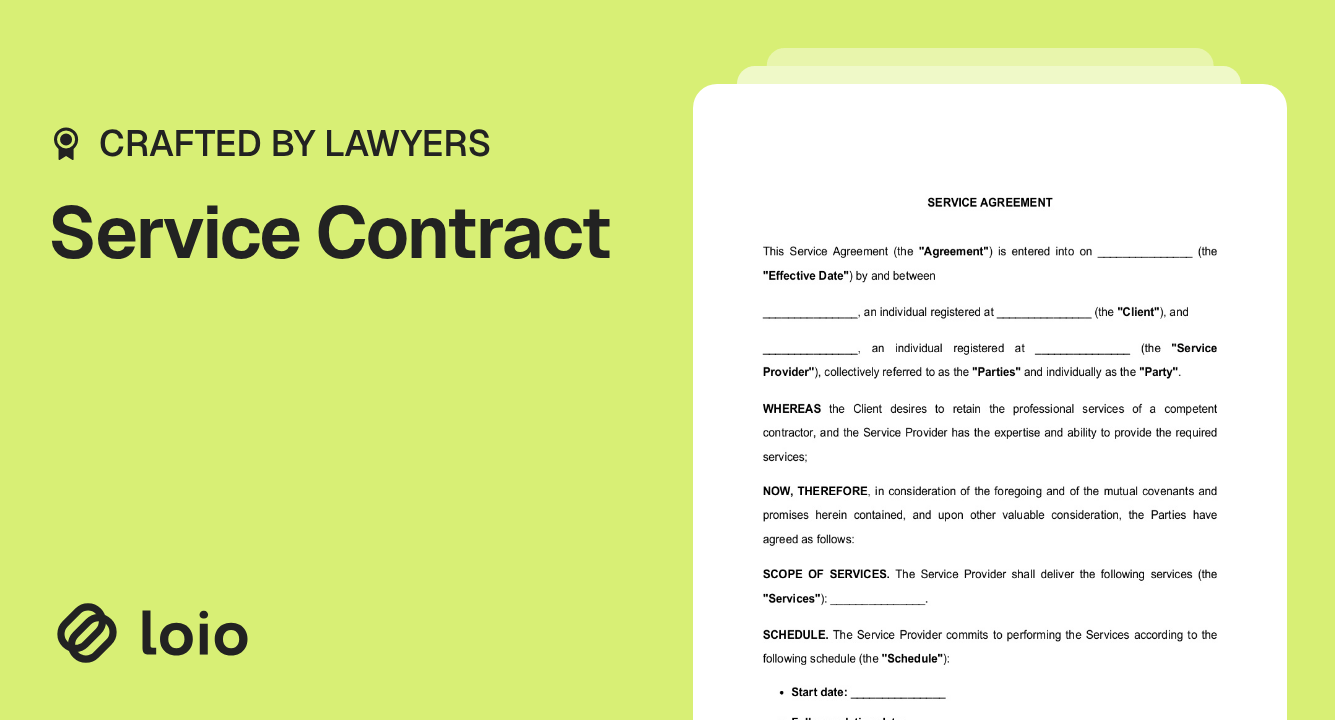
Service Contract Template

Plus template

4.6 (57 reviews)
All states | 16 types
Updated Aug 18, 2025
~ 7 pages
PDF
3.8K downloads
A Service Contract is a legal agreement between a service provider and a client outlining the scope of work, payment terms, and deadlines. It is used to ensure mutual understanding and prevent disputes over service quality or expectations.
Service Agreement Page 1
Preview
Written by Megan Thompson, LLB - Reviewed by Kate Adkham, LLB

Template Types

Electrical Service Agreement
This contract defines the electrical services to be provided and each party's duties.
Cleaning Service Contract
This document notes down the nature, duration, and cost of cleaning services.
Moving Contract
A moving contract lays out the exact terms of the move between the parties.
Catering Agreement
This specific type of service agreement regulating the catering services performance.
Photography Contract
This document covers the scope of photography work and the service-related details.
Daycare (Child Care) Contract
This contract is used when a parent or guardian enrolls the child in a daycare facility.
Landscaping Contract
This contract outlines the landscaping services the company will provide to the client.
Videography Contract
This contract helps agree on the services between the client and the hired videographer.
Roofing Contract
A roofing contract regulates the terms and conditions of a roofing project.
Plumbing Contract
A plumbing contract describes the work scope, schedule and timeline, and project costs.
Snow Removal Contract
This contract specifies the cooperation between a snow removal company and the customer.
Flooring Contract
This contract is signed between a company providing flooring services and a client.
Painting Contract
This contract outlines the scope of the work, pricing, and terms of the painting job.
Pool Service Contract
A pool service contract is signed by a swimming pool technician and a client.
Handyman Contract
This contract outlines the maintenance scope of work in exchange for the agreed fee.

What Is a Service Contract?

Copy section link

A service contract is a legal agreement between a client and a service provider. It outlines the work to be performed, compensation, deadlines, and responsibilities. A service agreement template focuses on project-specific or task-based work. That is usually used for freelancers, contractors, or specialized service providers.

For example, a simple contract for services can be used between a small business and a freelance web designer. It defines project scope, deadlines, and payment terms.

When To Use a Service Contract

Copy section link

A service contract is useful when:

  • Hiring a contractor for renovations.

  • Engaging a freelance copywriter or designer.

  • Contracting a cleaning or catering service.

  • Partnering with a software developer.

  • Outsourcing tasks to a marketing agency.

The service agreement contract formalizes the working relationship, clarifies roles, and protects legal interests.

Also, both Microsoft Word and Google Docs offer free service contract templates. But for legal compliance, it’s better to use specialized tools like Loio’s contract templates.

Parties to a Service Contract Template

Copy section link

A contract agreement for services generally involves two parties:

  • Client: The individual or business that hires the service provider, pays the agreed compensation, reviews completed services, and may report defects under the agreement.

  • Service Provider: The individual or business that performs the agreed services, follows the schedule, protects confidential information, and corrects covered defects within the stated cure period.

Key Components

Copy section link

A service agreement template should reflect the work being performed and the responsibilities the parties actually intend to accept. This template includes the following sections and clauses:

  • Parties — Names and registered addresses of both the client and service provider; establishes who is legally bound by the agreement.

  • Scope of Services — A precise description of all work to be delivered; prevents scope creep and eliminates ambiguity about what is and is not included.

  • Schedule — Start date and full completion date; gives both parties a shared, enforceable timeline.

  • Engagement of Subcontractors — Permits the service provider to delegate work to third parties while retaining full liability for quality and completion.

  • Payment Terms and Procedure — Fixed compensation amount, payment due date, and overtime hourly rate; removes any ambiguity about how and when the provider is paid.

  • Late Payment — Daily interest rate charged on overdue amounts; creates a financial incentive for on-time payment and establishes a clear remedy for delay.

  • Completion of the Services — Client inspection rights and a defined Cure Period within which the service provider must fix identified defects; failure to cure triggers automatic termination.

  • Relationship of Parties — Confirms the parties are independent contractors, not employer and employee; this distinction determines tax treatment, benefits eligibility, and legal protections.

  • Non-Competition and Non-Solicitation — Prevents the service provider from soliciting the client's customers or offering employment to the client's staff for a defined period after the engagement ends.

  • Confidentiality — Prohibits the service provider from disclosing any client business information for a specified period following termination.

  • Liability and Indemnification — Holds the service provider responsible for losses, fines, and legal costs arising from their negligence or breach; protects the client from financial harm caused by the provider.

  • Warranties — Both parties warrant that they have the legal authority to enter the agreement; the service provider additionally warrants timely and high-quality performance.

  • Term and Termination — Sets the agreement's end date and the written notice period required for either party to terminate without cause; permits immediate termination upon insolvency.

  • Notice — Defines acceptable methods of formal communication (personal delivery, certified mail, email) and when notices are considered received.

  • Force Majeure — Excuses delayed performance caused by events outside either party's control — natural disasters, pandemics, government orders — and triggers a termination right if the event persists beyond a specified number of days.

  • Governing Law and Dispute Resolution — Names the US state whose laws govern the agreement and whose courts will adjudicate unresolved disputes.

  • General Provisions — Severability, assignment restrictions, entire agreement, waiver, amendments, and binding effect; standard boilerplate that protects the integrity of the contract and prevents unauthorized modifications.

  • Signature Block — Signatures, printed names, and addresses for both parties; required for the agreement to be legally enforceable.

  • Service Provider: The party hired to perform the work described in the Scope of Services; treated as an independent contractor (not an employee) under this agreement.

  • Client: The party that retains and compensates the service provider; holds the right to inspect completed work and request corrections within the Cure Period.

  • Scope of Services: The specific tasks, deliverables, or outputs the service provider is contractually obligated to complete.

  • Compensation: The total fixed payment the client agrees to pay in exchange for full completion of the services.

  • Cure Period: The number of days the service provider has to correct a quality defect after receiving written notice from the client; failure to cure within this period can trigger automatic termination.

  • Force Majeure: An unforeseeable event beyond either party's reasonable control — such as a natural disaster, pandemic, or government action — that temporarily or permanently excuses performance.

  • Indemnification: A contractual obligation requiring one party (in this service agreement contract template, primarily the service provider) to compensate the other for losses, claims, fines, or legal costs arising from the indemnifying party's actions or breach.

  • Non-Solicitation: A restriction preventing the service provider from approaching the client's customers or employees for business or employment purposes for a defined period after the engagement ends.

  • Governing Law: The US state whose statutes and courts will be used to interpret and enforce the agreement.

  • Breach of Contract: A failure by one party to fulfill a material obligation under the agreement; entitles the non-breaching party to pursue remedies such as damages, specific performance, or termination. 

How To Create a Service Contract

Copy section link
  1. Identify the Client. Enter the client's full legal name and registered street address.

  2. Identify the Service Provider. Enter the service provider's full legal name and registered street address.

  3. Describe the Scope of Services. Write a specific, detailed description of all work to be performed. Avoid vague language — instead of "marketing support," specify deliverables, formats, and quantities.

  4. Enter the Effective Date. Provide the date on which the agreement takes effect — typically the date both parties sign.

  5. Set the Start Date. Enter the date on which the service provider will begin work.

  6. Set the Full Completion Date. Enter the date by which all services must be delivered and accepted by the client.

  7. Specify the Service Rendering Period. If services span a range of dates (for example, weekly site visits), note the full date range here.

  8. Enter the Compensation Amount. State the total fixed payment the client will make for the completed services.

  9. Set the Payment Due Date. Enter the date by which the client must pay the full compensation amount.

  10. Set the Overtime Rate. If the provider may be asked to work beyond the agreed scope, enter the hourly rate for any additional time.

  11. Enter the Late Payment Interest Rate. Specify the percentage per day that will accrue on any overdue balance.

  12. Set the Cure Period. Enter the number of days the service provider has to correct an identified defect after receiving written notice from the client.

  13. Define the Non-Solicitation Period (Customers). Enter the duration — after termination — during which the service provider may not solicit the client's customers.

  14. Define the Non-Solicitation Period (Employees). Enter the duration — after termination — during which the service provider may not offer employment to the client's staff.

  15. Set the Confidentiality Duration. Enter the number of months or years the confidentiality obligation will remain in force after the agreement ends.

  16. Enter the Agreement End Date. State the date on which the agreement expires if not renewed or terminated earlier.

  17. Set the Termination Notice Period. Enter the number of days' written notice either party must give to terminate the agreement without cause.

  18. Set the Force Majeure Threshold. Enter the number of consecutive days a force majeure event must persist before either party can terminate the agreement.

  19. Choose the Governing State. Enter the US state whose law will govern the agreement and where disputes will be heard.

  20. Complete the Signature Block. Both parties enter the signing city, county, and state; print their full legal name and address; and sign on the designated signature line. 

Lifecycle: Managing and Terminating a Service Contract

Copy section link
  • During the engagement. Either party may propose changes to the scope, schedule, or payment terms, but any modification must be documented in a written amendment signed by both parties. Verbal agreements to alter the contract are not enforceable.

  • Completion. When work is finished, the service provider notifies the client in writing. The client then has the right to inspect all deliverables. If defects are found, the client issues a written notice and the Cure Period begins. The service provider must rectify any defects at no additional cost within the Cure Period; failure to do so triggers automatic termination.

  • Renewal. This sample service contract template does not include an auto-renewal clause. If both parties wish to continue the engagement after the end date, they should execute a new service agreement contract or a written amendment extending the term before the current agreement expires.

  • Termination without cause. Either party may end the agreement before the scheduled end date by giving the other party written notice within the agreed notice period. Upon termination, the client must pay for all services satisfactorily completed through the termination date, and the service provider must return all client property.

  • Termination for cause. Either party may terminate immediately — without a notice period — by written notice if the other party becomes insolvent or files for bankruptcy. Uncured defects beyond the Cure Period also trigger automatic termination.

  • Dispute resolution. If the parties cannot resolve a dispute through negotiation, the agreement requires resolution through the courts of the governing state. For lower-stakes matters, parties can agree in writing before signing to add a mediation or arbitration clause as an amendment, which is typically faster and less expensive than litigation.

Statutory References for Service Contract

Copy section link

This template is intended for general use across all 50 U.S. states+DC. Local procedures — such as notarization, witnessing, or filing requirements — may still apply, so check your state's specific rules before signing.

Service Agreement Preview