Free template
Free Plumbing Contract Template

Template Description
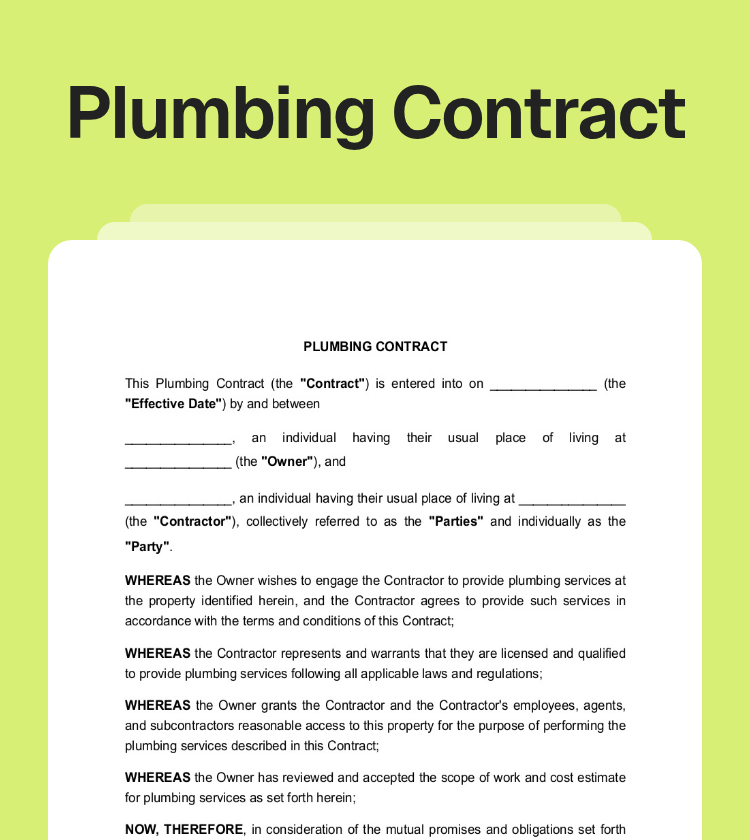
Copy section linkA plumbing contract serves to describe the work that will be provided by a plumbing contractor, including the cost and other relevant details. A plumbing service contract usually consists of the names and contact information for the two parties entering into the contract, the scope of work, the payment terms, the schedule, and some information about potential conflict resolution.
When using a plumbing contract template, all you have to do is insert your name and the name of the other party, as well as contact details. Then add the information specific to the project. Before you sign, read through the clauses and adjust them in any way you see fit for the job and the jurisdiction.
What Is a Plumbing Contract?
Copy section linkA plumbing contract is a legal agreement between a plumber and his or her client. The document outlines the terms of service, the cost, the time frame for the repairs, and payment procedures. The plumbing contract may also include clauses about force majeure events and the consequences of breaching the agreement.
The contract helps to prevent disagreements between the parties and settle legal disputes because it includes all the terms and conditions that apply to the plumber and the client for the project. Should a conflict occur, the contract will help the parties determine who is right and who is wrong. The party breaking the terms of the contract may face consequences as described in the plumbing contract.
Parties to the Plumbing Contract
Two parties usually enter into a plumbing contract — the plumbing contractor and the client or customer seeking plumbing services. A plumbing contract should include contact information for both parties, such as names, addresses, and phone numbers. A plumbing contract is only applicable for establishing the terms of plumbing services between those parties.
Key Terms
Several key terms will be included in a customizable plumbing contract template to be filled in by the parties as applicable. These include:
- Names of the parties — The contract should include the names of all parties to the contract, their addresses, and other contact information as applicable.
- Scope of work — Add a detailed description of the services that will be provided by the plumber.
- Payment terms — Include the full amount that will be paid for the service and the time in which it needs to be paid. This section may also call for itemizing supplies and materials, labor rates and estimated time, and other expenses.
- Warranty and/or guarantee — The guarantee that the plumber provides on his or her work, including any time frame allowed for free repairs and a description of what qualifies for a free repair.
- Contract termination clause — A description of the terms for terminating the contract by either party.
Benefits of Plumbing Contracts
Copy section linkThere are multiple benefits to using a plumbing service contract. The contract protects both parties and serves to help prevent disputes or make them easier to resolve. Some benefits of using a plumbing contract include:
- Minimized risk: Upon entering into a contract, both parties agree to certain terms and conditions. These terms serve to minimize risk for both parties and introduce some clarity. Whether you’re the contractor or the client, you will have the chance to alter the contract to your liking and make sure you agree with all the terms before you sign.
- Financial clarity: A major benefit of having a contract is knowing exactly how much the service will cost you as a client or knowing how much you’re going to receive in exchange for your services as a contractor.
- Guarantee of quality: With a contract, the plumber generally provides some sort of a quality guarantee. If the plumbing malfunctions soon after a repair, the contract may require the plumber to fix it free of charge or for only the cost of materials. Some plumbers provide warranties that cover years of use for certain projects.
- Resolution of disputes: Should a dispute arise, having a contract in place should make resolving the matter a lot easier. That is mostly due to the penalties for breaching the contract that are outlined within the contract itself. A well-drafted contract will list the recommended course of action for both parties in the event of a conflict.
- Timeline security: For the client, the contract provides some security in terms of when the service will be provided. For the contractor, it provides security in terms of when he or she can expect to receive payment for the services provided.
What Should Be Included in a Plumbing Contract?
Copy section linkA commercial plumbing contract should include certain elements that will make it legally binding. Any contract must first contain the names and contact information of both parties. A contract for plumbing work will contain a description of the work that will be performed. The scope of work portion of the contract should describe in exact terms what service will be provided for the customer.
A plumbing contract must outline the terms of payment. These may include the full amount that will be invoiced for the service and a list of possible extras. There may also be a payment calendar attached if the parties have agreed to installments. Along with the payment details, a contract for plumbing should include a detailed timeline of when the repairs will be made or when the project will begin and when it should be completed. Though no one wants conflict, dispute resolution and a contract termination clause are integral parts of a contract for plumbing.
How to Write a Plumbing Contract
Copy section linkA plumbing contract should describe the work clearly enough that the plumber and client understand what is included, how much it will cost, and what happens if the project changes. Use these steps to complete the agreement:
- Identify the parties. Enter the legal names, addresses, and contact information of the plumbing contractor and client. If a general contractor hires the plumber as a subcontractor, identify that relationship. Include the plumbing business name and applicable license information.
- Describe the property and project. Add the service address and explain whether the work involves a repair, replacement, installation, remodel, inspection, or ongoing maintenance.
- Define the scope of work. List services such as fixture replacement, pipe repair, water-heater installation, drain clearing, repiping, or installation of supply and waste lines. Specify materials and applicable brands, models, or performance standards. Where appropriate, the parties may identify EPA WaterSense-labeled fixtures. WaterSense is a voluntary water-efficiency designation and does not replace plumbing-code requirements.
- State what is excluded. Clarify work outside the agreed price, such as drywall repair, excavation, water damage restoration, asbestos removal, electrical work, or correction of concealed conditions discovered after work begins.
- Set the project schedule. Enter the expected start and completion dates, working hours, and milestones. Explain how inspections, material shortages, concealed damage, weather, or other delays will affect the schedule.
- Set the price and payment terms. State whether the project uses a fixed price, hourly rate, service-call fee, or another pricing method. Include deposits, progress payments, final payment, material charges, taxes, payment methods, and due dates. Disclose emergency, after-hours, weekend, or holiday charges in advance.
- Address permits and inspections. State who will coordinate required permits and inspections and who will pay the associated fees. The parties may allocate these administrative responsibilities and costs, but the contract cannot authorize someone to obtain a permit if local law reserves that function for a licensed contractor or another specified applicant.
- Address licenses, insurance, and subcontractors. Include applicable plumbing or contractor license numbers and identify any required commercial general liability, workers' compensation, or other relevant insurance. State whether subcontractors may be used and what work they may perform. Subcontracting generally does not eliminate the plumbing contractor's obligations to the client or override applicable licensing, payment, insurance, or lien laws.
- Establish the change-order process. Document changes to the scope, materials, price, or schedule before the modified work begins when required by law and whenever reasonably possible otherwise. A written change order should describe the additional or revised work, price adjustment, and effect on the completion date.
- Explain warranties. State separately any warranty covering the plumber's labor and any manufacturer warranty covering fixtures, equipment, or replacement parts. Include the warranty period, exclusions, and procedure for requesting warranty service.
- Address property access and cleanup. Explain when the plumber may access the property, whether the client must clear work areas, and who is responsible for protecting surrounding property and removing debris.
- Add liability and dispute terms. Address property damage, insurance, indemnification, dispute resolution, governing law, and other contractual remedies. Any indemnification, defense, or hold-harmless provision should comply with applicable state law because construction anti-indemnity statutes may restrict clauses that shift liability for another party's negligence. A valid arbitration clause generally requires covered disputes to be resolved through arbitration rather than a court trial and may waive the right to a jury, so its scope, costs, forum, and consumer-law requirements should be reviewed carefully.
- Review state and local requirements. Confirm that the contractor holds the licenses required for the work and that the project complies with the plumbing code actually adopted by the jurisdiction. The International Plumbing Code (IPC) and Uniform Plumbing Code (UPC) are model codes; they become legally controlling only when adopted by the relevant state or local authority, which may amend them. Residential plumbing work may also be subject to home-improvement laws governing written contracts, deposits, payment schedules, cancellation notices, change orders, contractor disclosures, or mechanics-lien notices.
- Sign and date the agreement. Both parties should review the completed agreement before signing. Anyone signing for a property owner, company, or another party should have authority to bind that party.
Why Do You Need a Plumbing Contract?
Copy section linkThere are many reasons why a plumbing contract may be necessary. It serves to prevent conflict or guide both parties through resolving their disputes more efficiently. It can protect both parties from each other by ensuring that the contractor will stick to the agreed schedule when delivering the service and the client will stick to the payment schedule.
Common Use Cases
Plumbing contracts are used in commercial and residential plumbing. Some common use cases for a plumbing contract include the following:
- Construction: Plumbers are an integral part of new construction projects. They install new plumbing systems, coordinate with other contractors, and make sure they’re following the rules and regulations according to the city code. Therefore, a new construction plumbing contract is necessary.
- Renovation: When a homeowner chooses to renovate a kitchen or bathroom, the homeowner will generally need a plumber to come in to install some of the fixtures, reroute water lines, or replace pipes. For any of these projects, the plumber should draft a contract for plumbing work.
- Maintenance: Over time, plumbing systems begin to show wear and tear. Plumbers may conduct routine maintenance checks to make sure the systems are working properly. Plumbing contracts can be used for one-time or periodic checks.
When Not To Use the Plumbing Contract
While it is often advisable to utilize a plumbing contract, you may not need one for a minor repair. Emergency repairs, for example, may not leave enough time to draft a contract before providing the service. In addition, there’s no need to draft a new contract for each visit if a long-term maintenance contract is already in place.
Frequently Asked Questions
Copy section linkWhat is the difference between a journeyman plumber and a master plumber?
Licensing systems vary by state, and not every jurisdiction uses both titles. A master plumber generally meets higher experience or examination requirements, but the credential does not necessarily authorize the person to contract with the public if separate contractor, business, or responsible-master licensing is required.
Who is responsible for obtaining plumbing permits?
The contract can state who coordinates permits, inspections, and related costs. However, local law determines who is legally allowed to obtain a permit. A contract cannot give the client or another person authority to pull a permit when the jurisdiction reserves that function for a licensed contractor or specified applicant.
Does a plumber have to test a backflow preventer?
Requirements depend on the jurisdiction, assembly, and water system. Backflow testing may require a credential separate from an ordinary plumbing license. In Texas, testing or repairing these assemblies requires a TCEQ Backflow Prevention Assembly Tester license, with additional restrictions for assemblies on fire lines.
Can a plumber charge an emergency-call surcharge?
Generally, yes, subject to applicable contract and consumer-protection laws. The agreement should disclose emergency, after-hours, weekend, or holiday rates before work begins and explain whether they apply to labor, travel, materials, or the regular service-call fee.
Is the warranty on plumbing parts the same as the warranty on labor?
No. A manufacturer may warranty fixtures, equipment, or parts, while the plumber may provide a separate workmanship warranty. The contract should distinguish the two and state their duration, exclusions, remedies, and whether labor for replacing a warranted part is covered.
Can I legally write my own plumbing contract?
Generally, yes, but the agreement still must comply with applicable licensing, permitting, consumer-protection, and home-improvement laws. Depending on the jurisdiction, residential contracts may require specific notices, payment terms, cancellation rights, change-order procedures, or other mandatory provisions.
How should I charge for plumbing work?
Plumbing work may be billed hourly, at a flat project rate, through a service-call fee, or using a combination. Pricing should account for labor, materials, permits, equipment, travel, subcontractors, emergency work, taxes, overhead, and profit.
Requirements for this document vary by state. Review your state's laws and procedures — or consult a licensed attorney — before using this template to ensure it's valid and enforceable where you live.
Sources
International Code Council — 2024 International Plumbing Code (IPC)
IAPMO — Uniform Plumbing Code (UPC)
Texas State Board of Plumbing Examiners — License Types TSBPE
Texas Commission on Environmental Quality — Backflow Prevention Assembly Tester Licensing TCEQ — Backflow Prevention Assembly Tester Licensing
California Contractors State License Board — Home Improvement Contracts CSLB
Texas Insurance Code Chapter 151 — Construction Contract Indemnification
Related Documents