Free Bill of Sale Template

Free template

4.8 (174 reviews)
All states | 23 types
Updated Jul 6, 2026
~ 3 pages
PDF
6.9K downloads
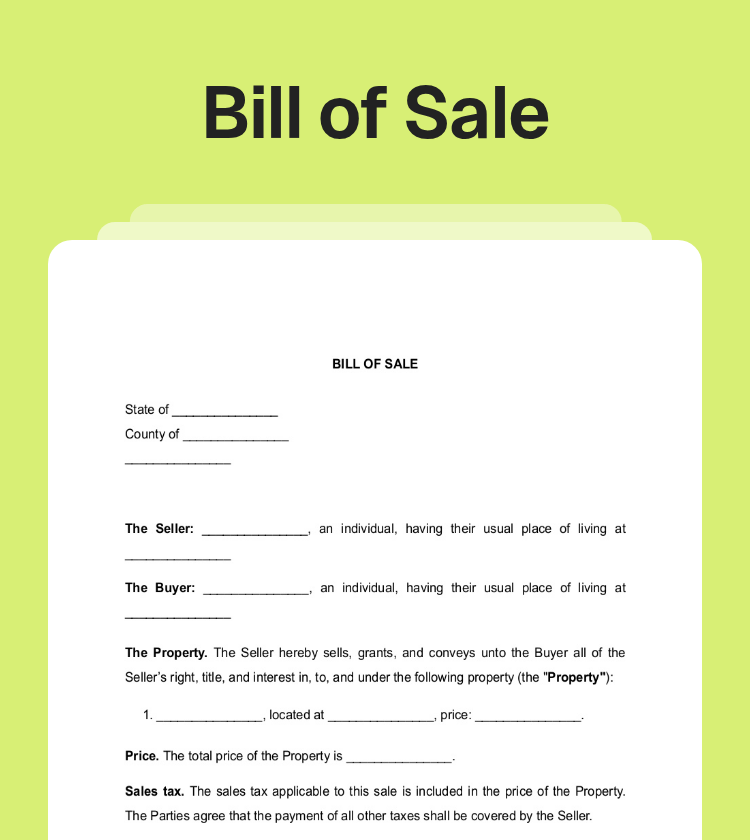
A Bill of Sale is a legal document between a seller and a buyer that records the transfer of ownership of an item or property. It is used by individuals or businesses to document the sale, confirm payment, and protect both parties from future disputes.
Bill of Sale Page 1
Preview
Written by Megan Thompson, LLB - Reviewed by Jonathan McGill, JD

Template Types

Golf Cart Bill of Sale
This document records the transfer of ownership of a golf cart from sellers to buyers.
As-Is Bill of Sale
This document delineates the transfer of property or vehicle in its as is condition.
Bill of Sale for Dog or Cat
This bill of sale serves as legal proof of the transfer of pet ownership.
Gun Bill of Sale
This bill of sale moderates the transfer of ownership of a gun from sellers to buyers.
Horse Bill of Sale
A horse bill of sale proves the horse purchase and sale between a buyer and a seller.
Bill of Sale for Semi-Truck
This bill of sale officially records the sale and purchase of a semi-truck.
Trailer Bill of Sale
A trailer bill of sale records the sale and purchase of a pull-behind vehicle.
Bill of Sale Template for Car
A car bill of sale is a legal document confirming a car purchase and sale deal.
Bill of Sale for Scooter/Moped
This bill of sale records the transfer of ownership and rights of the scooter or moped.
ATV Bill of Sale
This bill of sale is necessary when purchasing or selling an ATV or changing its ownership.
Bicycle Bill of Sale
This document signifies the transfer of ownership of the bicycle from sellers to buyers.
Dog (Puppy) Deposit Receipt
This form documents the deposit for a dog or puppy, capturing essential transaction details.
Furniture Bill of Sale
This bill of sale is executed during sales transactions involving furniture pieces.
Bill of Sale for Mobile Home
This bill of sale acknowledges the sale and purchase of a mobile home.
Bill of Sale for Equipment
This document is used in the transaction or sale of substantial equipment items.
Motorcycle Bill of Sale
This form entitles an individual to purchase and hold a receipt for a motorcycle.
Livestock Bill of Sale
This essential agreement proves the legality of the livestock purchase and sale.
Bill of Sale for Business
This document is used to transfer ownership of a business from a seller to a buyer.
Bill of Sale for Personal Property
This document defines the terms regarding the transfer of ownership of personal assets.
Bill of Sale for Tractor
This document is required when a tractor is bought or sold to prove the ownership change.
Jet Ski Bill of Sale
This bill of sale is necessary whenever a jet ski is being sold privately.
Boat Bill of Sale
This bill of sale ensures the transfer of ownership rights related to the boat.

A bill of sale is a legal document between a seller and a buyer that records the transfer of ownership of personal property. It is used to confirm what was sold, the agreed price, and when the buyer becomes responsible for the asset.

What Is a Bill of Sale?

Copy section link

A bill of sale template helps a seller and a buyer document the private sale or transfer of personal property. It works as written proof that ownership of an asset has moved from one party to another.

A bill of sale form usually includes the names of the seller and buyer, a description of the property, the sale price, tax details, transfer date, signatures, and sometimes a notary acknowledgment. For some transactions, such as selling a vehicle, motorcycle, scooter, moped, trailer, or boat, a bill of sale document may also support title transfer or registration with the Department of Motor Vehicles.

A bill of sale is especially useful when the parties want a clear record of the deal. It can help prove ownership, confirm payment, support tax records, and reduce disputes about the condition or value of the property after the sale.

When to Use a Bill of Sale

Copy section link

Use a bill of sale template when you need written proof that personal property has been sold, transferred, or given to another person.

Common situations include:

  • Selling or buying a vehicle, motorcycle, scooter, moped, ATV, trailer, or boat;
  • Selling equipment, tools, furniture, electronics, appliances, or other personal property;
  • Transferring ownership of a mobile home or other movable asset;
  • Giving property as a gift when both parties still want a written record;
  • Recording the agreed price for tax, insurance, or accounting purposes;
  • Confirming that the buyer accepts the property in its current condition;
  • Keeping proof of sale after a private transaction between individuals.

When not to use a bill of sale

A bill of sale does not fit every transaction. Use another document if the deal involves more than a simple transfer of personal property.

Parties to a Bill of Sale

Copy section link

A bill of sale usually includes two main parties and may include additional signers depending on the transaction or state requirements.

  • Seller: The person or business transferring ownership of the property.
  • Buyer: The person or business receiving ownership of the property.
  • Witness: A neutral person who may watch the parties sign and confirm that the signatures are genuine.
  • Notary public: A state-authorized official who verifies identity and acknowledges signatures when notarization is required or preferred.

Some transactions do not require a witness or notary. However, using one can add an extra layer of protection, especially for high-value property, vehicles, or sales between parties who do not know each other well.

Key Components of a Bill of Sale

Copy section link

A complete bill of sale form should include enough detail to identify the parties, the property, the price, and the transfer terms.

  • State and county: Shows where the bill of sale is signed and may help determine which local rules apply.
  • Seller details: Identifies the person or business transferring the property.
  • Buyer details: Identifies the person or business receiving the property.
  • Property description: Explains what is being sold, including identifying details such as make, model, serial number, VIN, year, color, size, or condition.
  • Property location: States where the property is located at the time of sale.
  • Price or consideration: Records the agreed value exchanged for the property, whether money, another item, or a gift.
  • Sales tax: Clarifies whether tax is included in the price or handled separately.
  • Warranty of title: Confirms that the seller owns the property and has the right to transfer it.
  • Encumbrance statement: Helps confirm whether the property is free from liens, claims, or other obligations.
  • As-is condition: States that the buyer accepts the property in its current condition unless the parties agree otherwise.
  • Transfer of title: Identifies when ownership and risk of loss pass to the buyer.
  • Effective date: States the date when the transfer becomes legally effective.
  • Signatures: Shows that the seller and buyer agree to the terms.
  • Notary acknowledgment: Provides formal verification of the signing when needed.

Key Terms to Know

Copy section link
  • As is: The buyer accepts the property in its current condition, including visible and hidden defects, unless the document says otherwise.
  • Where is: The buyer accepts the property at its current location and may be responsible for moving or collecting it.
  • Consideration: The value exchanged for the property, usually money, but sometimes another asset or a gift.
  • Warranty of title: The seller’s promise that they legally own the property and have the right to sell it.
  • Encumbrance: A claim, lien, debt, or legal restriction attached to the property.
  • Title: Legal ownership of property; for vehicles, title is usually documented through a state DMV or similar agency.
  • Effective date: The date when the sale and transfer of ownership take effect.
  • Sales tax: A tax that may apply to the sale depending on the type of property and state rules.
  • Notary acknowledgment: A notary’s confirmation that the signer appeared, proved their identity, and signed the document.

How to Fill Out a Bill of Sale Document

Copy section link

Follow these steps to complete a blank bill of sale correctly.

  1. Enter the state and county. Add the state and county where the bill of sale is signed.
  2. Add the seller’s information. Write the seller’s full legal name and usual address. If the seller is a business, include the legal business name.
  3. Add the buyer’s information. Write the buyer’s full legal name and usual address.
  4. Describe the property. Add a clear description of the asset being sold. For a vehicle, motorcycle, scooter, or moped, include details such as VIN, make, model, year, mileage, license plate number, and title information when available.
  5. Add the property location. State where the property is located at the time of sale.
  6. Enter the price. Write the agreed purchase price. If the property is a gift, state that clearly and identify the consideration as a gift or nominal value if required.
  7. Clarify sales tax. State whether applicable sales tax is included in the price or handled separately. Sales tax rules vary by state and property type, so the parties should check local requirements before signing.
  8. Review the warranty language. Confirm that the seller owns the property and has authority to sell it. If the property has a lien or other claim against it, disclose that before signing.
  9. Review the as-is condition. Make sure the buyer understands whether the property is sold as is, where is, and with all faults.
  10. Add the effective date. Enter the date when ownership and risk of loss transfer to the buyer.
  11. Sign the document. The seller and buyer should sign and date the bill of sale. Both parties should keep a copy.
  12. Complete the notary section if needed. If notarization is required by state law or preferred for extra security, sign the document before a notary public.

Bill of Sale Templates By Type

Copy section link

A generic bill of sale can work for many private sales, but some assets need more specific details. Choosing the right template helps the parties include the information commonly required for that type of property.

Common types include:

  • Car bill of sale: Used for cars, trucks, vans, and similar vehicles. It should include VIN, mileage, title details, and DMV-related information.
  • Motorcycle bill of sale: Used for motorcycles, scooters, and mopeds. It should include VIN, make, model, year, odometer reading, and registration details where relevant.
  • Boat bill of sale: Used for boats, personal watercraft, and related equipment. It may include hull identification number, registration number, trailer details, and motor details.
  • Trailer bill of sale: Used for utility trailers, travel trailers, and cargo trailers. It should identify the trailer by VIN or serial number if available.
  • Equipment bill of sale: Used for machinery, tools, farm equipment, construction equipment, and business assets.
  • Personal property bill of sale: Used for furniture, electronics, appliances, jewelry, collectibles, and other personal property.

Do My Bill of Sale Forms Need to Be Notarized?

Copy section link

A bill of sale does not always need to be notarized. In many private sales, the seller’s and buyer’s signatures are enough to create a useful written record. However, notarization may be required for certain property types or in certain states.

For example, vehicle title and registration rules are handled at the state level. A state DMV may require specific forms, title documents, odometer statements, tax forms, or other paperwork in addition to a bill of sale. A bill of sale can support the transfer, but it may not replace the official title transfer process.

Notarization can still be helpful even when it is not required. A notary public verifies the signer’s identity and confirms that the person signed the document. This can make the document more reliable if a dispute later arises over payment, ownership, or authorization to sell.

Bill of Sale vs. Receipt vs. Invoice

Copy section link

A bill of sale, receipt, and invoice are related, but they serve different purposes.

Main Purpose

Bill of sale:  Records transfer of ownership

Receipt: Confirms payment was made

Invoice: Requests payment

Best Used For

Bill of sale:  Private sale or gift of personal property

Receipt: Proof that money changed hands

Invoice: Business billing before payment is made

A receipt proves that payment was received. An invoice asks the buyer to pay. A bill of sale does more than confirm payment: it records the transfer of ownership and key sale terms.

For example, if a person sells a used motorcycle, the buyer may need both a receipt showing payment and a bill of sale showing ownership transfer. Depending on the state, the buyer may also need title documents for DMV registration.

Is a bill of sale legally binding?

A bill of sale can be legally binding when it identifies the parties, describes the property, states the consideration, and is signed by the parties. Its enforceability may depend on state law and the details of the transaction.

Can I write a bill of sale myself?

Yes, you can write a bill of sale yourself. Using a bill of sale template helps make sure you include important details such as party names, property description, price, transfer date, signatures, and notary information if needed.

Do I need to notarize a bill of sale?

Not always. Some states or asset types may require notarization, while others do not. Notarization can still be useful for high-value sales because it verifies the signer’s identity.

Can I use a bill of sale template for selling services?

No, a bill of sale is meant for transferring ownership of personal property, not providing services. For services, use a Service Contract Template that explains the work, payment terms, deadlines, and responsibilities.

Do I need a printable bill of sale to give property as a gift?

A printable bill of sale can be useful for gifts if the parties want proof that ownership was transferred without a standard purchase price. This is common for vehicles, family transfers, and valuable personal property.

Is a bill of sale enough to transfer a vehicle title?

Usually, no. A bill of sale can help prove the sale, but vehicle title transfer is handled through the state DMV or similar agency. The buyer may need the signed title, odometer disclosure, tax forms, registration documents, and fees.

What happens if a bill of sale is not signed?

An unsigned bill of sale may be harder to use as proof of the transaction. Without signatures, it can be difficult to show that both parties agreed to the sale, price, property description, and transfer date.

Disclaimer

This template is intended for general use across all 50 U.S. states+DC. Local procedures — such as notarization, witnessing, or filing requirements — may still apply, so check your state's specific rules before signing.

Sources

Bill of Sale Preview