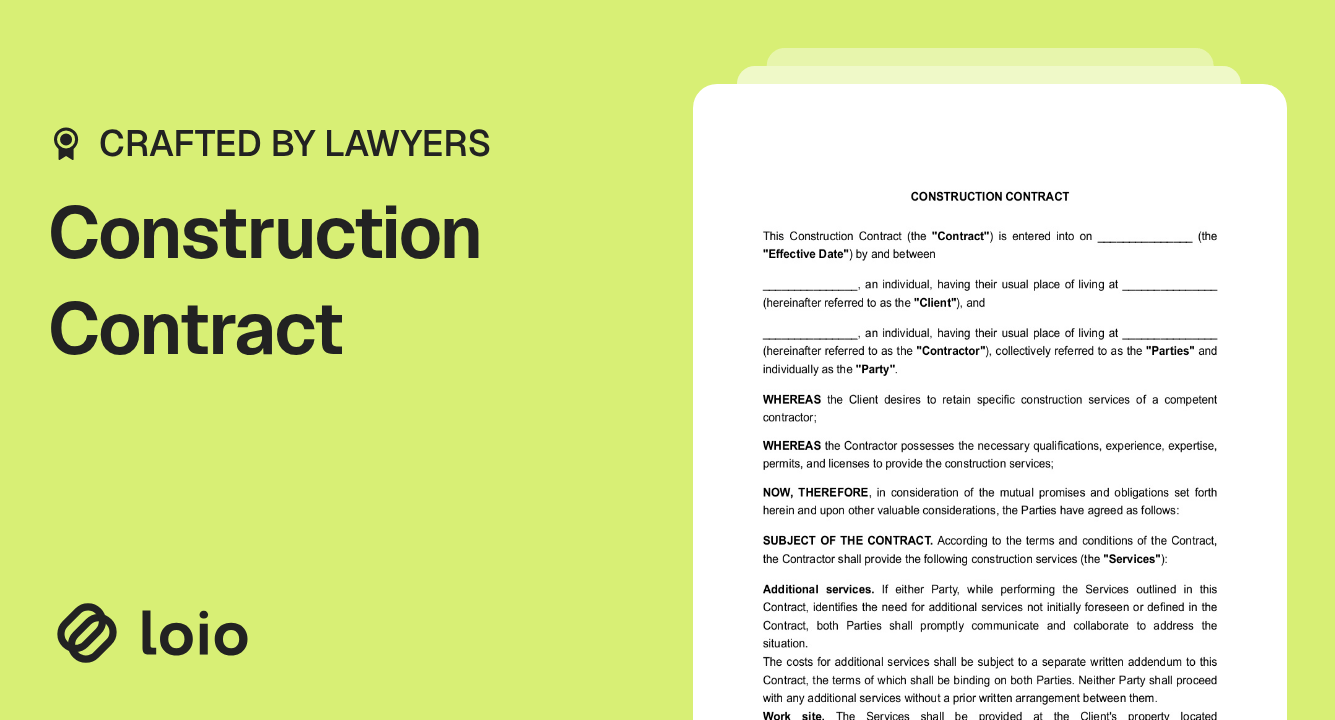
Construction Contract Template

4.9 (20 reviews)
All states | 3 types
Updated Nov 21, 2023
~ 8 pages
PDF
3.2K downloads
A Construction Contract is a legal agreement between a contractor and a client that outlines project scope, cost, and completion timeline. It is used in building projects to ensure both sides understand their duties and reduce the risk of disputes.
CONSTRUCTION CONTRACT

This Construction Contract (the "Contract") is entered into on   (the "Effective Date") by and between

 , an individual, having their usual place of living at   (hereinafter referred to as the "Client"), and

 , an individual, having their usual place of living at   (hereinafter referred to as the "Contractor"), collectively referred to as the "Parties" and individually as the "Party"

WHEREAS the Client desires to retain specific construction services of a competent contractor;

WHEREAS the Contractor possesses the necessary qualifications, experience, expertise, permits, and licenses to provide the construction services;

NOW, THEREFORE, in consideration of the mutual promises and obligations set forth herein and upon other valuable considerations, the Parties have agreed as follows:


SUBJECT OF THE CONTRACT. According to the terms and conditions of the Contract, the Contractor shall provide the following construction services (the "Services"):

Additional services. If either Party, while performing the Services outlined in this Contract, identifies the need for additional services not initially foreseen or defined in the Contract, both Parties shall promptly communicate and collaborate to address the situation.

The costs for additional services shall be subject to a separate written addendum to this Contract, the terms of which shall be binding on both Parties. Neither Party shall proceed with any additional services without a prior written arrangement between them.

Work site. The Services shall be provided at the Client's property located at   (the "Work Site"). The Client shall grant the Contractor safe and unrestricted access to the Work Site while the Services are performed.

EQUIPMENT. The Contractor shall supply the equipment and tools necessary to perform the Services. The Contractor is responsible for providing the required materials for rendering the Services. The Client agrees to reimburse the Contractor for the actual cost of materials, supported by receipts or invoices submitted by the Contractor. The reimbursement for materials expenses should be made within   days of receiving valid receipts or invoices from the Contractor.

SCHEDULE OF WORK. The Contractor shall commence on   (the "Commencement Date"), and the Services shall be provided in full no later than  .

The standard working schedule for providing the Services shall be   unless otherwise agreed upon in writing by both Parties (the "Schedule of Work").

RIGHTS AND RESPONSIBILITIES OF THE PARTIES. The Contractor is responsible for maintaining the Work Site in a safe, clean, and orderly appearance. Upon completion of the Services, the Contractor shall ensure the thorough cleaning of the Work Site and the proper disposal of any debris.

The Contractor shall be entitled to reasonable breaks and rest periods as required by applicable labor laws. The Client shall allow an appropriate duration for meal breaks.

The Client shall provide the Contractor with all necessary information and documentation connected with performing the Services, including but not limited to plans, drawings, and specifications.

The Client agrees to grant the Contractor access to:

QUALITY CHECK AND ACCEPTANCE. Upon completion of the Services, the Client shall have   days to inspect and assess the results to ensure they meet industry standards and the requirements outlined in this Contract. If deficiencies or deviations are identified during the inspection, the Contractor shall complete all necessary corrections within   days and at no additional cost to the Client. After the inspection and required corrections, the Client shall provide written notice of acceptance to the Contractor. The Services shall be deemed accepted if the Client fails to provide a written notice of defects within the specified period. 

The Client may engage an independent third-party inspector or evaluator to identify the deficiencies and provide remediation suggestions. If the third-party assessment confirms substantial defects or deficiencies and recommends corrective actions, the Contractor shall be responsible for covering the cost of the third-party evaluation and any subsequent corrections required to ensure compliance. Otherwise, the Client retains the right to seek remedies as outlined in the governing law and dispute resolution provisions of the Contract.

PAYMENT TERMS AND PROCEDURE. In consideration of the Services, the Client shall pay the Contractor the fixed fee of   (the "Price"). The payment shall be made in full before the Commencement Date. 

The Client shall pay the Contractor in cash.

Late payment. If the Client does not make any payment on time, the Contractor shall have the right to charge interest on the overdue amount at a rate of  % per day.

PERMITS. The Contractor shall be responsible for obtaining all required permits, licenses, and approvals necessary for the performance of the Services, including but not limited to building permits, zoning permits, and any other applicable governmental authorizations. The Contractor shall submit permit applications, pay associated fees, and promptly complete necessary paperwork. 

The Contractor assures the possession of all necessary permits, licenses, and authorizations required to provide the Services. 

INSURANCE. The Contractor shall obtain and maintain the necessary insurance coverage to protect the Parties from claims set forth below. These claims may arise from the Contractor's activities under the Contract, and for which the Contractor may be legally liable for general liability insurance coverage with a reputable insurance provider.

TERM OF THE CONTRACT AND DEFAULT. This Contract shall commence on the Effective Date and shall continue until   but not before the Parties fulfill their obligations under the Contract unless terminated earlier following the terms of this Contract.

Either Party may terminate this Contract without cause upon   days written termination notice.

The Client may immediately terminate this Contract by giving written notice to the Contractor if the Services are not provided within the agreed-upon time. The Client may also terminate this Contract if the Contractor refuses or fails to provide an adequate number of skilled workers when necessary or consistently disregards applicable laws or safety standards.


The Contractor may immediately terminate this Contract by giving written notice to the Client in case the Client's failure to make timely payments, denial of access to the Work Site, and failure by the Client to provide all necessary information and documentation essential for carrying out the Services, including but not limited to plans, drawings, and specifications.


In addition, either Party may terminate this Contract immediately upon written notice to the other Party if the other Party becomes insolvent or files for bankruptcy.


Upon termination of this Contract, the Client shall pay the Contractor for all Services satisfactorily provided by the Contractor through the date of termination. 

RELATIONSHIP OF PARTIES. The Parties agree that their relationship under this Contract is that of independent parties.

CONFIDENTIALITY. Neither Party shall disclose any terms or conditions of this Contract or give its copy to any third party, except when required by law or in any judicial proceeding, provided that the releasing Party has given the other Party reasonable notice of that requirement. Additionally, disclosure is permitted to a Party's attorneys, accountants, brokers, and other consultants or advisers, provided they agree to be bound by this clause.

LIABILITY. The Contractor shall indemnify and hold harmless the Client against all actions, claims, proceedings, liabilities, costs, expenses, and losses, including but not limited to direct, indirect, and consequential loss of profit suffered or incurred by the Client in relation with the Contractor's execution or breach of the Contract.

The Client shall be liable for damages to the Contractor caused by negligence or willful misconduct of the Client or the Client's associated persons. The damages shall be limited to actual and proven damages incurred by the Contractor.

If the Contractor's actions, negligence, or improper performance of this Contract result in fines, penalties, or other financial liabilities incurred by the Client, the Contractor shall be solely responsible for compensating such fines and penalties.

WARRANTIES. The Parties represent and warrant that they have full right, power, and authority to enter into and perform this Contract, ensuring that its execution has been duly authorized by all necessary actions. 

The Contractor guarantees that the Services provided meet all federal and state-specific product liability requirements, consumer protection laws, and standards in the construction industry.

The Contractor provides a   warranty period (the "Warranty Period") for the completed Services, effective from the date of receiving the written notice of the Services acceptance. The warranty covers defects in workmanship and materials used, as determined by the Client's inspection. The warranty does not cover damages or issues resulting from normal wear and tear, acts of nature, improper maintenance, alterations, or modifications made by the Parties other than the Contractor. In case of any defects or issues covered by the warranty, the Client shall promptly notify the Contractor in writing during the Warranty Period. Upon receipt of a valid warranty notification, the Contractor shall promptly inspect and assess the reported issue. If the inspection confirms the presence of a covered defect, the Contractor shall undertake remediation and necessary repairs at no additional cost to the Client. 

NOTICE. Any notice or communication required under this Contract shall be sufficiently given if delivered personally or by certified mail, return receipt requested, to the address specified in the opening paragraph or to such other address as one Party may have furnished to the other Party in writing, or emails set forth below:

If to the Client:  ;

If to the Contractor:  .

Either Party may change its registered mail or email address for receipt of notices by giving written notice to the other Party. All notices shall be deemed received on the day of delivery if sent by hand or courier service or on the third business day after the date of posting if sent by registered mail or email.

FORCE MAJEURE. Neither Party shall be liable for any failure to perform or delay in performing the obligations under this Contract if such failure or delay is caused by events of force majeure, including but not limited to acts of God, war, terrorism, strikes, lockouts, labor disputes, pandemics, epidemics, governmental regulations, or any other similar cause beyond the reasonable control of the affected Party. In the case of force majeure, the affected Party shall immediately notify the other Party in writing and provide reasonable proof of the cause of the delay or inability to perform the obligations. The Party affected by force majeure shall endeavor to mitigate the consequences of such circumstances and resume the performance of obligations as soon as possible after the circumstances cease to exist. 

If the force majeure circumstances last more than   days, either Party may terminate this Contract by giving written notice to the other Party. In this case, neither Party shall be liable to the other Party for any damages arising from the termination of this Contract. 

GOVERNING LAW AND DISPUTE RESOLUTION. This Contract shall be governed by and interpreted under the laws of the State of  , and any disputes resulting from or related to this Contract shall be exclusively resolved by the courts of the State of  .

SEVERABILITY. The invalidity or unenforceability of any provision of this Contract shall not affect the validity or enforceability of any other provision of this Contract.

ASSIGNMENT. Neither Party may assign or transfer this Contract without the prior written consent of the non-assigning Party, which approval shall not be unreasonably withheld.

ENTIRE AGREEMENT. This Contract is the complete and exclusive agreement between the Parties with respect to the subject matter hereof, superseding any prior agreements and communications, both written and oral, regarding such subject matter. 

WAIVER. The failure of any Party to enforce a particular provision of this Contract shall not constitute a waiver of their right to enforce that provision in the future. 

AMENDMENTS. This Contract may only be modified, or any rights under it waived, by a written document executed by both Parties. 

BINDING EFFECT. This Contract shall be binding for the Parties and their respective permitted successors and assigns.

IN WITNESS WHEREOF, the Parties have signed this Contract as of the Effective Date.

THE CLIENT

THE CONTRACTOR


 , USA
 , USA


__________________________________

(Place for signature)

__________________________________

(Place for signature)


Written by Karyna Pukaniuk - Reviewed by Kate Adkham

Template Types

Certificate of Final Completion
This form is essential when a construction project reaches final completion.
Change Order Form
This document records variations in the original construction contract.

Template Description

Copy section link
Paper titled "Construction Contract"; male builders talking vie cellphone and holding tools; reconstruction plan near the house

One of the vital instruments used when carrying out a construction project is the basic construction contract. This legal document outlines the terms and conditions that govern the relationship between parties involved in a construction project. A well-drafted construction contract assigns responsibilities, establishes timelines, and safeguards the rights and interests of each party. It also helps to manage potential disputes and protect parties from financial and legal risks.

When To Use a Construction Contract?

Copy section link

A general contractor contract template, which can also be referred to as a construction contract template, should be utilized whenever construction work is being performed. Even in situations where a project involves professional services such as building, renovations, or home improvements, having a simple construction contract protects both the contractor and the client. Moreover, homeowners would benefit from a residential construction contract template for any home construction or renovation project.

Parties of the Construction Contract

Copy section link
  • Contractor –– This is the entity or individual who has been commissioned to complete the construction project. The contractor is responsible for supplying the labor, equipment, materials, and services necessary for the construction of the project, as stipulated by the terms of the construction contract. Once the project has been completed to the satisfaction of all parties, a certificate of completion is generally issued. This document signifies that the contractor has satisfactorily completed their obligations, effectively granting the project as finished to the client.

  • Client –– This is the individual, group, or organization that commissions the construction project. In the context of the construction contract, the client is responsible for making payments for the work performed and approving the milestones reached in line with the agreed-upon terms. Upon the completion of the project, the client accepts the work handed over by the contractor. The client provides the contractor with a certificate of completion, thereby acknowledging the fulfillment of the contract. This document, often recorded or filed for future reference, confirms the successful conclusion of the construction contract.

Key Terms of the Construction Contract

Copy section link
  • Scope of Work: This term details the tasks the contractor is supposed to perform under the contract, providing a guideline for what the contractor can and cannot do.

  • Payment Terms: These terms establish how and when the contractor will be paid, the payment methods, and any conditions tied to payment, such as milestones or completion percentages.

  • Project Schedule: It outlines the projected timeline for the project along with milestones and deadlines, forming a critical component of the construction contract sample.

  • Change Orders: They provide a method for modifying the contract's terms and conditions after it is signed, which is particularly useful in addressing changes and unforeseen issues that occur during construction.

  • Dispute Resolution: This term outlines the processes to be followed if and when disputes arise between the contractor and the client.

How to Write a Construction Contract

Copy section link

A construction contract agreement is a legal instrument that sets out the terms, conditions, and specifics of a construction project, ensuring all parties are in agreement before any work begins. You can easily find a suitable template for a general contractor contract at Loio or consult with a legal professional to help you draft a customized one. Using this construction contract template can significantly save your time and money.

Here are some guidelines on how to create a construction contract, whether you are a client or a contractor:

Client
  1. Provide all relevant details of all parties involved, including your name and contact information.

  2. Spell out the total cost of the construction project and any payment plan that has been agreed upon.

  3. Describe the expected scope of work, clearly indicating what is expected of the contractor.

  4. Include all pertinent information regarding project timelines, from commencement to completion.
Contractor
  1. List the name of the project and any associated project reference numbers.

  2. Specify the governing laws and regulations that influence the execution of the construction project.

  3. State clearly that the client has agreed to all financial commitments related to the project.

  4. Include any provisions for change of work scope or dispute resolutions over the course of the project.

  5. Determine how the construction contract will be enforced and who bears responsibility for enforcing compliance.

All parties involved should fully review the simple construction work agreement, specifically the contractor agreement for construction, with legal guidance in order to safeguard their individual interests. Getting a prior consensus on significant aspects of the document, like change orders, project schedules, or enforcement measures, is key to ensuring a seamless process when preparing a construction contract.

A contract agreement for construction work is an indispensable tool for an effective and successful construction project. Meanwhile, a simple construction contract template serves as a blueprint for the entire project. Using a sample construction contract or construction contract templates can greatly ease this process and ensure all necessary aspects are covered.

Construction Contract Preview