Free template
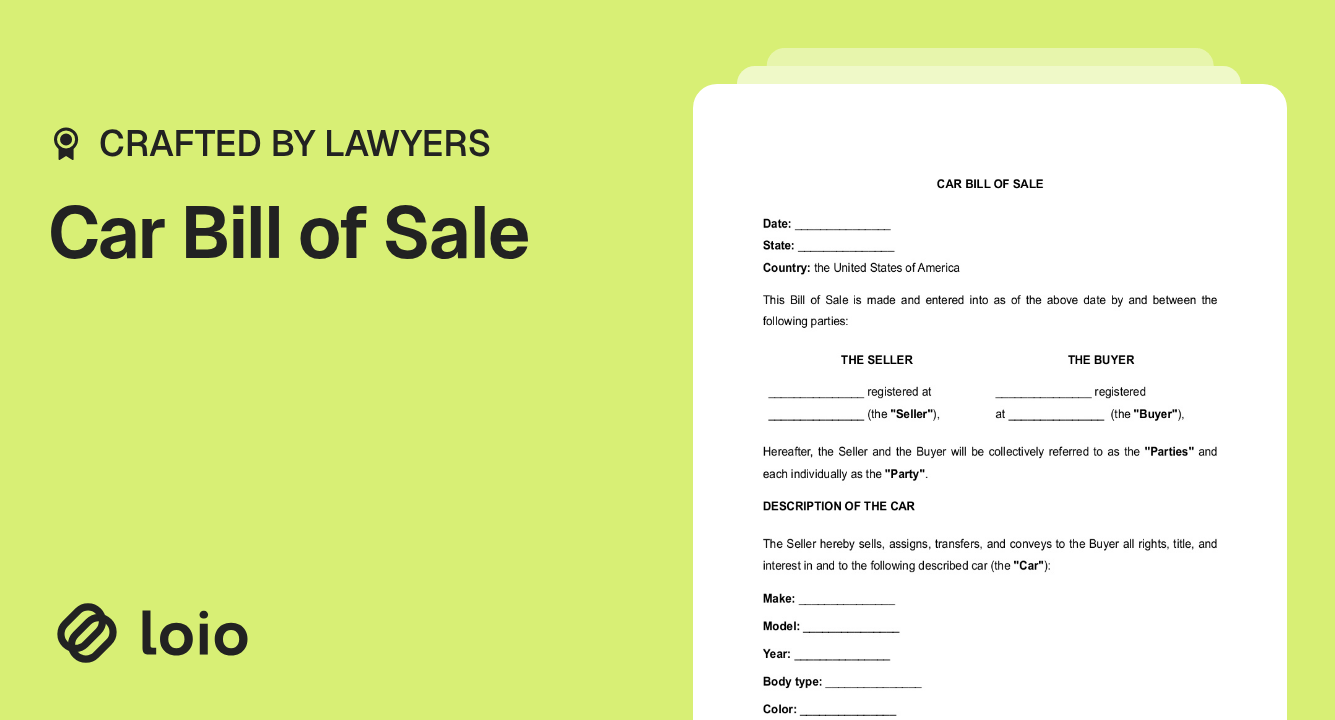
Free Bill of Sale Template for Car

Find a state
 Alabama
 Arizona
 Colorado
 DC
DC Delaware
 Hawaii
 Idaho
Idaho Indiana
 Iowa
Iowa Maine
Maine Mississippi
 Missouri
 Nebraska
 New Jersey
 New York
 North Dakota
 Ohio
Ohio Oklahoma
 Tennessee
 Washington
 Wisconsin
 Wyoming
Car Bill of Sale Examples For Other Vehicles and Specific Use Cases
Copy section linkFor selling or transferring ownership of a motorcycle.
Documents the sale of a boat or other watercraft.
Used to transfer ownership of trailers, often required for registration.
Most private sales are completed “as-is,” meaning the buyer accepts the car in its current condition with no warranties.
A general bill of sale can be used for selling personal property.
What Is a Car Bill of Sale?
Copy section linkA car bill of sale serves as a written record of a vehicle transaction, confirming that ownership has officially moved from the seller to the buyer. It outlines key information such as the vehicle’s details, the parties involved, the agreed price, and the date the sale took place. The main purpose of a bill of sale template for car is to show that ownership has officially changed hands and to prevent disputes in the future. Both the buyer and seller sign the document. In some states, like Louisiana, Maryland, Montana, Nebraska, West Virginia, and Wyoming, notarization is required for added validity.
Even when it isn’t mandatory, having a motor vehicle bill of sale is highly beneficial since it supports Department of Motor Vehicles (DMV) paperwork, marks the exact point of transfer, shields the seller from future claims, and gives the buyer reliable proof of ownership.
When to Use a Car Bill of Sale?
Copy section linkAn automobile bill of sale comes into play in several common situations during the selling process. It serves as proof of ownership transfer and protects both the buyer and the seller.
Buying from a private seller
When purchasing a car from an individual instead of a dealership, the bill of sale is often the only written record of the transaction. It confirms that you paid for the vehicle and that the seller no longer owns it.
Selling to a private buyer
For sellers, a bill of sale DMV provides legal protection. Once the car is sold, you can’t be held responsible for tickets, accidents, or other issues tied to the vehicle. It also establishes the exact date ownership changed.
Transferring vehicle ownership
Whenever a car changes hands – through a sale, gift, or inheritance – the bill of sale documents the transfer. This record is necessary for updating the title and registration.
Registering the vehicle
Many state DMVs require a bill of sale to complete registration [1]. Without it, you may be unable to get license plates or officially transfer the title to the new owner’s name. In some states, buyers may also need to complete a vehicle inspection before the title transfer and registration process can be finalized.
For “as-is” sales
Most private vehicle sales are “as-is,” meaning the car is sold in its current condition without warranties. An “as-is” bill of sale records this agreement so the buyer cannot later demand repairs or compensation. Buyers should also keep a signed receipt or copy of the completed vehicle bill of sale as proof of purchase for future registration, insurance, or tax purposes.
Gifting or inheriting a vehicle
Even when no money is exchanged, a bill of sale confirms the transfer of ownership. This ensures that the DMV updates the vehicle records and recognizes the new owner properly. After the transfer is complete, the new owner should arrange vehicle insurance coverage as required by state law.
If the transaction involves more detailed purchase terms — such as installment payments, warranties, financing conditions, or additional obligations between the buyer and seller — you may also need a vehicle purchase agreement or sales agreement in addition to the car bill of sale.
What Are the Parties of the Car Bill of Sale?
Copy section linkIn any vehicle sale, the bill of sale records who is transferring the car and who is receiving it. Let’s look at all the parties involved:
The Seller (Vendor): The current legal owner of the car who is transferring it to someone else. The seller provides details about the car, confirms there are no unpaid loans or liens on it (or explains how those will be handled), and signs the bill of sale. The seller may also provide warranty information if any guarantees are included as part of the sale.
The Buyer (Purchaser): The person acquiring the car. The buyer’s details are recorded so there is no confusion about who owns the car after the sale. For the buyer, the bill of sale is proof of purchase and may be required by lenders or insurance companies when updating coverage.
Witnesses (Optional): Some states allow or recommend witnesses to sign the bill of sale to confirm that the transaction took place. This adds extra credibility if disputes arise later.
Notary Public (If Required by State): In certain states, a notary public must verify the bill of sale. This service checks IDs, watches both parties sign, and then stamps the document to confirm it is valid.
Which Clauses Can You Include in a Car Bill of Sale?
Copy section linkA bill of sale vehicle document can include additional clauses that clarify the terms of the transaction and help prevent misunderstandings between the buyer and seller. While some clauses are optional, they can provide extra legal protection and make the agreement more detailed.
“As-Is” Clause
This clause states that the vehicle is being sold in its current condition without guarantees or promises from the seller. It protects the seller from future claims if the buyer later discovers problems with the car after the purchase.
Warranty Clause
In some cases, a seller may choose to provide a limited warranty. This means the seller guarantees certain conditions about the vehicle, such as confirming that major systems are working properly at the time of sale. Private vehicle sales usually do not include warranties unless specifically stated. Any warranty terms should be described clearly to avoid future disputes about repairs or vehicle condition.
Odometer Disclosure Clause
Federal law requires mileage disclosure for many vehicle sales. This clause confirms the current odometer reading and helps prevent odometer fraud or disputes about the vehicle’s actual mileage. Under National Highway Traffic Safety Administration odometer disclosure requirements [2], sellers transferring ownership of most Model Year 2011 or newer vehicles must provide a written odometer disclosure statement for the first 20 years after the vehicle’s model year. Older vehicles may be exempt from federal disclosure requirements.
Payment Terms Clause
If the buyer is paying in installments instead of making a full payment up front, the bill of sale can explain the payment schedule, due dates, and remaining balance owed.
Liens and Encumbrances Clause
This clause confirms whether the vehicle has unpaid loans or other financial claims attached to it. Sellers should clearly state if the title is free of liens before transferring ownership.
Vehicle Condition Disclosure Clause
The seller may include information about known mechanical issues, accident history, or damage. This helps document the vehicle’s condition at the time of sale and reduces the risk of future disagreements.
Delivery Clause
Some vehicle transactions involve delivery arrangements instead of immediate transfer. A delivery clause explains when and where the buyer will receive the vehicle and keys.
Signatures and Notarization Clause
The bill of sale should include signature lines for both parties. In states where notarization is required, the document may also contain a section for the notary public’s signature and seal. Many people also choose to sign bills of sale electronically since eSignatures make the process faster, easier to share, and more convenient when the parties are not meeting in person.
What Are the Key Terms of the Car Bill of Sale
Copy section linkSeveral important terms are commonly included in a car bill of sale, each clarifying a part of the agreement.
VIN (Vehicle Identification Number): A unique 17-character code assigned to every vehicle. Like a fingerprint, it identifies one specific car.
Make, Model, Year: Make = the manufacturer (e.g., Toyota), Model = the version of the car (e.g., Corolla), Year = when it was made.
Odometer Reading: The mileage on the car when it is sold. This helps buyers accurately know how much the car has been driven.
Purchase Price: The amount paid for the car. Both buyer and seller agree to this number before signing. The final amount may also include applicable sales taxes depending on state requirements.
As-Is: Means the car is sold in its current state, with no promises about future condition.
Warranty: A guarantee from the seller that the car meets certain conditions. Not common in private sales. Some used car sales may include a limited warranty covering certain repairs or mechanical conditions.
Lien/Encumbrance: A claim on the car from a lender if money is still owed.
Date of Sale: The day the deal is completed and ownership changes.
How To Write a Car Bill of Sale
Copy section linkHere’s what you need to include in a bill of sale for a car before completing the transaction:
- Gather information about the parties. Collect the full legal names, home addresses, and driver’s license numbers of both the buyer and the seller. This ensures the document clearly identifies who is involved in the transaction. Both parties should verify each other’s driver’s license information to help prevent identity errors or fraudulent sales.
- Describe the vehicle in detail. Record the car’s year, make, model, Vehicle Identification Number (VIN) [3], and the current odometer reading. Buyers may also review the vehicle’s fuel economy, maintenance history, and inspection records before completing the purchase. These details uniquely identify the vehicle being sold.
- State the sale price. Write the purchase price clearly in both words and numbers – for example, “Five Thousand Dollars ($5,000.00)”. This helps prevent disputes or misunderstandings about the amount paid. Buyers should also consider applicable sales taxes in their state since taxes may increase the final purchase cost.
- Specify the date of the sale. Note the exact day, month, and year the transaction takes place. This date is often important for registration and liability purposes.
- Disclose any liens or loans. If there are outstanding liens, loans, or encumbrances connected to the vehicle, the seller must explain them in the bill of sale and outline how they will be resolved.
- Include an “as-is” clause. In most private sales, the bill of sale form for car should state that the vehicle is sold “as-is.” This means the buyer accepts the car in its current condition, and the seller makes no promises about future repairs.
- Sign the document. Both the buyer and seller must sign and date the bill of sale. This step makes the agreement official.
- Notarize if required. Check your state’s requirements. In some states, a notary public must witness the signing, verify identities, and stamp the document for it to be legally valid.
Do I Need a Car Bill of Sale for My State?
Copy section linkWhen you privately purchase or sell a vehicle, some states require a bill of sale for cars for the transaction to be valid. The majority of states do not require this agreement to be notarized. However, some do require a notary to witness the signing of the DMV bill of sale for it to become legally binding.
- Bill of Sale is required to validate private purchase & sale deals.
- Notarized Bill of Sale is NOT required.
- Bill of Sale is NOT required to validate private purchase & sale deals.
- Notarized Bill of Sale is NOT required.
- Bill of Sale is NOT required to validate private purchase & sale deals.
- Notarized Bill of Sale is NOT required.
- Bill of Sale is NOT required to validate private purchase & sale deals.
- Notarized Bill of Sale is NOT required.
- Bill of Sale is required to validate private purchase & sale deals.
- Notarized Bill of Sale is NOT required.
- Bill of Sale is required to validate private purchase & sale deals.
- Notarized Bill of Sale is NOT required.
- Bill of Sale is required to validate private purchase & sale deals.
- Notarized Bill of Sale is NOT required.
- Bill of Sale is NOT required to validate private purchase & sale deals.
- Notarized Bill of Sale is NOT required.
- Bill of Sale is required to validate private purchase & sale deals.
- Notarized Bill of Sale is NOT required.
- Bill of Sale is required to validate private purchase & sale deals.
- Notarized Bill of Sale is NOT required.
- Bill of Sale is NOT required to validate private purchase & sale deals.
- Notarized Bill of Sale is NOT required.
- Bill of Sale is required to validate private purchase & sale deals.
- Notarized Bill of Sale is NOT required.
- Bill of Sale is required to validate private purchase & sale deals in specific cases.
- Notarized Bill of Sale is NOT required.
- Bill of Sale is NOT required to validate private purchase & sale deals.
- Notarized Bill of Sale is NOT required.
- Bill of Sale is required to validate private purchase & sale deals.
- Notarized Bill of Sale is NOT required.
- Bill of Sale is required to validate private purchase & sale deals in specific cases.
- Notarized Bill of Sale is NOT required.
- Bill of Sale is NOT required to validate private purchase & sale deals.
- Notarized Bill of Sale is NOT required.
- Bill of Sale is required to validate private purchase & sale deals in specific cases.
- Notarized Bill of Sale is NOT required.
- Bill of Sale is required to validate private purchase & sale deals.
- Notarized Bill of Sale is NOT required.
- Bill of Sale is required to validate private purchase & sale deals.
- Notarized Bill of Sale is required in specific cases.
- Bill of Sale is NOT required to validate private purchase & sale deals.
- Notarized Bill of Sale is NOT required.
- Bill of Sale is NOT required to validate private purchase & sale deals.
- Notarized Bill of Sale is NOT required.
- Bill of Sale is NOT required to validate private purchase & sale deals.
- Notarized Bill of Sale is NOT required.
- Bill of Sale is required to validate private purchase & sale deals in specific cases.
- Notarized Bill of Sale is NOT required.
- Bill of Sale is required to validate private purchase & sale deals in specific cases.
- Notarized Bill of Sale is NOT required.
- Bill of Sale is NOT required to validate private purchase & sale deals.
- Notarized Bill of Sale is NOT required.
- Bill of Sale is required to validate private purchase & sale deals.
- Notarized Bill of Sale is required.
- Bill of Sale is required to validate private purchase & sale deals.
- Notarized Bill of Sale is NOT required.
- Bill of Sale is required to validate private purchase & sale deals in specific cases.
- Notarized Bill of Sale is required.
- Bill of Sale is required to validate private purchase & sale deals.
- Notarized Bill of Sale is NOT required.
- Bill of Sale is required to validate private purchase & sale deals in specific cases.
- Notarized Bill of Sale is required.
- Bill of Sale is required to validate private purchase & sale deals.
- Notarized Bill of Sale is NOT required.
- Bill of Sale is NOT required to validate private purchase & sale deals.
- Notarized Bill of Sale is NOT required.
- Bill of Sale is NOT required to validate private purchase & sale deals.
- Notarized Bill of Sale is NOT required.
- Bill of Sale is NOT required to validate private purchase & sale deals.
- Notarized Bill of Sale is NOT required.
- Bill of Sale is NOT required to validate private purchase & sale deals.
- Notarized Bill of Sale is NOT required.
- Bill of Sale is required to validate private purchase & sale deals in specific cases.
- Notarized Bill of Sale is NOT required.
- Bill of Sale is NOT required to validate private purchase & sale deals.
- Notarized Bill of Sale is NOT required.
- Bill of Sale is required to validate private purchase & sale deals.
- Notarized Bill of Sale is NOT required.
- Bill of Sale is required to validate private purchase & sale deals in specific cases.
- Notarized Bill of Sale is NOT required.
- Bill of Sale is NOT required to validate private purchase & sale deals.
- Notarized Bill of Sale is NOT required.
- Bill of Sale is NOT required to validate private purchase & sale deals.
- Notarized Bill of Sale is NOT required.
- Bill of Sale is NOT required to validate private purchase & sale deals.
- Notarized Bill of Sale is NOT required.
- Bill of Sale is NOT required to validate private purchase & sale deals.
- Notarized Bill of Sale is NOT required.
- Bill of Sale is required to validate private purchase & sale deals.
- Notarized Bill of Sale is NOT required.
- Bill of Sale is required to validate private purchase & sale deals.
- Notarized Bill of Sale is NOT required.
- Bill of Sale is required to validate private purchase & sale deals.
- Notarized Bill of Sale is NOT required.
- Bill of Sale is required to validate private purchase & sale deals in specific cases.
- Notarized Bill of Sale is NOT required.
- Bill of Sale is NOT required to validate private purchase & sale deals.
- Notarized Bill of Sale is NOT required.
- Bill of Sale is required to validate private purchase & sale deals in specific cases.
- Notarized Bill of Sale is required.
What are the common mistakes in bills of sale?
Common mistakes in bills of sale include missing vehicle details, incorrect VIN numbers, failing to include the sale date, unclear payment terms, and missing signatures. Some people also forget to include an “as-is” clause or odometer disclosure statement when required. Even small errors can create problems during title transfer or vehicle registration.
Is a handwritten bill of sale legit?
Yes, a handwritten bill of sale is generally legally valid as long as it includes all required information, such as the buyer and seller details, vehicle description, purchase price, date of sale, and signatures. However, some states may require notarization or specific DMV forms for vehicle transactions.
Does a car bill of sale need to be notarized?
Not always. Most states do not require a car bill of sale to be notarized, but some states may require notarization for the document to be legally valid or accepted by the DMV. It is important to check your state’s vehicle transfer requirements before completing the sale.
Can I use a car bill of sale without a title?
In some situations, a car bill of sale may be used without a title, but it usually does not replace the title itself. Most states still require a valid vehicle title to officially transfer ownership and register the car. A bill of sale mainly serves as proof that the transaction took place.
Why is the VIN important in a car bill of sale?
The Vehicle Identification Number (VIN) uniquely identifies the vehicle involved in the transaction. Including the correct VIN helps prevent registration issues, title disputes, and fraud during the ownership transfer process.
Requirements for this document vary by state. Review your state's laws and procedures — or consult a licensed attorney — before using this template to ensure it's valid and enforceable where you live.
Sources
Related documents
Also read