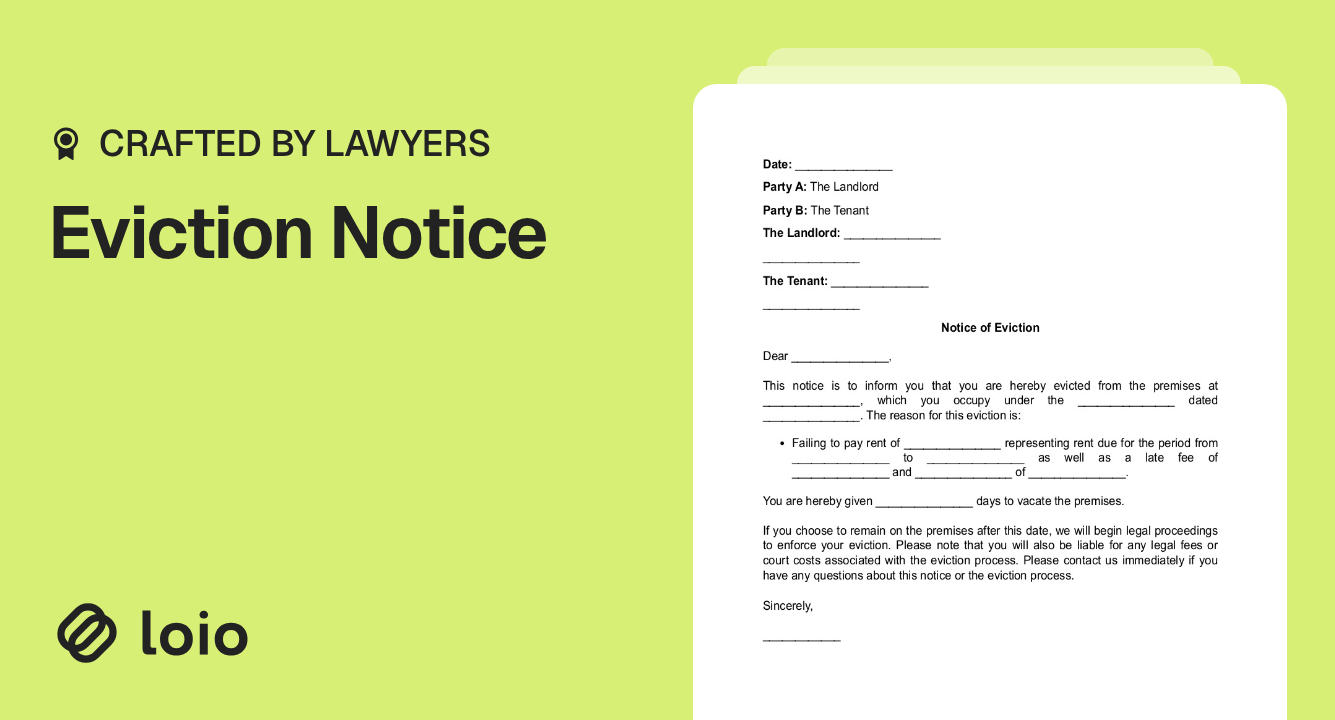
Free template
Free Eviction Notice Template

Find a state
 Alabama
 Alaska
 Arizona
 Arkansas
 California
 Colorado
 Connecticut
 DC
DC Delaware
 Florida
 Georgia
 Hawaii
 Illinois
 Indiana
 Iowa
Iowa Kansas
 Kentucky
 Louisiana
 Maine
Maine Maryland
 Massachusetts
 Michigan
 Minnesota
 Mississippi
 Montana
 Nebraska
 Nevada
 New Hampshire
 New Mexico
 North Carolina
 North Dakota
 Ohio
Ohio Oklahoma
 Oregon
 Pennsylvania
 Rhode Island
 South Carolina
 South Dakota
 Tennessee
 Texas
TexasU
 Utah
Utah Vermont
 Virginia
 Washington
 Wisconsin
 Wyoming
Template Types
What Is an Eviction Notice?
Copy section linkAn eviction notice template is a written notice that tells a tenant they must either resolve the issue or vacate the premises. It is used when the tenant violates the terms of the lease agreement – the fundamental document regulating tenant-landlord relationships: does not pay the rent, damages property, or hosts unauthorized occupants.
The notice also provides the required notice period set by state laws, which can range from a three-day notice for nonpayment of rent to a 30- or 60-day notice to quit for month-to-month tenancies.
Even if your state does not mandate the use of a specific form, issuing an eviction notice letter is considered a best practice. It creates a clear record, allows the tenant a chance to fix the violation, and ensures the landlord can proceed with eviction in court if needed.
When to Use an Eviction Notice?
Copy section linkYou should use a landlord eviction notice template whenever you need to formally evict a tenant or resolve a dispute. Common situations include:
Nonpayment of rent: Inform the tenant of unpaid rent, including any late fees, and give them a deadline to pay rent or vacate the property.
Lease violation: An issue occurring when a tenant breaks a rule written in the lease agreement, such as not paying rent or having an unauthorized pet.
End of lease: When the lease agreement ends, and you do not wish to renew, a notice to quit tells the tenant they must vacate the property.
Serious misconduct: For unlawful activity or repeated violations, landlords may use an unconditional quit notice, giving no chance to fix the problem.
Month-to-month tenancy: Provide a notice to vacate when ending a flexible rental arrangement.
When not to use an eviction notice:
When lease modifications are required (use a lease addendum instead).
If the lease is about to end due to the lease agreement, and the landlord does not plan to extend it (use a lease termination notice).
What Are the Parties to the Eviction Notice?
Copy section linkTenant (Lessee): The person renting the rental property or rental unit.
Landlord (Lessor): The property owner exercising their rights as a landlord.
Property manager/Management company: May issue or deliver an eviction notice form on behalf of the landlord.
Guarantor/Co-signer: Responsible for obligations under the lease.
Authorized occupants: Other named residents.
Legal designations: Many notices include “all other occupants” or “unknown occupants” to ensure everyone is covered.
Recipient/Signee: Whoever legally receives and signs the notice.
What to Include Into an Eviction Notice?
Copy section linkNotice to vacate: States the deadline by which the tenant must vacate the premises.
Reason for eviction: Outlines the type of violation, such as nonpayment, noncompliance, or end of lease.
Amount due: Lists the sum a tenant should pay, including the unpaid rent or late fees, before the eviction date.
Cure period: Gives the tenant time to comply or vacate.
Tenant’s rights: Advises the tenant of their option to contest the eviction case in eviction court.
Property description: Includes the address of the property and unit details.
Date of notice: When the notice was issued.
Landlord information: Name and contact details.
Statement of intent: Informs the tenant that the landlord may need to file an unlawful detainer if they don’t comply.
Lease agreement reference: Links the notice back to the lease agreement.
What Are the Key Terms in an Eviction Notice?
Copy section linkNotice period: The number of days before a tenant must vacate the rental property after they receive an eviction letter.
Unlawful detainer: The lawsuit filed to remove a tenant after a failed notice.
Cure: The way to resolve the violation (e.g., by paying rent).
Service of process: How you deliver the completed letter of eviction template.
Possession: Control of the property after lease termination.
Default: Failure to follow the terms of the lease.
How to Fill Out an Eviction Notice?
Copy section link- Review your state and local laws and legal requirements.
- Choose the right notice type: a pay rent or quit, cure or quit, unconditional quit, or notice to vacate.
- Provide the tenants' names, lease agreement details, and address of the property.
- State the reason for eviction, deadline, and consequences.
- Deliver the eviction notice by certified mail, personal service, or posting.
Requirements for this document vary by state. Review your state's laws and procedures — or consult a licensed attorney — before using this template to ensure it's valid and enforceable where you live.
Nonpayment of Rent: 7 days
The Tenant has pets, long-term guests, has damaged the property, or is using the property commercially: 7 days
The Tenant lied on their rental application or is conducting illegal activities: 7 days
Breach of the Rental Contract: 14 days (the rental agreement may be terminated upon a date not less than 7 business days after receipt of the notice).
End of / No Lease: 30 days
State Law: Ala. Code § 35-9A-421
Nonpayment of Rent: 7 days
Nonpayment of utilities: 5 days
Illegal activity: 5 days
Repeating the same or similar lease violation during 6 months: 5 days
State Law: Alaska Stat. §§ 09.45.090, 34.03.220
Nonpayment of Rent: 5 days
Health/Safety Violation: 5 days
Falsifying basic information on rental application: 10 days
Repetitive Conduct: 10 days
Illegal Activity: Immediately
End of / No Lease: 30 days
State Law: Ariz. Rev. Stat. Ann. § 33-1368
Nonpayment of Rent: 3 days
Illegal Activity: Immediately
End of / No Lease: 30 days
State Law: Ark. Stat. §§ 18-16-101,18-17-701
Nonpayment of Rent: 3 days
Illegal Activity: 3 days
Damage to the Property: 3 days
End of / No Lease: 30–90 days, depending on the Lease duration
State Law: Cal. Civ. Proc. Code Part 3, Title 3, Chapter 4 § 1161
Nonpayment of Rent: 3–10 days
Lease Violation: 3–10 days
Illegal Activity: 3 days
End of / No Lease: 1–91 days, depending on the Lease duration
State Law: Colo. Rev. Stat. §§ 13-40-104, 13-40-107.5
Nonpayment of Rent: 3 days
Lease Violation: 15 days
Illegal Activity / Repeat Lease Violation: 3 days
End of / No lease: 30 days
State Law: Conn. Gen. Stat. Ann. §§ 47a-23
Nonpayment of Rent: 5 days
Irreparable Harm: Immediately
Lease Violation: 7 days
Repeat Lease Violation: 7 days
Violating Local or State Laws: 7 days
End of / No Lease: 60 days
State Law: Del. Code Ann. tit. 25, §§ 5501(d), 5502, 5513
Nonpayment of Rent: 3 days
State Law: Fla. Stat. Ann. § 83.56
Oral eviction notice is sufficient.
Nonpayment of Rent: 7 days
End of / No Lease: 60 days
State Law: Ga. Code Ann. §§ 44-7-50, 44-7-52
Nonpayment of Rent: 5 days
Lease Violation: 10 days
Illegal Activity: Immediately
End of / No Lease: 10–45 days, depending on the type of Lease
State Law: Haw. Rev. Stat. §§ 521-68, 521-69
Nonpayment of Rent: 3 days
Lease Violation: 3 days
Illegal Activity: 3 days
End of / No Lease: 30 days
State Law: Idaho Code § 6-303(2)
Nonpayment of Rent: 5 days
Lease Violation: 10 days (14 days in Chicago)
Illegal Activity: 5 days
End of / No Lease: 7–60 days, depending on the type of Lease
State Law: Ill. Comp. Stat. § 5/9-209
Nonpayment of Rent: 10 days
Lease Violation: 10 days
Illegal Activity: 45 days
End of / No Lease: 30–90 days, dependong on the Lease duration
State Law: Ind. Code Ann. §§ 32-31-1-6, 32-31-7-7
Nonpayment of Rent: 3 days
Lease Violation: 7 days
Repeat Lease Violation: 7 days
Illegal Activity: 3 days
End of / No Lease: 10–30 days, depending on the type of Lease
State Law: Iowa Code §§ 562A.27, 562A.34
Nonpayment of Rent: 3 days
Illegal Activity: 3 days
Lease Violation: 30 days
Repeat Lease Violation: 30 days
End of / No Lease: 7–30 days, depending on the type of Lease
State Law: Kan. Stat. Ann. §§ 58-2507, 58-2508, 58-2564(b), 58-2570
Nonpayment of Rent: 7 days
Illegal Activity: 14 days
Lease Violation: 14 days
End of / No Lease: 7–30 days, depending on the type of Lease
State Law: Ky. Rev. Stat. Ann. §§ 383.660(2)
Nonpayment of Rent: 5–20 days, depending on the form of the notice, oral or verbal.
Lease Violation: 5 days
End of / No Lease: 5–30 days, depending on the type of Lease
State Law: La. Civ. Proc. Code Ann. art. 4701
Nonpayment of Rent: 7 days
Illegal Activity: 7 days
Lease Violation: 7 days
End of / No Lease: 7–30 days, depending on the type of lease
State Law: Me. Rev. Stat. Ann. tit. 14, § 6002
Nonpayment of Rent: 10 days
Illegal Activity: 14 days
Imminent Threat / Serious Harm: 14 days
Lease Violation: 30 days
End of / No Lease: 7–90 days, depending on the type of Lease
State Law: Md. Code Ann. [Real Prop.], §§ 8-401, 8-402-1
Nonpayment of Rent: 14 days
Illegal Activity: 7 days
Lease Violation: 7 days
End of / No Lease: 30–90 days, depending on the type of Lease
State Law: Mass. Gen. Laws ch. 186, §§ 11, 11A, 12
Nonpayment of Rent: 7 days
Damage to the Property: 7 days
Health Hazard: 7 days
Illegal Activity: 24 hours
Lease Violation: 30 days
End of / No Lease: 30 days, dependong on the Lease type
State Law: Mich. Comp. Laws § 554.134(2)
Nonpayment of Rent: 14 days or immediately, depends on the type of Lease
Destruction of Premises: Immediately
Illegal Activity: Immediately
Lease Violation: Immediately
End of / No Lease: 7–30 days, depending on the type of lease
State Law: Minn. Stat. Ann. §§ 504B.135, 504B.291
Nonpayment of Rent: 3 days
Lease Violation: 14 days
End of / No Lease: 7–30 days
State Law: Miss. Code Ann. §§ 89-7-27, 89-7-45
Nonpayment of Rent: Immediately
Criminal Activity: 5 days
Illegal Activity: 10 days
Lease Violation: 10 days
End of / No Lease: 30–60 days, depending on the type of Lease
State Law: Mo. Rev. Stat. §§ 535.020, 441-060
Nonpayment of Rent: 3 days
Illegal Activity: 3 days
Verbally Abusing the Landlord: 3 days
Unauthorized persons / Pets on the Premises: 3 days
Lease Violation: 14 days
Repeat Lease Violation: 5 days
End of / No Lease: 7–30 days, depending on the type of Lease
State Law: Mont. Code Ann. § 70-24-422(2)
Nonpayment of Rent: 7 days
Illegal Activity: 5 days
Lease Violation: 30 days
Repeat Lease Violation: 14 days
End of / No Lease: 7–30 days, depending on the type of Lease
State Law: Neb. Rev. Stat. § 76-1431
Nonpayment of Rent: 4–45 days, depending on the type of Lease
Illegal Activity: 3 days
Lease Violation: 5 days
End of / No Lease: 5–30 days, depending on the type of Lease
State Law: Nev. Rev. Stat. Ann. §§ 40.2512, 40.253
Nonpayment of Rent: 7 days
Illegal Activity: 7 days
Major Property Damage: 7 days
Refusal to comply with maintenance: 30 days
Lease Violation: 30 days
Breach of the Rental Contract: 30 days
State Law: N.H. Rev. Stat. Ann. §§ 540:2, 540:3, 540:9
Nonpayment of Rent: Immediately
Illegal Activity: 3 days
Major Property Damage: 3 days
Disorderly Conduct: 3 days
Lease Violation: 30 days
Health / Safety Violations: 3 months
Discontinued Use of the Rental Property: 18 months
End of / No Lease: 7–90 days
State Law: N.J. Stat. Ann. §§ 2A:18-53, 2A:18-61.1, 2A:18-61.2, 2A:42-9
Nonpayment of Rent: 3 days
Illegal Activity: 3 days
Health / Safety Violation: 7 days
Lease Violation: 7 days
End of / No Lease: 7–30 days, depending on the type of Lease
State Law: N.M. Stat. Ann. § 47-8-33(D), 47-8-37
Nonpayment of Rent: 14 days
Nonpayment of Taxes: 3 days
Illegal Activity: No statute
Lease Violation: 10 days
End of / No Lease: 15–30 days, depending on the type of Lease
State Law: N.Y. Real Prop. Law § 235-e(d); N.Y. Real Prop. Acts. Law § 711(2)
Nonpayment of Rent: 10 days
Illegal Activity: No statute
Lease Violation: No statute
End of / No Lease: 2–31 days, depending on the type of Lease
State Law: N.C. Gen. Stat. §§ 42-3, 42-14, 42-26
Nonpayment of Rent: 3 days
Damage to the Property: 3 days
Illegal Activity: 3 days
Lease Violation: 3 days
End of / No Lease: 30 days
Breach of the Rental Contract: 3 days and no more than 15 days from the date on which the summon of a proper district court is issued.
State Law: N.D. Cent. Code § 47-32
Nonpayment of Rent: 3 days
Illegal Activity: 3 days
Material Health / Safety Violation: 30 days
Lease Violation: 3 days
End of / No Lease: 7–30 days, depending on the type of Lease
State Law: Ohio Rev. Code Ann. § 1923.02
Nonpayment of Rent: 5 days
Illegal Activity: Immediately
Lease Violation: 15 days
End of / No Lease: 7–30 days, depending on the type of Lease
State Law: Okla. Stat. Ann. tit. 41, §§ 131, 132
Nonpayment of Rent: 3–6 days, depending on the type of Lease
Illegal Activity: 24 hours
Providing False Information: 24 hours
Unpermitted pet: from 24 hours to 20 days, depending on the damage caused by the pet
Drug/Alcohol-Free Housing Violation: 48 hours
Lease Violation: 7–30 days, depending on the type of Lease
End of / No Lease: 10–30 days, depending on the type of Lease
State Law: Or. Rev. Stat. Ann. §§ 90.394(2)(a), 90.392
Nonpayment of Rent: 10 days
Illegal Activity: 10 days
Lease Violation: 15–30 days, depending on the type of Lease
End of / No Lease: 15–30 days, depending on the type of Lease
State Law: 68 Pa. Cons. Stat. Ann. § 250.501(b)
Nonpayment of Rent: 5 days
Illegal Activity: Immediately
Lease Violation: 20 days
End of / No Lease: 10–90 days, depending on the type of Lease
State Law: R.I. Gen. Laws § 34-18-35, 34-18-36, 34-18-37
Nonpayment of Rent: 5 days
Illegal Activity: Immediately
Lease Violation: 14 days
End of / No Lease: 7–30 days, depending on the type of Lease
State Law: S.C. Code Ann. §§ 27-37-10(B), 27-40-710(B)
Nonpayment of Rent: 3 days
Lease Violation: Immediately
Sale of the Rental Property: 3 days
End of / No Lease: 7–31 days, depending on the type of Lease
State Law: S.D. Codified Laws §§ 21-16-1(4), 21-16-2, 43-32-18, 43-32-15
Nonpayment of Rent: 14 days
Illegal Activity: 3 days
Health / Safety Violation: 3 days
Curable Lease Violation: 14 days
Incurable Lease Violation: 30 days
Subsequent Violation: 7 days
End of / No Lease: 10–30 days
State Law: Tenn. Code Ann. § 66-28-505
Nonpayment of Rent: 3 days
Breach of the Rental Contract: 3 days or other term for certain tenancies as specified in § 91.001.
State Law: Tex. Prop. Code Ann. §§ 24.005, 91.001
Nonpayment of Rent: 3 days
Illegal Activity: 3 days
Lease Violation: 3 days
Subleasing: 3 days
End of / No Lease: 5–15 days, depending on the type of Lease
Breach of the Rental Contract: 3 days
State Law: Utah Code Ann. § 78B-6-802
Nonpayment of Rent: 14 days
Illegal Activity: 14 days
Lease Violation: 30 days
Sale of the Rental Property: 30 days
End of / No Lease: 7–90 days, depending on the type of Lease
State Law: Vt. Stat. Ann. tit. 9, § 4467(a)
Nonpayment of Rent: 5 days
Illegal Activity: Immediately
Lease Violation: 30 days
End of / No Lease: 7–30 days, depending on the type of Lease
State Law: Va. Code Ann. §§ 55.1-1245, 55.1-1250, 55-225, 55-222, 55-239
Nonpayment of Rent: 14 days
Illegal Activity: Immediately
Curable Lease Violation: 10 days
Incurable Lease Violation: 3 days
End of / No Lease: 20 days
State Law: Wash. Rev. Code Ann. §§ 59.12.030(3), 59.18.057, 59.18.650
Nonpayment of Rent: Immediately
Lease Violation: Immediately
End of / No Lease: 7–90 days, depending on the type of Lease
Breach of the Rental Contract: The landlord can immediately provide an eviction notice.
State Law: W.Va. Code § 55-3A-1
Nonpayment of Rent: 5 days.
Illegal Activity: 5 days
Lease Violation: 5–30 days, depending on the type of Lease
End of / No Lease: 7–28 days
State Law: Wis. Stat. Ann. §§ 704.17, 704.19
Nonpayment of Rent: 3 days
Lease Violation: 3 days
End of / No Lease: 30 days
State Law: Wyo. Stat. Ann. §§ 1-21-1002 to 1-21-1003
Sources
Related documents
Also read