Free template
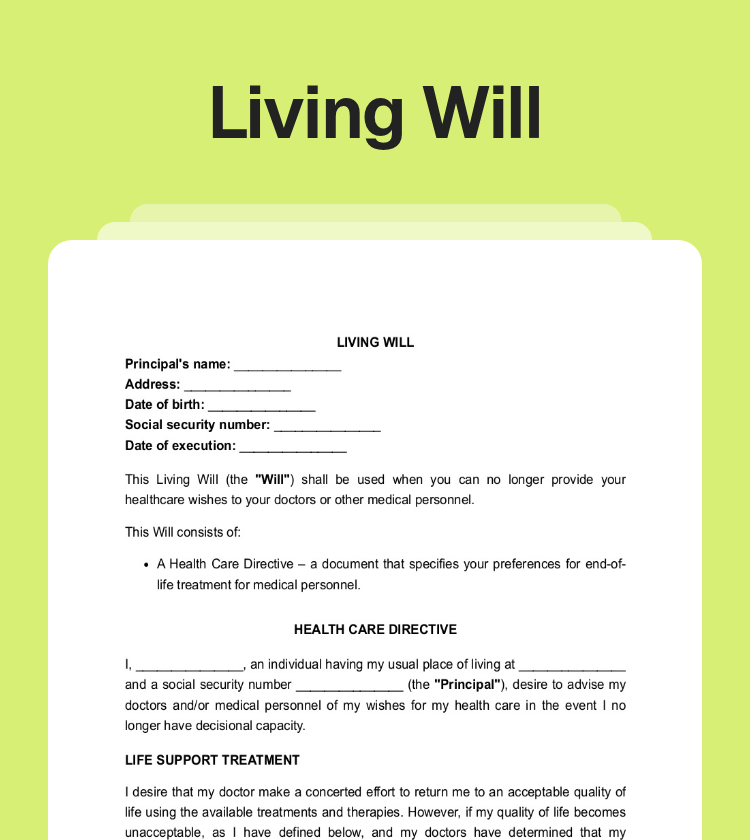
Free Living Will Form

What Is a Living Will Form?
Copy section linkA living will is an advance healthcare directive that lets you specify the medical treatments you want (or don't want) if you are ever in a condition where you can no longer speak for yourself. This includes situations such as a coma, a terminal illness, advanced dementia, or permanent unconsciousness.
Unlike a last will and testament, which deals with property and assets after death, a living will takes effect while you are alive but incapacitated. It speaks directly to your medical team, telling them which interventions to pursue and which to refuse. Without putting that burden on your family in an already difficult moment.
A living will form typically addresses decisions about resuscitation (CPR), artificial ventilation, feeding tubes, hydration, and palliative care. Some states use the terms "advance directive" and "healthcare directive" to refer to the same document. The legal requirements: how many witnesses are needed, whether notarization is required, vary by state, so the governing law you select when completing the form matters.
When to Use a Living Will Form
Copy section linkA living will applies when a person is incapacitated and cannot communicate their medical wishes. Common situations include:
A severe brain injury leaves a person in a coma or persistent vegetative state with no reasonable chance of recovery.
A terminal illness in its final stages, where the person wants to avoid interventions that prolong suffering without improving the outcome.
Advanced dementia, where cognitive decline has progressed to the point that the person can no longer make informed medical decisions.
Major surgical complications that leave a patient temporarily or permanently unable to communicate.
Any sudden medical emergency: stroke, cardiac arrest, accident, where decisions must be made quickly, and the person cannot participate.
When not to use a living will:
Use a power of attorney (POA) instead if you want to appoint a specific person to make healthcare decisions on your behalf, rather than specifying the decisions yourself in advance.
Use an advance directive form if you want a combined document that includes both a living will and a medical power of attorney, as many states recognize.
Use a last will and testament for decisions about property, assets, and what happens after death — a living will does not cover these.
Parties to the Living Will
Copy section linkPrincipal: The person creating the living will and whose healthcare wishes it records. Must be a competent adult at the time of signing.
Witness(es): One or two adults who sign the document to confirm the principal signed voluntarily and appeared to be of sound mind. Most states require at least one witness; many require two. A witness generally cannot be a family member, heir, or anyone who would benefit from the principal's death.
Notary public (conditional): Some states require notarization in addition to, or instead of, witnesses. Where required, the notary confirms the principal's identity and the voluntariness of the signing.
Healthcare proxy/agent (conditional): If the living will names a person to carry out the principal's wishes or communicate with medical staff, that person is the healthcare proxy. This role is more fully defined in a separate medical power of attorney.
What Are the Key Components of a Living Will?
Copy section linkPrincipal's personal information: Full name, address, date of birth, and Social Security number to identify the document's author and prevent confusion with another patient.
Declaration of intent: A statement confirming that this document reflects the principal's own wishes and that they are of sound mind at the time of signing.
Healthcare directive: Specification of which life-sustaining treatments the principal wants or refuses, and under what conditions those instructions apply.
End-of-life treatment preferences: Explicit choices about CPR, mechanical ventilation, artificial nutrition and hydration, dialysis, and whether to pursue comfort-only (palliative) care.
Organ and tissue donation wishes (conditional): A statement about whether the principal consents to organ or tissue donation upon death.
Governing law: The state whose laws apply to the document. This determines the legal requirements for validity and how the document will be interpreted by healthcare providers.
Principal's signature and date: Required for the document to be valid. Can be signed by hand or, where permitted, electronically.
Witness signature(s): One or two witnesses confirming the principal signed willingly and was competent at the time of signing.
Notary acknowledgment (conditional): Required in states where notarization is mandated for a living will to be legally valid.
What Are the Key Terms in a Living Will?
Copy section linkAdvance healthcare directive: An umbrella term for legal documents that record a person's medical wishes or delegate medical decision-making to someone else. Living wills and medical powers of attorney are both types of advance healthcare directives.
Life-sustaining treatment: Medical interventions that maintain bodily functions when the body cannot do so on its own — such as mechanical ventilation, feeding tubes, dialysis, or CPR.
Palliative care: Medical care focused on relieving pain, discomfort, and symptoms rather than curing an underlying condition or extending life. It can be provided alongside other treatments or as the primary approach when a person chooses to forgo life-sustaining interventions.
Incapacity: A state in which a person is unable to understand information, make decisions, or communicate their healthcare preferences. This is the condition that triggers a living will.
Do Not Resuscitate (DNR) order: A specific medical instruction not to perform CPR if the patient's heart stops or they stop breathing. A living will can express this preference, but a formal DNR is typically issued separately by a physician.
Healthcare proxy: A person named to communicate or act on the principal's healthcare wishes. More commonly defined in a medical power of attorney than in a living will.
Principal: The person whose healthcare wishes the living will documents.
Vegetative state: A condition of severe brain damage in which a person is alive but shows no awareness or purposeful response and cannot communicate.
How to Fill Out a Living Will Template?
Copy section link- Enter your full legal name, home address, date of birth, and Social Security number.
- Write the date you are completing and signing the form.
- Review the healthcare directive section and indicate which life-sustaining treatments you want to receive and which you want to refuse.
- State your preferences for end-of-life scenarios specifically: what you want if you are in a terminal condition, a persistent vegetative state, or have an end-stage condition with no expected recovery.
- Indicate whether you want resuscitation (CPR) attempted if your heart stops.
- State your preferences regarding artificial nutrition and hydration if you are permanently unable to eat or drink on your own.
- Specify whether you consent to organ and tissue donation, and if so, for what purposes.
- Select the state whose laws will govern the document.
- Sign the form by hand or with eSign. Have one or two witnesses sign as required by your state, and have the document notarized if your state requires it.
- Store the signed original in an accessible location. Give a copy to your doctor, your healthcare proxy if you have one, and any family members likely to be present in a medical emergency.
Requirements for this document vary by state. Review your state's laws and procedures — or consult a licensed attorney — before using this template to ensure it's valid and enforceable where you live.
Sources
Related documents
Also read