What Medical Conditions Require a Living Will?

Updated November 10, 2025
4 min read
What Medical Conditions Require a Living Will?

Do you plan only for your finances – or for your health, too?

It’s easy to focus on money, savings, or property, but your health deserves the same care and preparation.

A Living Will lets you take control of your medical treatment if you become unable to communicate your wishes.

Certain medical conditions make this document especially important, helping you and your loved ones avoid confusion or conflict in times of crisis.

Should You Make a Living Will Even If You’re Healthy?

A living will isn’t only for people who are sick or elderly. In fact, the best time to make all necessary medical documents is when you’re healthy and able to clearly express your wishes.

This document only takes effect if you become unable to make medical decisions – for example, if you’re unconscious or in a coma – but having it ready in advance prevents confusion or disagreements later. It lets doctors and loved ones know exactly what kind of care you want.

A living will can also include your wishes about organ donation. For instance, if you want to donate your organs after death, writing it down ensures that your decision is respected and carried out.

Living Will or Medical Power of Attorney?

While both documents fall under advance directives, they serve different purposes:

  • Living Will – States your medical treatment preferences in specific scenarios (e.g., use of life support, resuscitation, artificial nutrition).

  • Medical Power of Attorney – Authorizes a trusted person to make medical decisions on your behalf if you’re unable to do so.

Your Living Will provides clear instructions, while your Medical Power of Attorney allows flexibility for unforeseen circumstances.
Actual updates
|
4 pages
PDF
|
2.6K created templates

Start your living will — protect your wishes

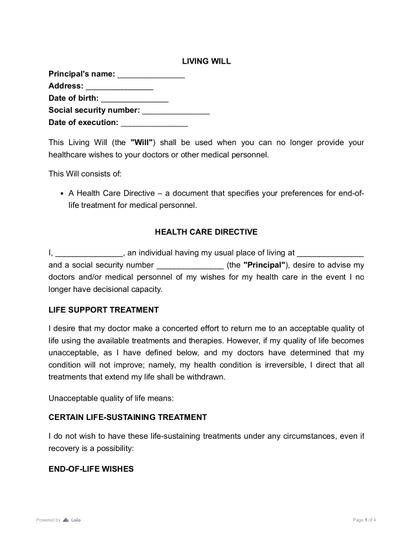
Living Will Preview
Preview
Create & Download

Medical Treatments Addressed in a Living Will

The Living Will form allows you to specify a variety of medical procedures and care options. These directions guide healthcare providers.

So what are these medical conditions?

Life Support and Mechanical Ventilation

This involves machines helping you breathe when you can’t on your own. People who have chronic respiratory diseases (like COPD or ALS) or those at risk of severe brain injuries may want to clarify whether they’d want to be placed on long-term life support.

Artificial Nutrition and Hydration

Feeding tubes or IV fluids can sustain life when someone can’t eat or drink independently.
Patients facing advanced dementia, severe stroke, or coma may use the Living Will to state whether they want artificial nutrition continued indefinitely.

Resuscitation (DNR Orders)

A Do Not Resuscitate (DNR) directive tells doctors not to perform CPR if your heart stops.
It’s commonly included for people with terminal illnesses or advanced heart failure, who prefer natural death without aggressive intervention.

Pain Management and Palliative Care

Specify how you want pain relief handled, even if strong medication could hasten death. Individuals with cancer, end-stage organ failure, or progressive neurological diseases often outline comfort-focused care preferences in their Living Will.

When to Review or Update Your Living Will

Your medical wishes may change over time, so it’s important to keep your Living Will up to date. Review it whenever there’s a major life event or a change in your health.

When to update:

  • New medical diagnosis. Chronic illness, terminal disease, or degenerative condition.
  • Major life change. Divorce, marriage, or loss of a loved one.
  • Relocation. Moving to another state with different healthcare laws.
  • Advances in medicine. New treatment options may affect your choices.

Best practice: Review your Living Will every 2–3 years or after a significant health change.

Keep copies in easily accessible places – at home, with your healthcare proxy, and with your physician. Store the digital version securely using Loio’s template library for convenient updates anytime.

Conclusion

Whether you’re managing a chronic illness or planning ahead for peace of mind, taking this step is an act of care for yourself and others.

Start by exploring Loio’s Living Will Template, Power of Attorney, and Advance Directive Form – created to make the process clear, legally sound, and fully under your control.

Article by Megan Thompson

Megan Thompson is a communications pro who found her niche at the intersection of law and creativity. At Loio, Megan leads corporate communications, public relations, and content initiatives, always focused on making legal information accessible and building strong connections with partners and audiences.

Also Read

15 Legal Documents Everyone Should Have
Life is full of unpredictability. Although we want to believe that we are in 100% control of everything, the reality is that all we have is the illusion of control. We can never predict such things as facing a severe illness, disability, or death or the legal issues resulting from not having a carefully drafted estate plan, for instance. Taking the time to ask what legal documents everyone should have on hand will prepare you and your loved ones if you are not able to make your own medical decis
5 Things You Need To Know About Car Accident Lawsuits
Introduction Many car accident victims receive compensation for medical bills, property damage, and other expenses without stepping into a courtroom by negotiating a settlement with the insurance company. Sometimes, however, negotiations break down because disputes over who's at fault or questions about the victim's injuries arise. That's when it might be time to talk to a car accident attorney and consider filing a lawsuit. Before you sign up for a consultation, here are five things you need to
California Dog Bite Checklist! What To Do If A Dog Bites You
Every day, people interact with dogs. Most of the time, dogs are friendly companions, but sometimes, things can take a tragic turn. In the United States, over 4.5 million people experience dog bites annually, with more than 800,000 of these attacks requiring medical assistance. Here in this guide, you'll learn vital steps to take if you find yourself victim to a dog bite incident, with a focus on dog bites in California. In a recent and eye-opening case, the family of a child attacked by a dog i
Can Family Override Your Decision to Become an Organ Donor?
Thinking about becoming an organ donor is a deeply personal decision – one that can save lives and carry powerful meaning. Yet, many people worry: Can family override organ donation if I’ve already made that choice? In the United States, the law gives individuals strong rights over their own bodies and medical choices, including organ donation. However, because families are often involved in end-of-life decisions, confusion and emotional conflict can sometimes arise. This guide explains how orga
Guide To Child Care Authorization
Are you a busy parent or guardian who sometimes needs to be in two places at once? Do you worry about leaving your child in the care of a third-party service provider? Child care authorization may be the solution you need!  Essentially, child care authorization allows a non-relative to act on behalf of a minor child when the parent or guardian is not present. This is often necessary when a third-party service provider requires parental permission to administer care, services, or other benefits
Civil Law
Civil law is a fundamental branch of the legal system that governs disputes between individuals, businesses, and organizations. Unlike criminal law, which deals with offenses against the state, civil law focuses on resolving private disputes and providing remedies to those who have suffered harm. This legal guide explores the key principles and areas of civil law. What Is Civil Law? Civil law encompasses a wide range of legal issues related to personal and business matters. It is primarily conce
Common App Document Requirements: What You Need to Know
Applying to college through the Common App makes the process simpler — but it also means you’ll need to gather several important documents in advance. From transcripts to recommendation letters, each file plays a role in presenting your academic history and personal story. We will break down what documents the Common App requires, why they matter, and how to prepare them efficiently. What Is the Common Application? The Common Application (Common App) is an online platform that allows students to
Consumer Protection Law
US consumer protection laws are a group of statutes designed to protect the interest of consumers and promote fair competition by requiring that businesses provide accurate information about their products or services and operate honestly and transparently. Seven main issues that the federal consumer protection laws address are: False advertising — Advertising that misrepresents the true nature of a product or service either by giving deceptive descriptions, pricing, measures, or quantities or b
All Guides
    Business
    Personal
      10 Essential Documents Every Student Should Bring to College
      15 Legal Documents Everyone Should Have
      5 Things You Need To Know About Car Accident Lawsuits
      California Dog Bite Checklist! What To Do If A Dog Bites You
      Can Family Override Your Decision to Become an Organ Donor?
      Civil Law
      Common App Document Requirements: What You Need to Know
      Consumer Protection Law
      Criminal Law
      Do You Really Need a Counselor Recommendation Letter?
      Estate Planning Law
      Family Law
      Finding The Ideal Legal Counsel For Your Needs
      Guide To Child Care Authorization
      How Does a Living Will Differ from Other Medical Decision Documents?
      How Long Does It Take To Settle a Personal Injury Lawsuit?
      How Much Will I Get as Compensation for a Bicycle Injury?
      How Often Should I Hear from My Attorney?
      How to Apply for Scholarships: Tips & Insights
      How To Choose a Lawyer Using Loio Match?
      How To Get the Letter of Recommendation from Coach?
      How To Write a Demand Letter: Key Do’s and Don’ts You Need To Know
      How To Write a Recommendation Letter in Five Steps
      Immigration Law
      Insurance Law
      International Law
      Is a Community Service Form Vital for Your Church?
      Lawyer vs. Attorney: What Are the Differences?
      Microsoft Word for Lawyers: Tips and Tricks That Every Lawyer Should Know
      Personal Injury Law
      Products vs. Services: Buy with Intention
      Strategy for Getting the Best Letters of Recommendation
      Top 10 Lawyer Directories: Find a Lawyer for Your Needs
      Top 5 Healthcare Documents You Need
      Traffic & Vehicle Law
      What Happens To Engagement Ring in Broken Engagement
      What Is the Cost of Assisted Living in the US?
      What Is the Difference Between a Judge and a Magistrate?
      What Medical Conditions Require a Living Will?
      What to Do If You Receive a Negative Letter of Recommendation
      What To Do When Your Lawyer Drops Your Case?
      Where To Find a Lawyer: 5+ Proven Options
      Who Can File a Wrongful Death Suit?
      Word Wonders: Multilevel Numbering for Lawyers
      Нealthcare Law
    Real Estate