Free template
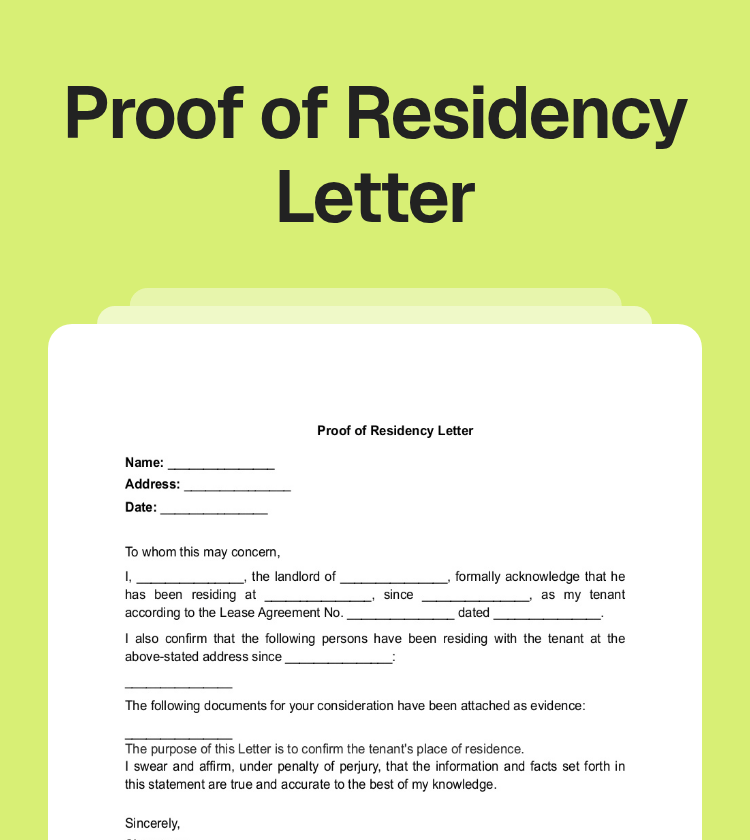
Free Proof of Residency Letter Template

What Is a Proof of Residency?
Copy section linkA proof of residency letter is a document that confirms where you live. It’s often needed for things like enrolling in school, applying for a driver’s license, or setting up utility services. The proof of residency letter template usually includes your name, full address, how long you’ve lived there, and sometimes a signature from a landlord, roommate, or another official who can verify the information.
Depending on the organization requesting the document, a proof of residency letter may need to be supported by additional records, such as utility bills, lease agreements, tax documents [1], or government correspondence that shows the resident's address. If you photograph or scan one of these with a phone, make the scanned PDF searchable before attaching it.
Common documents used to establish residency include a lease agreement, apartment lease, mortgage statement, utility bill, bank statement, voter registration record, or motor vehicle registration. These records are often submitted together with identity documents such as a driver's license, passport, or visa when additional verification is required.
When to Use a Proof of Residency
Copy section linkA letter of proof of residence can help verify where a person lives when an organization requires confirmation of their address. Use a proof of residency when:
School enrollment — A parent needs to confirm that a child lives within a school district.
Driver's license or state ID applications — Many state DMVs [2] require applicants to provide documents showing their residential address before issuing or renewing identification documents.
Voter registration — A resident must verify their place of residence before registering to vote.
Opening a bank account — A financial institution requires address verification as part of its identification process.
Government benefits applications — An applicant must prove residency to qualify for state or local programs.
Housing or rental matters — A tenant needs written confirmation that they reside at a particular property.
Employment onboarding — An employer requests proof of the employee's current address.
Insurance applications — An insurer requires confirmation of where the policyholder lives.
College or university residency verification — A student must establish residency status for tuition or enrollment purposes.
When Not to Use a Proof of Residency
Copy section linkThe residence proof documents is not appropriate when another document is needed to establish a legal relationship or housing arrangement.
Instead, consider using:
A Residential Lease Agreement when creating a landlord-tenant relationship and establishing rental terms.
A Room Rental Agreement when renting a room within a shared residence.
A Lease Renewal Agreement when extending an existing tenancy.
A Landlord Reference Letter when confirming a tenant's rental history or character rather than simply verifying their address.
A Notarized Affidavit when an organization specifically requires a sworn statement made under oath.
Parties to the Proof of Residency
Copy section linkA proof of residence may involve several individuals, depending on how residency is being verified. The exact parties vary based on the purpose of the document and the requirements of the requesting organization.
Resident — The person whose address or place of residence is being verified.
Declarant (Affiant) — The individual providing the statement confirming the resident's address, such as a landlord, homeowner, parent, roommate, or other person with knowledge of the resident's living situation.
Property Owner or Landlord (if applicable) — The owner or manager of the property who confirms that the resident lives at the stated address.
Parent or Legal Guardian (if applicable) — A parent or guardian who verifies the residency of a minor child.
Key Components of a Proof of Residency
Copy section linkA proof of residency template should include enough information to clearly identify the resident, confirm the address, and establish the basis for the residency verification.
Resident Information — Identifies the individual whose residency is being verified, including their full legal name.
Residential Address — Specifies the physical address where the resident currently lives.
Residency Statement — Confirms that the resident resides at the listed address and states the nature of their occupancy.
Declarant Information — Identifies the person providing the residency verification, such as a landlord, homeowner, parent, or roommate.
Relationship to the Resident — Explains how the declarant knows the resident and why they are qualified to verify the residency claim.
Supporting Details — Provides additional information that helps establish residency, such as the date residency began or the resident's living arrangement.
Key Terms in a Proof of Residency
Copy section linkNotarization: The process of having a notary public verify the identity of the signer and witness the signing of the proof of residency document.
Primary Proof of Residency: A document that directly establishes a person's address, such as a utility bill, lease agreement, mortgage statement, or government-issued correspondence.
Secondary Proof of Residency: An additional document used to support a residency claim when primary proof is unavailable, such as a bank statement, insurance document, or school record.
Residency: The place where a person currently lives and maintains a physical presence, regardless of whether they intend to stay there permanently.
Domicile: A person's permanent legal home where they intend to return and remain, even if they temporarily live elsewhere.
Leasehold: The legal right to occupy a property under a lease agreement for a specified period of time.
Affidavit of Residency: A sworn written statement used to verify a person's address, often signed under penalty of perjury and sometimes notarized.
Visa: A government-issued document that may help verify a person's immigration status and identity but is not usually sufficient on its own to prove residency.
Occupancy: The act of living in or residing at a property, whether as an owner, tenant, family member, or other lawful occupant.
Notary Public: A state-authorized official who verifies the identity of document signers and helps prevent fraud by witnessing signatures.
How to Fill Out a Proof of Residency
Copy section linkCompleting a proof of residency form is straightforward as long as all information is accurate and supported by any required documentation. Follow these steps to fill out the form correctly.
Enter the Resident's Full Name. Provide the full legal name of the person whose residency is being verified.
Add the Residential Address. Enter the complete street address, including the city, state, and ZIP code where the resident currently lives.
State the Residency Confirmation. Confirm that the resident lives at the listed address and identify the nature of their occupancy, if applicable.
Enter the Declarant's Full Name. Provide the name of the person making the residency statement, such as a landlord, homeowner, parent, or roommate.
Describe the Relationship to the Resident. Explain how the declarant knows the resident and why they are able to verify the residency information.
Add Supporting Residency Details. Include any relevant information that supports the residency claim, such as the date the resident began living at the address or details about the living arrangement.
Review the Information for Accuracy. Carefully verify all names, addresses, dates, and statements before signing the document.
Sign and Date the Document. The declarant should sign and date the Proof of Residency to confirm that the information provided is true and accurate. The parties can securely sign the proof of residency electronically. This allows the document to be signed remotely and shared without printing or mailing physical copies.
Obtain a Witness Signature (If Required). If requested by the receiving organization, have a witness observe the signing and add their signature.
Complete Notarization (If Required). If the Proof of Residency must be notarized, sign the document in the presence of a notary public and complete the notarial acknowledgment section.
Attach Supporting Documents (If Requested). Include copies of documents that help verify residency, such as utility bills, lease agreements, bank statements, tax records, driver's license records, or government-issued correspondence. Some organizations may also accept address verification documents maintained through the United States Postal Service (USPS) [3].
Once completed, the proof of residency may be saved, shared, or submitted in digital formats such as PDF or Microsoft Word, depending on the receiving organization's requirements.
Can I Use the Same Proof of Residency Form for Different Requests?
Sometimes, yes — but not always. You may be able to use the same proof of residency form if the requests are similar and the receiving organizations have the same documentation requirements.
However, some schools, government agencies, employers, or financial institutions may require a different format, additional information, a more recent date, or a notarized version of the document. Before submitting a proof of residency letter, check the specific requirements of the organization requesting it. If the existing form does not meet those requirements, you should prepare a new one.
Do I Need to Notarize a Proof of Residency Letter?
Not always. Many organizations accept a proof of residency letter as long as it is signed by the person verifying the resident's address, such as a landlord, homeowner, or parent.
However, some institutions require notarization to confirm the identity of the signer and add an extra layer of verification. If a school, DMV, government agency, or other organization requests a notarized proof of residency, the signer must appear before a notary public and sign the document according to the notary's instructions.
Can a Proof of Residency Be Used as Proof of Identity?
No. A proof of residency verifies where a person lives, but it does not confirm their identity. Many organizations require both proof of residency and a government-issued photo ID, such as a driver's license, state ID card, or passport.
What Documents Can Be Used to Support a Proof of Residency?
Supporting documents commonly include utility bills, lease agreements, mortgage statements, bank statements, insurance documents, voter registration records, or government correspondence that shows the resident's name and address. The exact documents accepted may vary depending on the organization requesting proof of residency.
Can a Passport Be Used as Proof of Residency?
Copy section linkA U.S. passport or passport card is commonly accepted as proof of identity but does not usually prove where a person lives. Many organizations require additional documents, such as a lease agreement, utility bill, or bank statement, to verify residency.
Requirements for this document vary by state. Review your state's laws and procedures — or consult a licensed attorney — before using this template to ensure it's valid and enforceable where you live.
Sources
Related documents
Also read