Free template
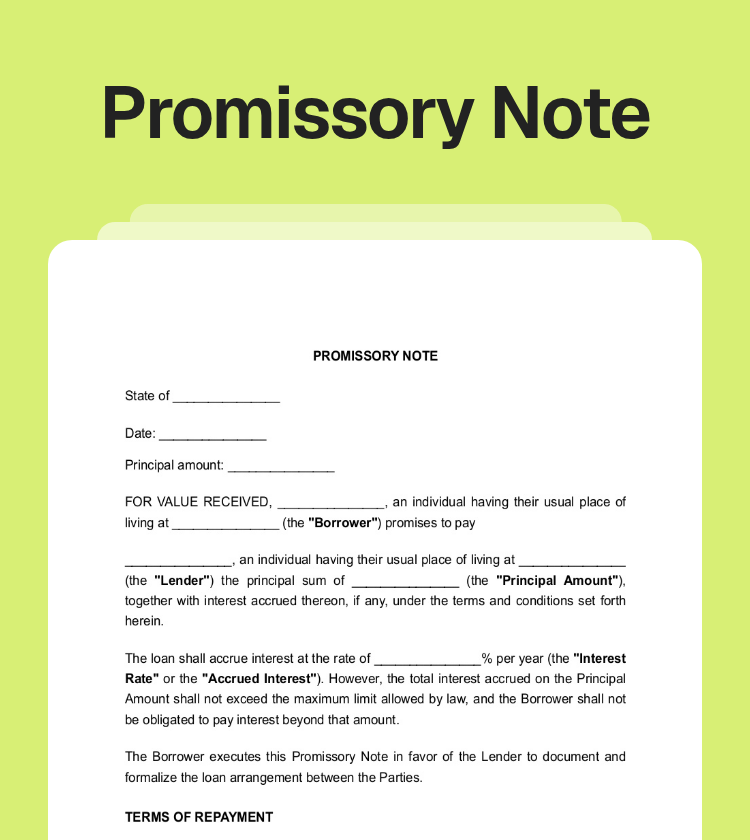
Free Promissory Note Template

A promissory note is a written agreement between a borrower and a lender that records a promise to repay money. It is used to document the loan amount, interest rate, maturity date, late fees, default rules, and other repayment terms.
What Is a Promissory Note?
Copy section linkA promissory note is a legally binding document in which one party, the borrower, promises to repay a specific debt to another party, the lender. It works as a formal promise to pay agreement and helps both sides record the essential loan terms in writing.
A promissory note template is often used for personal loans, business loans, real estate financing, family loans, or other situations where one person or company lends money to another. A standard promissory note usually includes the principal amount, interest rate, maturity date, payment method, default rules, and signatures.
This document is more detailed than a simple IOU but usually shorter than a full loan agreement. It can be used for secured debt, where collateral supports repayment, or unsecured debt, where the lender relies on the borrower’s promise and financial reliability.
When to Use a Promissory Note
Copy section linkUse a promissory note form when the parties need a clear written record of a loan and repayment terms. Common situations include:
Personal loans: A friend or family member lends money and wants repayment terms in writing.
Business loans: A creditor lends money to a company, startup, or business owner.
Real estate financing: A buyer promises to repay money connected with a mortgage, second mortgage, or seller financing.
Installment payments: A borrower repays the debt over time instead of paying everything at once.
Unsecured debt: The lender does not require collateral but still needs a written promise to repay.
Loans with a guarantor: A third party agrees to cover the debt if the borrower defaults.
When not to use a promissory note
Copy section linkA blank promissory note may not be enough if the transaction requires detailed collateral terms, complex business obligations, or multiple lender protections. In these cases, consider using a Loan Agreement Template or Personal Loan Agreement Template instead.
If the parties only need to record a simple informal debt without detailed repayment terms, an I Owe You (IOU) Template may be enough.
Parties to a Promissory Note
Copy section linkA promissory note usually includes the following parties:
- Borrower: The person or business that receives the money and promises to repay it.
- Debtor: Another term for the borrower, meaning the party that owes the debt.
- Lender: The person or business that provides the money.
- Creditor: Another term for the lender, meaning the party that has the right to receive repayment.
- Guarantor: A third party who promises to cover the borrower’s obligations if the borrower defaults.
- Notary or witness: An optional person who confirms the signing process, depending on state rules and the parties’ preference.
Types of Promissory Notes
Copy section linkPromissory notes can be structured in different ways depending on the loan, repayment plan, and level of risk.
Secured promissory note: The debt is backed by collateral, such as real estate, a vehicle, equipment, or another asset. If the borrower defaults, the lender may have the right to repossession or another legal remedy.
Unsecured promissory note: The debt is not backed by collateral. This can be riskier for the lender because repayment depends mainly on the borrower’s promise and creditworthiness.
Demand promissory note: The borrower must repay the debt when the lender demands payment, subject to the terms of the note and applicable law.
Installment promissory note: The borrower repays the debt through scheduled payments over time.
Balloon promissory note: The borrower makes smaller payments first and then pays a larger final amount at the end.
Convertible promissory note: The debt may convert into equity, which is common in some startup or investment arrangements.
Key Terms in a Promissory Note
Copy section link- Principal: The original amount borrowed before interest, late fees, or collection costs are added.
- Interest rate: The percentage charged on the principal amount. It affects the total repayment amount and may differ between personal loans, business loans, mortgages, and other financial arrangements.
- Maturity date: The final date by which the borrower must repay the debt.
- Default: A failure to meet the promissory note’s terms, usually by missing payment or providing false information.
- Acceleration: The lender’s right to demand the full outstanding balance immediately after default.
- Usury: Charging interest above the maximum rate allowed by state law or other applicable law. Some lenders and loan types may be subject to special exemptions or federal rules.
- Late fee: An extra amount the borrower must pay if payment is not made on time.
- Guaranty: A promise by a guarantor to cover the borrower’s obligations if the borrower does not pay.
- Secured debt: Debt backed by collateral that the lender may be able to claim if the borrower defaults.
- Unsecured debt: Debt without collateral, which may create higher risk for the lender.
- Attorney’s fees: Legal fees that may be charged to the borrower if the lender has to enforce the note.
- Credit history: A borrower’s record of repayment activity, which may be checked through credit bureaus such as Equifax or TransUnion before a lender agrees to the loan terms.
How to calculate interest on a promissory note
Interest may be calculated as simple or compound interest, depending on the terms of the promissory note.
For simple interest, the basic formula is:
Principal amount × annual interest rate × time = interest owed
For example, if the borrower receives $10,000 at 6% annual simple interest for one year, the interest would be $600. The borrower would owe $10,600 in total, assuming no late fees, compounding, or additional costs apply.
Compound interest works differently because interest may accrue on both the principal and previously accrued interest. If the note allows compound interest, the total repayment amount can be higher than under a simple interest calculation.
Before adding an interest rate, check the law that governs the note. State usury rules, lender exemptions, and federal rules for certain lenders can affect whether an interest rate is allowed.
Check state usury laws
Interest rates are not unlimited, but the rules vary by state, loan type, lender type, and whether an exemption applies. A promissory note should not treat one state’s general rule as a universal cap.
For example, California addresses usury in Article 15, Section 1 of its Constitution. The rule includes different limits for consumer and non-consumer loans and does not apply the same way to all lenders, since many regulated lenders may be exempt.
New York uses a connected statutory framework. General Obligations Law § 5-501 sets a default interest rule and points to Banking Law § 14-a, which prescribes the maximum civil usury rate at 16% per year.
If the note involves a mortgage loan, the Consumer Financial Protection Bureau explains that a promissory note can include the loan amount, interest rate, payment dates, total repayment amount, repayment period, and payment location in its mortgage closing guidance: CFPB mortgage loan documents.
What to Include in a Promissory Note
Copy section linkA well-drafted promissory note should clearly explain who owes money, how much is owed, when repayment is due, and what happens if the borrower does not pay. Loio’s promissory note form includes the following sections:
- State and date: Identifies the governing state and the date the note is created.
- Principal amount: States the original amount borrowed.
- Borrower details: Identifies the person who promises to repay the debt.
- Lender details: Identifies the person who provides the money and receives repayment.
- Interest rate: States the annual percentage rate applied to the debt, if any.
- Maturity date: Sets the final repayment deadline.
- Payment method: Explains how the borrower must pay the principal and accrued interest.
- Late fee: States when a payment becomes late and what fee applies.
- Guaranty: Allows a guarantor to promise repayment if the borrower defaults.
- Collection costs: Explains whether the borrower must cover collection agency fees, court costs, attorney’s fees, or other enforcement expenses.
- Default: Lists events that count as default, such as missed payment, insolvency, bankruptcy, or false statements.
- Lender remedies: Explains what the lender may do after default, including acceleration or legal action.
- Notice: States how the parties must send formal notices.
- Force majeure: Addresses delays caused by events beyond a party’s reasonable control.
- Governing law and dispute resolution: Identifies the state law and court jurisdiction that apply.
- Confidentiality: Requires the parties to keep disclosed information private.
- Severability: Keeps the rest of the note valid if one provision is unenforceable.
- Entire agreement: Confirms that the note replaces prior oral or written agreements on the same matter.
- Waiver: States that failing to enforce a right once does not waive that right in the future.
- Amendments: Requires changes to be made in writing and signed by both parties.
- Binding effect: Makes the note binding on the parties and their successors or assigns.
- Signatures: Confirms that the borrower, lender, and guarantor agree to the note.
How to Fill Out a Promissory Note Form
Copy section linkFollow these steps to complete a promissory note template:
- Enter the state. Add the state whose laws will govern the promissory note.
- Add the date. Enter the date when the note is created or signed.
- State the principal amount. Write the total amount borrowed before interest or fees.
- Identify the borrower. Add the borrower’s full legal name and address.
- Identify the lender. Add the lender’s full legal name and address.
- Set the interest rate. Enter the annual interest rate, if the loan includes interest.
- Add the maturity date. State the final date when the debt must be repaid.
- Confirm payment terms. Specify whether payment will be made in full, by installments, or another agreed method.
- Set late fee terms. Add the number of days after the due date when a late fee applies and the fee amount or percentage.
- Add guarantor details. If a guarantor is involved, include their name, address, and contact information.
- Review collection cost terms. Make sure the borrower understands responsibility for reasonable collection costs, attorney’s fees, and court costs.
- Review default rules. Confirm what events allow the lender to enforce remedies.
- Add notice details. Include mailing addresses and email addresses for formal notices.
- Choose governing law and jurisdiction. Add the state law and court location that will apply to disputes.
- Review confidentiality and general clauses. Make sure both parties understand confidentiality, amendments, waiver, and binding effect.
- Sign the document. The borrower, lender, and guarantor, if any, should sign the completed form.
Legal Considerations before Signing
Copy section linkPromissory notes are governed mainly by state contract law, and some terms may be limited by state-specific rules. Before signing, review the following points.
Check state usury laws
Interest rates are not unlimited. Many states restrict the maximum lawful interest rate that may be charged on a loan. For example, California addresses usury limits in California Constitution Article 15, Section 1, Texas regulates interest rates under Texas Finance Code Chapter 302, and New York addresses usury in General Obligations Law § 5-501 and Banking Law § 14-a.
If the note involves a mortgage loan, the Consumer Financial Protection Bureau explains that a promissory note can include the loan amount, interest rate, payment dates, total repayment amount, repayment period, and payment location in its mortgage closing guidance: CFPB mortgage loan documents.
Decide whether the debt is secured or unsecured
A secured promissory note gives the lender rights in collateral if the borrower defaults. Collateral may include real estate, equipment, a vehicle, or another valuable asset.
An unsecured promissory note does not include collateral. This may be simpler for the borrower, but it creates more risk for the lender. If the borrower fails to pay, the lender may need to pursue collection, court action, or another legal remedy.
Consider credit history and repayment risk
Before lending money, a creditor may want to review the debtor’s repayment history. Credit bureaus such as Equifax and TransUnion may help lenders assess whether a borrower has a history of late payments, defaults, or high debt levels.
This information can affect the interest rate, guarantor requirement, collateral request, or decision to lend at all.
Review default and collection terms
Default rules should be clear before the note is signed. The borrower should understand when payment becomes late, when the full balance may become due, and whether late fees, attorney’s fees, court costs, or collection agency fees may be added.
If the amount is small, disputes may sometimes be handled in small claims court, depending on the state, amount in dispute, and type of claim.
Decide whether notarization is needed
A promissory note can be legally binding without notarization if it meets the basic requirements of a valid contract. However, notarization may help confirm the identity of the signers and reduce disputes over whether the document was signed voluntarily.
For real estate-related notes, high-value loans, or notes involving a guarantor, notarization can add an extra layer of formality.
Frequently Asked Questions
Copy section linkCan I do my own promissory note?
Yes, you can create your own promissory note if the document clearly states the borrower, lender, principal amount, interest rate, maturity date, repayment terms, default rules, and signatures. A promissory note template can help you include the essential terms and avoid leaving out important details.
Are there free promissory note templates?
Yes, free promissory note templates are available online. Before using one, make sure the form matches your loan type, state law, repayment structure, interest terms, and whether the debt is secured or unsecured.
Is a promissory note legally binding?
Yes, a promissory note can be legally binding if it includes the basic elements of a valid contract, such as clear terms, agreement between the parties, consideration, and signatures. State law may affect specific terms, especially interest rates and enforcement.
Do I need to notarize a promissory note?
Not always. Many promissory notes are valid without notarization, but notarizing the document may help prove that the borrower, lender, and guarantor signed it voluntarily. Notarization is especially useful for high-value loans or real estate-related transactions.
Who keeps the original promissory note?
The lender usually keeps the original promissory note because it proves the borrower’s repayment obligation. The borrower should also keep a signed copy for their records.
What happens if the borrower defaults?
If the borrower defaults, the lender may demand payment, charge late fees, accelerate the debt, pursue collection efforts, or take legal action. If the note is secured, the lender may also have rights against the collateral, subject to the terms of the note and applicable law.
What is the difference between a promissory note and a loan agreement?
A promissory note is usually a shorter document focused on the borrower’s promise to repay. A loan agreement is often more detailed and may include broader terms on collateral, representations, warranties, covenants, lender obligations, and dispute procedures.
Is a handwritten promissory note legal?
A handwritten promissory note may be legal if it clearly identifies the parties, loan amount, repayment terms, and signatures. However, using a structured promissory note form can reduce confusion and help ensure that important terms are not missed.
Requirements for this document vary by state. Review your state's laws and procedures — or consult a licensed attorney — before using this template to ensure it's valid and enforceable where you live.
Sources
Related documents
Also read