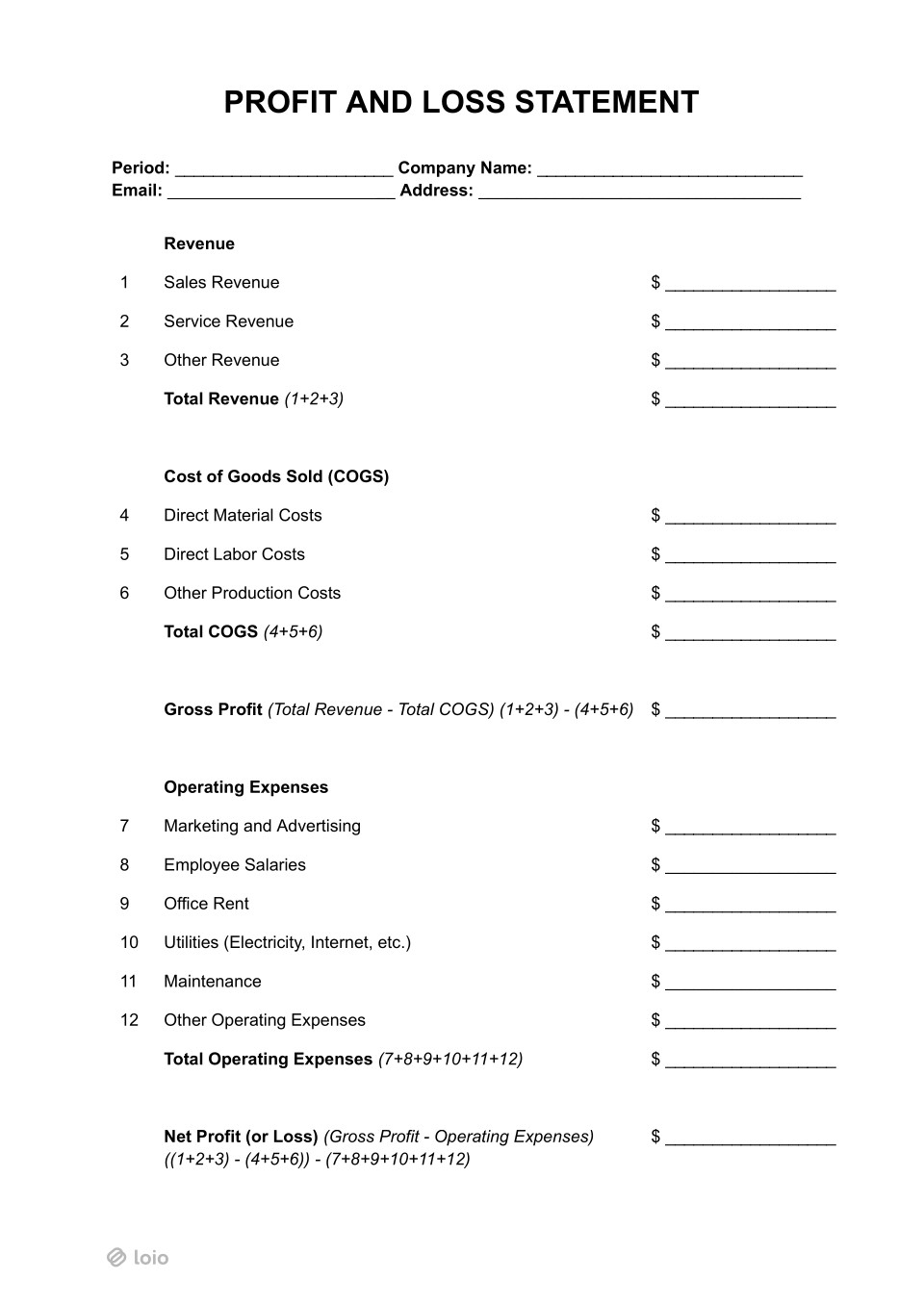
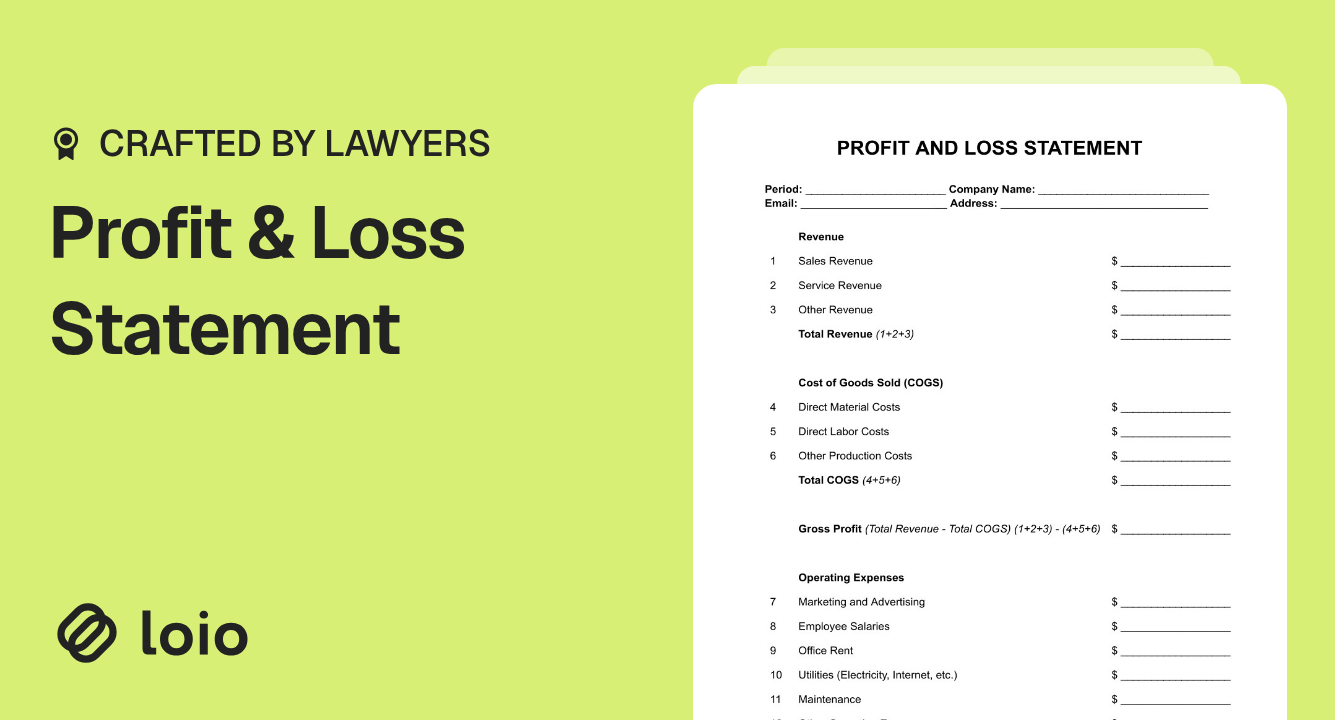
A profit and loss statement, also known as an income statement or statement of financial performance, is a financial document that summarizes your company's revenue and expenses over a given period (a month, quarter, or fiscal year). It measures how much money your business earns and spends, showing whether you made a net profit or incurred a loss.
This statement shows a clear picture of your financial performance by organizing your income and expenses into categories that reveal how efficiently your business operates. A well-prepared profit and loss statement template helps you monitor profitability, plan budgets, and make informed financial decisions.
There are two common types of profit and loss statements:
A single-step profit and loss statement groups all income and expenses together and uses a simple formula: Revenue – Total Expenses = Net Income. It's perfect for small business owners who want to quickly assess their financial health.
A multi-step profit and loss statement separates the cost of goods sold (COGS) and operating expenses from other business expenses to show gross profit, operating income, and net income separately. This structure allows you to analyze profitability at different levels of your operations and identify opportunities to grow your business.
Every business has to prepare a well-drafted profit and loss template. This document helps companies to look at past performance and make wise decisions about the future. Plus, with the help of a sample profit and loss statement, one can share financial information with stakeholders, which is essential for:
Securing loans. Banks and financial institutions often request this document when a business applies for a loan to assess financial stability.
Attracting investors. Potential investors look at the P&L statement to gauge the company’s profitability and growth potential.
Tax assessment. Governments require businesses to submit a profit and loss statement for accurate tax evaluation.
Understanding each element of your profit and loss statement helps ensure that your financial report is accurate and easy to interpret.
Revenue is the total money your company earns from selling goods or services. It's the top line of your profit and loss statement and forms the foundation for all further calculations. Tracking revenue regularly, such as quarterly, helps business owners identify growth trends and make smarter pricing decisions.
Cost of goods sold (COGS) refers to the direct costs needed to produce your products or services, including raw materials, labor, and manufacturing overhead. Correctly recording the cost of goods allows you to calculate your gross profit accurately and maintain control over your business expenses.
Gross profit = Revenue – Cost of Goods Sold. It shows how efficiently your company produces and delivers its products or services. A higher gross profit indicates that you're generating strong returns relative to your production costs — a key measure of profitability for both small businesses and large companies alike.
Operating expenses include day-to-day business expenses that keep the company running but aren't tied directly to production. These may include:
Summing your total expenses helps reveal the full cost of all your business operations.
Net income or net profit represents your bottom line — the result after you subtract all costs, including operating expenses, interest, and taxes, from gross profit. It's the final indicator of your profitability. If your revenues exceed your total business expenses, you have a net profit; if not, it's a net loss. Recording net income consistently helps you prepare accurate financial statements, tax filings, and investor reports.
A profit and loss statement serves multiple stakeholders:
Business owners: Use the P&L template to monitor financial performance and shape strategies that grow your business.
Accountants: Ensure that every expense and invoice is recorded properly for reporting accuracy.
Investors: Evaluate profitability and potential returns before funding.
Lenders: Review the financial statement to assess creditworthiness and lending risk.
Tax authorities: Verify declared income and expenses for compliance purposes.
You can easily create a profit and loss statement using the Loio template. Follow these steps:
Gather your financial data.
Collect all invoices, receipts, and transaction records from your fiscal year or reporting period.
Enter revenue.
Add the information about your total sales from all products or services.
Calculate and enter COGS.
Sum your cost of goods sold to determine how much it costs to produce what you sell.
List and sum operating expenses.
Add up all recurring business expenses, including rent, payroll, and marketing.
Calculate the final profit or loss.
Subtract your total expenses (including COGS and operating expenses) from your total revenue. The remaining balance represents your net income or loss for that given period.
By following these steps, business owners can prepare a clear and reliable financial report that accurately reflects their company's profitability and financial health.
While a profit and loss statement provides a detailed view of your income and expenses, additional records offer deeper insight into your company's overall finances:
Yes. You can easily use Loio's profit and loss statement template to organize your income and expenses without hiring an accountant.
EBITDA (Earnings Before Interest, Taxes, Depreciation, and Amortization) adds back non-cash expenses to operating income, showing your cash-based profitability.