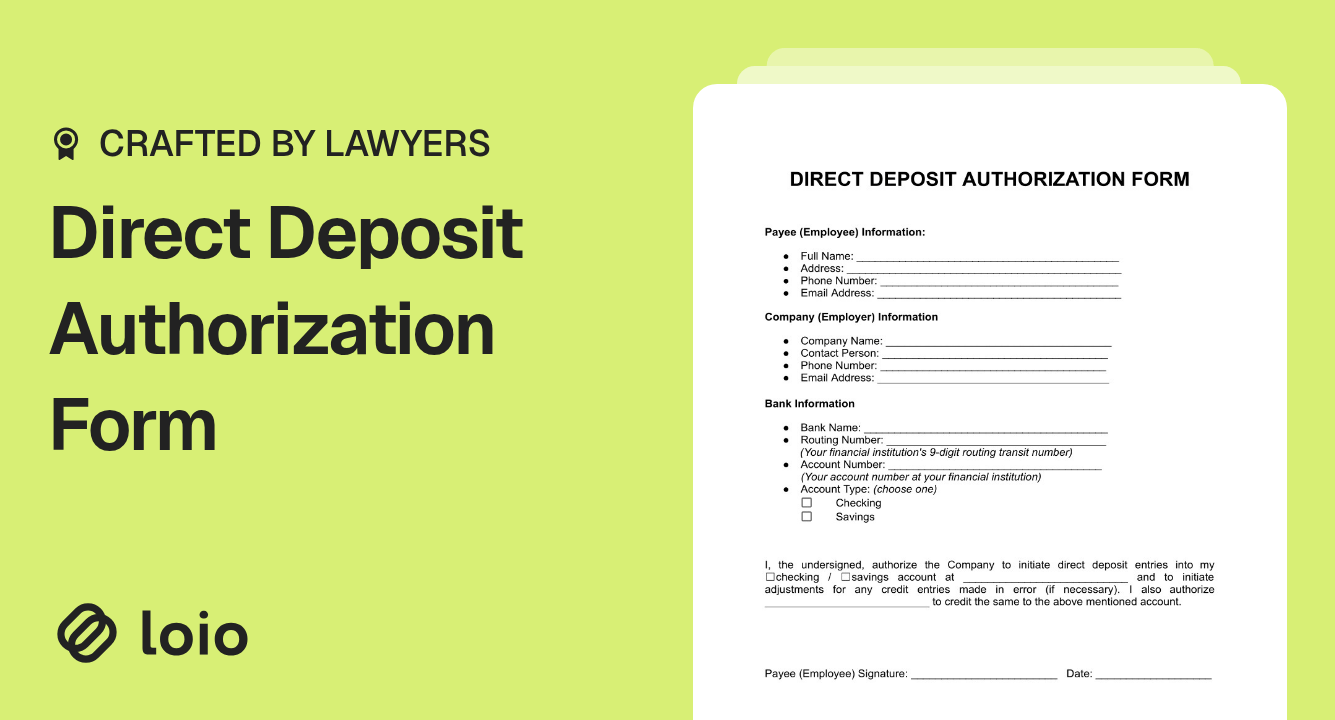
A direct deposit authorization form is a banking document between an employer and an employee that allows salary payments to be sent directly to a bank account. It is used by companies to streamline payroll processes and by employees to receive their wages securely and on time.
A direct deposit authorization form is a document employees complete to authorize their employer to send paychecks electronically to a bank account. It is also called a direct deposit form or an employee direct deposit form.
Instead of issuing paper checks, employers use the Automated Clearing House (ACH) network to transfer funds directly to an employee’s checking or savings account. Direct deposit forms collect banking details, such as the routing number and account number, along with personal information needed for payroll processing.
Accurate information on a direct deposit form template is important for compliance with payroll and tax rules in the United States. Employers rely on details like the employee’s Social Security number (SSN) and the company’s Employer Identification Number (EIN) to properly report income tax withholding, Federal Insurance Contributions Act (FICA) deductions for Social Security and Medicare, and other paycheck deductions.
Employee information: Includes the employee’s full legal name, address, contact details, and Social Security Number (SSN) to ensure accurate identification, payroll processing, and tax reporting.
Employer information: Lists the employer’s legal business name and Employer Identification Number (EIN) to identify the company responsible for wage payment and income tax withholding.
Bank information: Contains the bank name, routing number, account number, account type, and deposit instructions, which are required to process ACH direct deposits correctly.
What Are the Key Terms of the Direct Deposit Authorization Form?
Add the employee’s home address and contact information.
Provide the employee’s Social Security number for payroll reporting.
Enter the employer’s legal business name.
Add the employer’s Employer Identification Number (EIN).
Write the name of the employee’s bank or credit union.
Enter the bank’s nine-digit routing number.
Provide the employee’s bank account number.
Select the account type (checking or savings).
Indicate whether the deposit is for the full paycheck, a specific amount, or a percentage.
Attach a voided check (if required by the employer).
Sign and date the employee direct deposit form.
Requirements for this document vary by state. Review your state's laws and procedures — or consult a licensed attorney — before using this template to ensure it's valid and enforceable where you live.