Free template
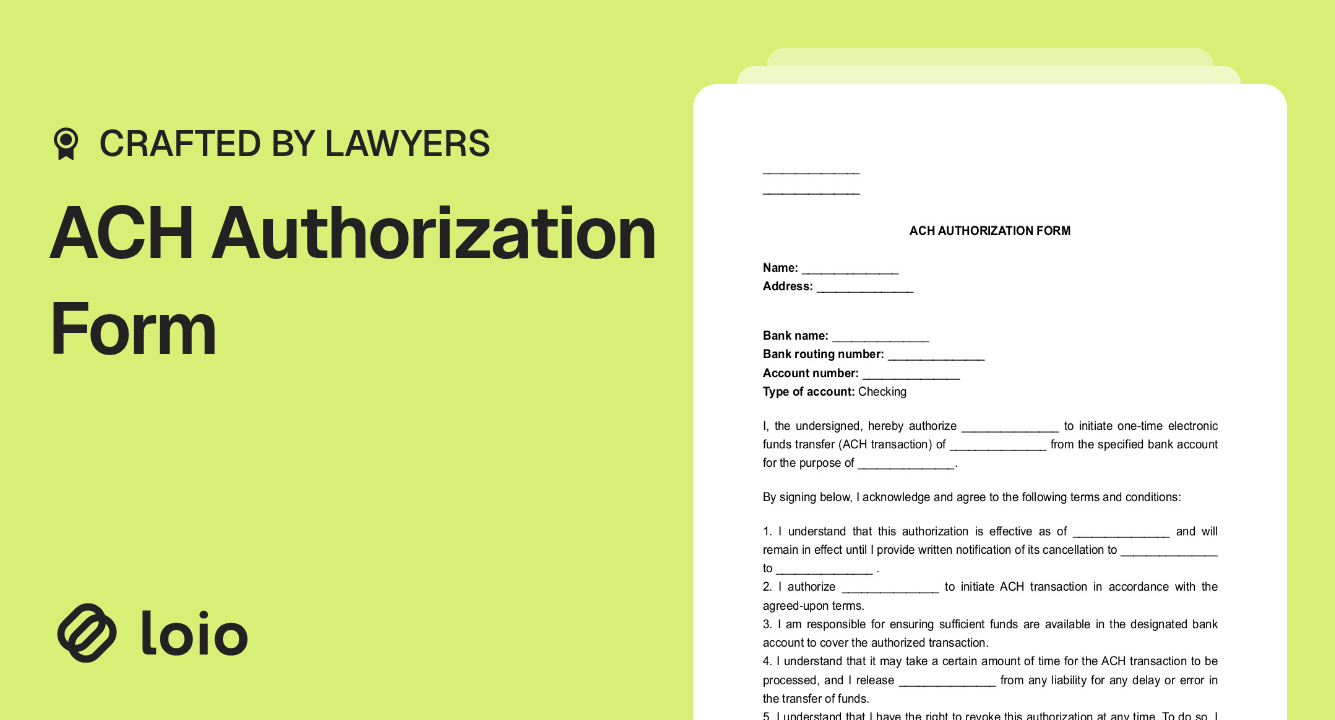
Free ACH Authorization Form Template

Template Types
What Is an ACH Authorization Form?
Copy section linkAn ACH authorization form is a written permission form that allows a business, organization, or service provider to electronically transfer money to or from a person’s bank account through the Automated Clearing House network. It is commonly used for recurring payments, one-time bank transfers, payroll deposits, membership fees, rent payments, loan payments, and subscription billing.
The ACH authorization form template confirms that the account holder agrees to the ACH payment terms before any electronic funds transfer is processed. It usually includes the account holder’s name, bank account details, routing number, payment amount or payment schedule, authorization type, and signature.
When to Use an ACH Authorization Form
Copy section linkAn ACH form template is used when one party needs clear permission to send or receive money through an electronic bank transfer. Businesses, landlords, lenders, employers, nonprofits, and service providers often use an ACH authorization form to make payments more predictable and easier to document. The form can apply to either ACH debit transactions, where money is withdrawn from an account, or ACH credit transactions, where money is deposited into an account.
Use an ACH authorization form when:
A business needs permission to withdraw recurring payments from a customer’s bank account;
A company wants to set up direct deposit for employee wages, reimbursements, or contractor payments;
A landlord collects rent payments through automatic bank transfers;
A lender receives scheduled loan payments directly from a borrower’s bank account;
A subscription-based business charges customers on a monthly or annual basis;
A nonprofit collects recurring donations from supporters through ACH payments;
A service provider receives one-time payment authorization from a client;
A company needs written proof that the account holder approved an electronic funds transfer.
A company needs written proof that the account holder approved an electronic funds transfer.
If the parties need to document the full terms of a loan, use a Loan Agreement instead;
If the payment is connected to buying or selling goods or services, use a Sales Agreement or Service Agreement;
If an employer is hiring a worker and needs to define job terms, use an Employment Contract;
If the payment is being made by check, wire transfer, card, or cash without ACH processing, an ACH authorization form may not be necessary;
If the account holder has not clearly agreed to the transfer terms, do not process ACH payments without proper authorization.
Before using the form, make sure the payment amount, frequency, bank account details, cancellation process, and authorization language are clear. This helps both sides understand what was approved and reduces the risk of payment disputes, failed transfers, or unauthorized transaction claims.
Parties to the ACH Authorization Form
Copy section linkAccount holder: The person or business that owns the bank account and gives permission for ACH transfers.
Payee or company: The business, organization, lender, landlord, employer, or service provider authorized to debit or credit the account.
Financial institution: The bank or credit union that holds the account and processes the ACH transaction through the banking network.
Authorized representative: A person who signs on behalf of a business account holder or company, if the account is owned by an organization.
Payment processor: A third-party provider that may help submit, manage, or process ACH transactions for the payee.
What to Include in an ACH Authorization Form
Copy section linkAn ACH payment authorization form should clearly explain who is authorizing the transfer, which bank account will be used, and what type of payment is being approved. Since ACH payments involve direct access to a bank account, the form should leave no confusion about the payment amount, schedule, start date, and the account holder’s consent.
The main sections of an ACH authorization form usually include:
Account holder information: Identifies the person or business giving permission to transfer funds from or to a bank account.
Company or payee information: Names the business, organization, landlord, lender, employer, or service provider authorized to process the ACH transaction.
Bank name: Identifies the financial institution where the account is held.
Routing number: Provides the bank’s routing details so the ACH transfer can be sent through the correct financial institution.
Account number: Identifies the specific bank account that will be debited or credited.
Account type: States whether the transfer applies to a checking account or a savings account.
Transaction type: Clarifies whether the authorization is for an ACH debit, ACH credit, or both.
Payment amount: States the exact amount to be transferred or explains how variable payment amounts will be determined.
Payment frequency: Shows whether the transfer is one-time, weekly, monthly, recurring, or scheduled according to another payment plan.
Payment start date: Identifies when the ACH authorization begins and when the first transfer may occur.
Recurring payment terms: Explains how often automatic payments will continue and whether they end on a specific date or continue until canceled.
Authorization statement: Confirms that the account holder gives permission for the listed ACH transfers.
Cancellation or revocation terms: Explains how the account holder can cancel the ACH authorization and how much notice may be required.
Key Terms of the ACH Authorization Template
Copy section linkACH: The Automated Clearing House network, an electronic system used to move money between U.S. bank accounts.
NACHA: The organization that manages the rules and standards for ACH payments in the United States.
Routing number: A nine-digit bank identification number used to route an ACH payment to the correct financial institution.
ACH authorization: The account holder’s permission allowing a company, organization, or financial institution to initiate an ACH transaction.
Debit entry: An ACH transaction that withdraws money from the account holder’s bank account.
Credit entry: An ACH transaction that deposits money into the account holder’s bank account.
Revocation: The account holder’s cancellation of ACH authorization, usually by giving notice according to the form’s terms.
R-codes: Return codes used in ACH processing to explain why a transaction was rejected, returned, or could not be completed.
How to Fill Out an ACH Authorization Form
Copy section linkLoio’s interactive system can help you complete an ACH payment form template step by step. You can answer simple questions, enter the required bank and payment details, and then review the completed document before downloading or signing it.
Enter the account holder’s details: Add the full legal name, mailing address, phone number, and email of the person or business authorizing the ACH transfer.
Add bank information: Enter the bank name, routing number, account number, and whether the account is checking or savings.
Identify the authorized company: Add the name of the business, landlord, lender, employer, or service provider that may initiate the ACH transaction.
Choose the transaction type: State whether the form authorizes an ACH debit, ACH credit, or both.
Add the payment amount: Enter the fixed amount or explain how variable payment amounts will be calculated.
Set the payment schedule: Specify whether the payment is one-time, recurring, monthly, weekly, or based on another agreed schedule.
Write the authorization statement: Confirm that the account holder allows the listed party to initiate the ACH transaction using the provided bank account.
Add the effective date: State when the authorization begins and when the first transfer may be processed.
Include cancellation terms: Explain how the account holder can revoke authorization and how much advance written notice is required.
Review standard terms: Confirm responsibility for sufficient funds, processing delays, returned payments, and any agreed payment conditions.
Sources
Related documents
Also read