Blank Affidavit Form Template

4.6 (115 reviews)
All states | 16 types
Updated Aug 7, 2025
~ 2 pages
PDF
3.4K downloads
An Affidavit is a sworn written statement between a declarant and an authorized officer, such as a notary public, confirming facts under oath. It is used by individuals in legal, financial, or personal matters to provide verified statements of truth.
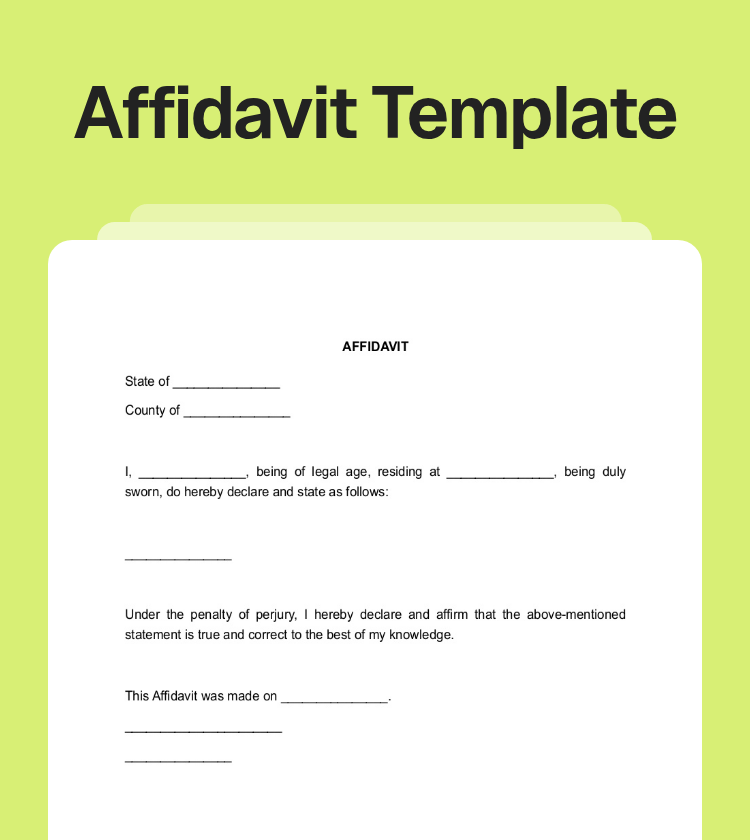
AFFIDAVIT

State of  

County of  


I,  , being of legal age, residing at  , being duly sworn, do hereby declare and state as follows:


Under the penalty of perjury, I hereby declare and affirm that the above-mentioned statement is true and correct to the best of my knowledge.


This Affidavit was made on  .

______________________


NOTARY ACKNOWLEDGMENT 


State of  

Acting in the county of  


Sworn to and subscribed before me on ___________________________.


___________________________________

Place for signature


______________________________________

Notary public's name and seal

Written by Karyna Pukaniuk - Reviewed by Jonathan McGill

Template Types

Affidavit of Identity
This document verifies the identity of an individual in various legal matters.
Affidavit of Service
This affidavit confirms a notice has been served during a court proceeding.
Certificate of Trust
This form confirms a trust's existence and details its critical elements.
Small Estate Affidavit
This affidavit is used to bypass probate when distributing the decedent's small property.
Affidavit of Survivorship
This legal form helps the surviving owner of jointly owned property claim survivorship.
Affidavit of Domicile
This document proves a person's legal place of residence for tax and inheritance issues.
Affidavit of Ownership
This document attests to the ownership of tangible and intangible assets.
Affidavit of Gift
This affidavit records the transfer of ownership of an item from a donor to the recipient.
Affidavit of Residency
This affidavit verifies the home address of the live person or the decedent.
Affidavit of Heirship
This affidavit identifies rightful heirs and ensures an orderly distribution of assets.
Form I-864
This form proves that a sponsor has sufficient financial means to support an immigrant.
Form 14039
This form is used to report and address tax-related identity theft.
Affidavit of Death
This document is used to declare an individual's end officially for various processes.
Affidavit of Birth
This document is used to provide verified facts regarding the birth of an individual.
Affidavit of Marriage
This affidavit ensures the legal verification of a marital relationship.

What Is an Affidavit Form?

Copy section link

An affidavit is a written statement of fact confirmed by an oath or affirmation. An affidavit is used as testimony in court and other legal proceedings. It serves as a sworn statement, where the person who signs affirms that the included information is true. 

The person making the statement, known as the affiant, must swear that the contents are something they know to be true, based on personal knowledge or belief. To lie on an affidavit is to commit perjury, a serious criminal offense that can result in a criminal charge.

What Are the Key Elements of an Affidavit?

Copy section link

For your affidavit to be valid, it must include several key components. Once you know what they are, putting the document together becomes much easier.

  • Caption: If the affidavit is for a court case, this section includes the court name, district, state, county, and the names of the plaintiff and defendant.

  • Venue: This states the location (State and County) where the affidavit is signed and notarized.

  • Affiant Identification: A statement identifying the affiant (the person who signs), confirming they are of sound mind and are making the statement. The affiant must be at least 18 years old in most jurisdictions.

  • Statement of Facts: This is the core of the affidavit. It should be a numbered list of facts, written clearly and concisely.

  • The Oath & Jurat: The jurat is the clause at the end where the notary public certifies that the document was sworn to and signed in their presence (e.g., "Sworn to and subscribed before me..."). This part often functions as a certificate of authenticity.

  • Signature Blocks: Sections for the affiant’s signature, plus the notary public’s signature and seal.

In family law cases, affidavits are often required to present evidence about children, estate matters, or financial support.

How To Write an Affidavit

Copy section link

Start by going through each step carefully. This will help you prepare your affidavit the right way.

  • Step 1: State the facts clearly
    Write your statement in the first person ("I, [Your Name]..."). Present events chronologically and stick to the facts you personally know. Avoid opinions or speculation.
  • Step 2: Structure your statement
    Use the anatomy above as your guide. Start with the caption (if needed) and venue. Then, list each fact in a separate numbered paragraph.
  • Step 3: Attach supporting documents (exhibits)
    If you reference another person or a document like a contract, license, or receipt, you can attach it as an "Exhibit." Refer to it in your statement (e.g., "A copy of the rental agreement is attached as Exhibit A.").
  • Step 4: Find a notary public (do not sign yet)
    The most critical requirement is that the affidavit needs to be notarized. You must sign the document in front of a notary public. Do not sign it beforehand.
  • Step 5: Sign and swear under oath
    In the notary's presence, you will be asked to swear an oath that the information is true. After taking the oath, you will sign the affidavit. The notary public will then complete their section.
  • Step 6 (Recommended): Seek legal counsel
    Especially for complex court matters, it's wise to have an attorney review your affidavit before you sign to ensure it meets all legal requirements and effectively supports your case. An attorney can also recommend whether an affidavit or an alternative sworn declaration is the best choice for your situation.

What to Consider Before You Sign an Affidavit

Copy section link
Before you sign any affidavit, several considerations are crucial. You must be of sound mind and understand that you are taking a formal oath. Ensure every fact in your statement is accurate, as a false statement constitutes perjury. The affiant could face severe legal consequences, including fines and jail time, for committing perjury.

Always understand the jurisdiction and law under which you sign the affidavit. Consulting with an attorney is highly recommended to ensure your statement complies with all legal standards.

Remember, an affidavit is a powerful sworn statement. Its accuracy is paramount to uphold its purpose in court. Once you submit the affidavit, it becomes part of the official record. Whether you use a free affidavit template you found online, one provided by a court site, or through a document service, the responsibility to provide truthful information remains the same. You must sign it knowing the gravity of your declaration and the potential consequences.

Even if someone helps you prepare it, you — the affiant — are responsible for its content.

Affidavit Preview