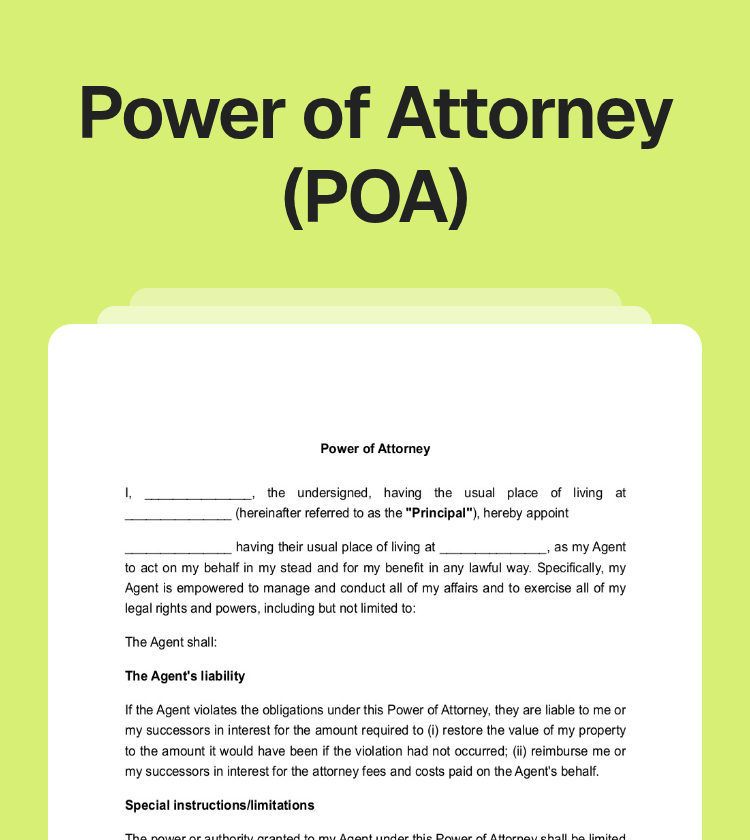
Power of Attorney (POA) Form

Pro template

4.6 (253 reviews)
All states | 7 types
Updated Sep 2, 2025
~ 3 pages
PDF
6.7K downloads
A Power of Attorney is a legal document between a principal and an agent granting authority to act on the principal’s behalf. It is used to manage financial, medical, or legal matters when the principal is unavailable or incapacitated.
Power of Attorney (POA) Page 1
Preview
Written by Megan Thompson, LLB - Reviewed by Jonathan McGill, JD

Template Types

Motor Vehicle Power of Attorney
This form marks the transfer of decision-making powers regarding a particular vehicle.
Revocation of Power of Attorney
This document changes the person in charge for acting on your behalf for legal issues.
Power of Attorney for Child
This document allows parents to give short-term care for their child to another adult.
Durable Power of Attorney (DPA)
This form assigns another person to manage financial and healthcare matters in the long term.
Limited (Special) Power of Attorney
This form is necessary to hand over specific financial or legal tasks on your behalf.
Medical Power of Attorney (MPOA)
MPOA helps principals to assign an entrusted person to make healthcare decisions.

What Is a Power of Attorney (POA)?

Copy section link

A Power of Attorney is a legal document that grants someone (called an agent or attorney-in-fact) the authority to act on behalf of another person (the principal). This authority can range from handling financial transactions and making healthcare decisions to signing contracts and managing property. A POA becomes a critical instrument when the principal is incapacitated, traveling, or simply needs help managing specific responsibilities.

Having a POA in place can help avoid the need for a court-ordered conservatorship, offering a faster, more flexible alternative for managing affairs.

When Is a Power of Attorney Used?

Copy section link

A power of attorney form PDF is useful in many situations, including:

  • Medical emergencies — If a person is unexpectedly hospitalized, having a trusted individual make medical and financial decisions can be crucial.
  • Elderly care — Seniors often use a power of attorney document so that loved ones can manage their affairs if they develop illnesses that impair decision-making.
  • Business purposes — Business owners may assign an employee or partner to manage operations when unavailable.
  • Real estate transactions — If a seller or buyer is unavailable for closing, power of attorney forms can allow a representative to sign contracts.
  • Military deployment — Service members stationed overseas often issue a sample power of attorney to spouses or trusted family members.
  • Long-term travel — If someone stays abroad for an extended period, a power of attorney ensures that financial and legal matters are maintained at home.

How to Write and Customize a Power of Attorney Form

Copy section link

Filling out power of attorney forms correctly is essential to ensure its validity and enforceability. Follow these steps:

Step 1: Identify the principal and agent

  • Write your full name in the "Principal" section.
  • Provide your address under "usual place of living."
  • Write the Agent’s full name in the designated section.
  • Provide the Agent’s address for clarity.

If you need the Agent to manage specific tasks (e.g., financial, legal, or medical decisions), outline them in this section.

Example:

I, Michael Thompson, the undersigned, having the usual place of living at 980 Greenway Drive, Austin, TX, hereby appoint Emily Carter, having their usual place of living at 215 Sunset Boulevard, Miami, FL, as my Agent to act on my behalf.

Step 2: Appoint a successor agent (optional but recommended)

A Successor Agent serves as a backup in case the primary Agent outlined in the general power of attorney form is unable or unwilling to act.

  • Write the full name of the Successor Agent in the appropriate section.
  • Provide their residential address to ensure clarity.

If you do not want to assign a Successor Agent, you may leave this blank.

Example:

If my Agent is unable or unwilling to act for me, I appoint David Ramirez, having their usual place of living at 762 Harbor Lane, Seattle, WA, as my Successor Agent.

Step 3: Define the effective date and termination

It is important to specify when the blank power of attorney form becomes effective and when it ends.

  • Write the starting date when the Agent’s authority begins.
  • Specify when the POA terminates, such as:
    - When the Principal revokes it.
    - If the Principal becomes incapacitated.
    - A specific date (if applicable).
Example:

This Power of Attorney takes effect on March 15, 2024, and shall terminate upon my written revocation or on March 15, 2027.

Step 4: Sign the document

To ensure the general power of attorney form complies with state laws, the governing jurisdiction must be clearly defined.

  • Write the state name that governs the printable power of attorney.
  • Indicate the county and the date of execution.
  • Sign the document as the Principal.
  • Provide your full name and address to certify the document’s validity.
  • Ensure a witness and/or notary signs, if required by state law.
Example:

This Power of Attorney is governed by the laws of the State of Illinois.

Signature: Michael Thompson
Full Name: Michael Thompson
Address: 980 Greenway Drive, Austin, TX
Date: March 15, 2024

Can I Revoke a Power of Attorney?

Copy section link

Yes, a POA can be revoked at any time by the principal as long as they are legally competent. To do so:

  1. Complete a Revocation of Power of Attorney form.
  2. Notify the agent and any institutions relying on the original POA.
  3. Destroy copies of the old POA if applicable.
  4. File the revocation with the county recorder if the original was recorded (common in real estate transactions).
Power of Attorney (POA) Preview