Free template
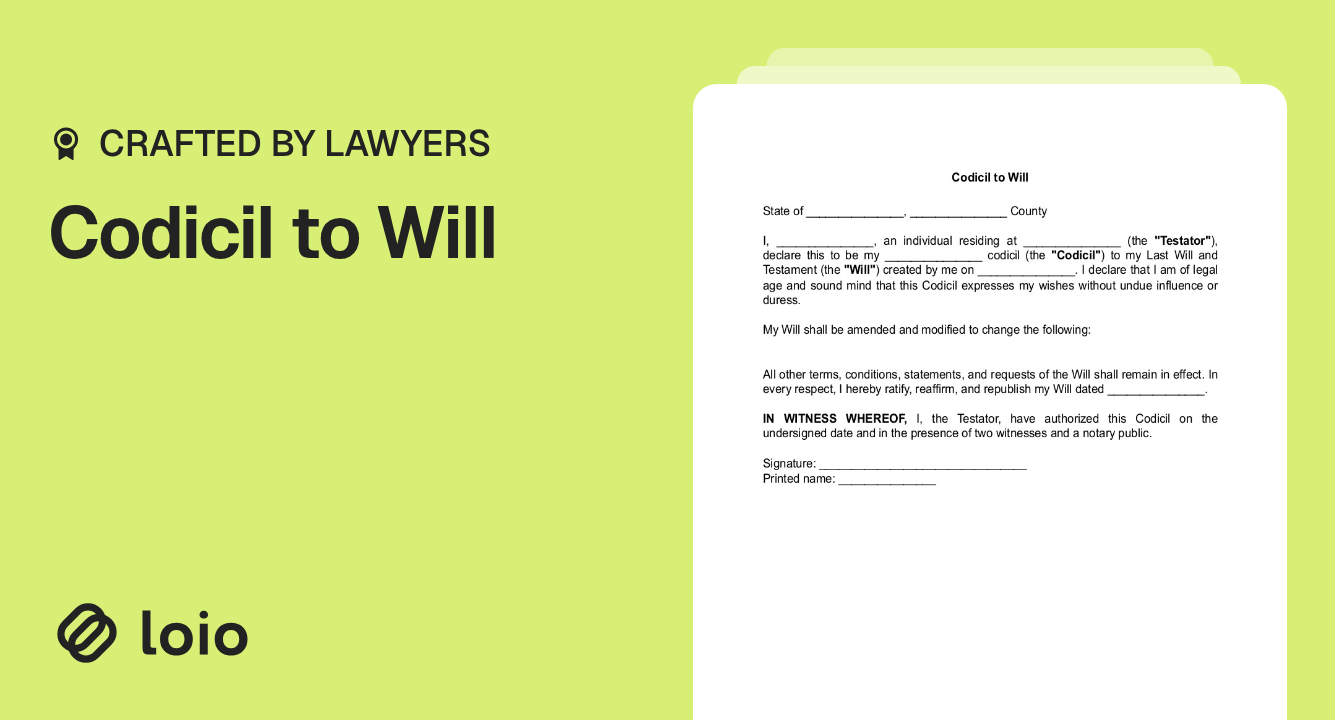
Free Codicil to Will Form

Template Description
Copy section link
A codicil to will, referred to as a codicil, bears considerable importance for individuals preparing to revise their will. This legal document indicates a change in direction — it denotes that the stipulations of the original will have been reconsidered and appropriately altered.
When to Use a Codicil to Will
Copy section linkA codicil form might be necessary whenever original provisions in a will need updating. This can occur due to changes in life circumstances such as marriage, divorce, or the birth of a child, or significant shifts in financial situations, like acquiring or losing substantial assets. A codicil to will form serves as a legal affirmation that the original will's terms have evolved, modifying the anticipations regarding the distribution of the estate to reflect the current scenario.
Parties
Copy section link-
Testator — This is the individual or entity who initially prepared the will. It is this individual or entity's responsibility to maintain the will current and valid according to their evolving circumstances. Once they decide to make any alterations in the will, a codicil is drafted. This document represents that the testator has intentionally revised their original will, initiating an addendum to the will form as part of their official testamentary dispositions.
-
Witnesses — These are the individuals, usually two in number, who preside over the signing of the will codicil form. In the process of executing the codicil, the witnesses are responsible for authenticating that the testator was in a sound state of mind and willingly made the changes to their will. Upon doing so, the witnesses sign the blank codicil form, confirming their presence during its execution. Their signatures lend added legal credibility to the document.
Key Terms
Copy section link- Beneficiary: The person or entity that will receive an asset, property, or benefit from the testator.
- Estate: All of the testator's property, including physical belongings, real estate, and monetary assets.
- Executor: The person appointed by the testator to carry out the instructions in the will.
How to Write a Codicil to Will
Copy section linkDrafting a codicil to your will doesn't have to be a daunting task. With a proper understanding of relevant clauses and key terms, you can confidently and precisely amend your will as per your evolving needs. Easy-to-use resources such as a codicil to will template can provide the structured framework that simplifies this process. Here are the steps you should follow:
Identify the will:
Begin your amendment to the will form by referring to the original will using your full name and the exact date when the will was created. A sample codicil to a will might provide a model to follow.Declare the intent:
It's essential to state that you mean to make changes to your will through the codicil. The codicil examples could help guide you through properly phrasing your intentions.Detail the changes:
Next, describe what changes are being made. This could involve adding, deleting, or replacing sections within the will. Here, viewing a codicil template could help you better understand how such changes could be outlined.Reference the remainder of the will:
After describing the changes, assert that the remainder of the will stays intact, barring the changes you've outlined.Signature and date:
At the end of the document, you must sign and date the codicil similarly to how you did the original will, indicating that you agree with the applied modifications.Attestation by witnesses:
Finally, have the document attested by at least two witnesses, just as you did for the original will. These witnesses confirm that you have created this codicil willingly while in a sound frame of mind. They will then sign and date the codicil.
In conclusion, using a codicil to will proves advantageous for implementing amendments to one's existing will without needing to revise the entire document. This practice presents an efficient and practical method, facilitating the defense of your assets while also ensuring the accurate allocation of your estate amongst the intended beneficiaries. Utilizing a free printable codicil to will is an excellent starting point for making precise adjustments tailored to your evolving circumstances.
While a codicil template PDF helps to streamline the process by providing a clear structure to follow, it is crucial to engage with a legal professional for consultation. This step assures that the codicil accurately reflects your intentions, stands up to legal scrutiny, and abides by all the relevant legal standards and conditions in your jurisdiction, securing your best interests in the long run.
Related documents
Also read