Revocable Living Trust Forms

4.6 (58 reviews)
All states | 2 types
Updated Apr 18, 2025
~ 8 pages
PDF
2.8K downloads
A Living Trust Form is a legal document between a grantor and a trustee that outlines how assets will be managed and distributed during and after the grantor’s life. It is used to avoid probate, protect privacy, and ensure a smooth asset transfer to beneficiaries.
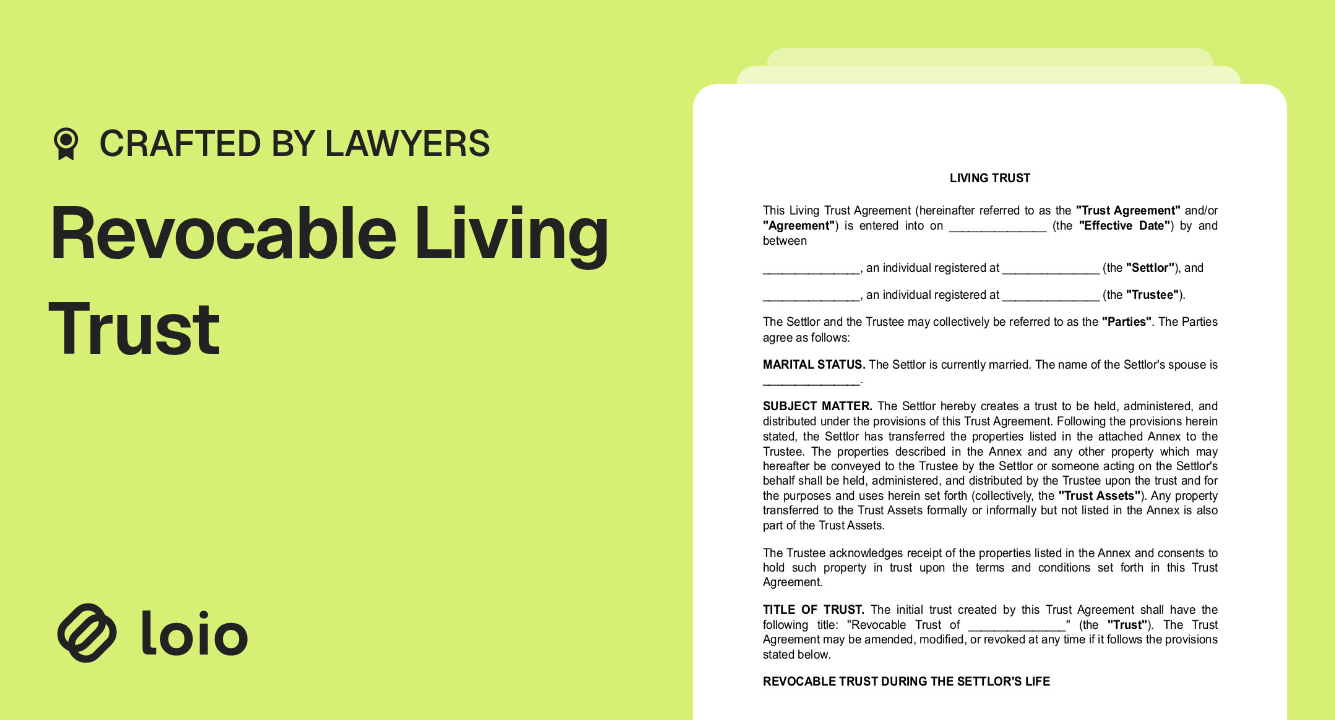
LIVING TRUST

This Living Trust Agreement (hereinafter referred to as the "Trust Agreement" and/or "Agreement") is entered into on   (the "Effective Date") by and between

 , an individual registered at   (the "Settlor"), and

 , an individual registered at   (the "Trustee").

The Settlor and the Trustee may collectively be referred to as the "Parties". The Parties agree as follows:

MARITAL STATUS. The Settlor is currently married. The name of the Settlor's spouse is  

SUBJECT MATTER. The Settlor hereby creates a trust to be held, administered, and distributed under the provisions of this Trust Agreement. Following the provisions herein stated, the Settlor has transferred the properties listed in the attached Annex to the Trustee. The properties described in the Annex and any other property which may hereafter be conveyed to the Trustee by the Settlor or someone acting on the Settlor's behalf shall be held, administered, and distributed by the Trustee upon the trust and for the purposes and uses herein set forth (collectively, the "Trust Assets"). Any property transferred to the Trust Assets formally or informally but not listed in the Annex is also part of the Trust Assets.

The Trustee acknowledges receipt of the properties listed in the Annex and consents to hold such property in trust upon the terms and conditions set forth in this Trust Agreement.

TITLE OF TRUST. The initial trust created by this Trust Agreement shall have the following title: "Revocable Trust of  " (the "Trust"). The Trust Agreement may be amended, modified, or revoked at any time if it follows the provisions stated below.

REVOCABLE TRUST DURING THE SETTLOR'S LIFE

  • Revocability by the Settlor. Unless the Settlor is incapacitated, the Settlor has the power to alter, amend, modify, terminate, or revoke this Trust Agreement during the Settlor's lifetime by duly acknowledged written instrument, provided that no such alteration, amendment, modification, or restatement shall in any manner increase the duties and responsibilities of the Trustee in office without such Trustee's consent. Unless the Settlor acts as the sole Trustee, the Settlor must provide notice of any such alteration, amendment, modification, restatement, revocation, or termination to the Trustee following the procedure stated in the section "Notice" of the article "Administrative Procedures" under this Trust Agreement. Notwithstanding, this Trust Agreement shall become irrevocable and may not be altered, amended, modified, or revoked upon the Settlor's death.

  • Distributions during the Settlor's lifetime. During the lifetime of the Settlor, the Trustee shall hold, manage, sell, exchange, invest, and reinvest the Trust property, collect all income, and, following the deduction of appropriate expenses, accumulate and distribute the income and principal as outlined in this Agreement.

The Trustee shall distribute the income and principal of the Trust to the Settlor in such amounts as the Settlor may direct at any time. All undistributed trust income shall be accumulated and added to the principal. If the Settlor becomes incapacitated, the Trustee shall allocate the income and principal of the Trust for the comfort, health, support, maintenance, or other needs of the Settlor as the Trustee shall determine to be necessary or appropriate to maintain the Settlor's standard of living at the time of the execution of this Trust Agreement. The Trustee has the discretion to determine the appropriate amount necessary to maintain the Settlor's accustomed way of living. Incapacity shall be defined as the inability to manage one's personal and financial affairs due to mental or physical conditions. The determination of incapacity shall be certified by either a court of competent jurisdiction or two physicians licensed to practice medicine in the state where the Settlor resides at the time of the certification. One of the two physicians should be board-certified in the specialty most closely associated with the cause of the Settlor's incapacity. The Settlor shall be deemed to have regained capacity upon a determination by a court of competent jurisdiction or two licensed physicians confirming the Settlor's ability to manage personal and financial affairs.

  • Additions following the Settlor's death. Following the Settlor's death, the Trustee shall add all of the Settlor's properties to the Trust that are payable to the Trustee. These properties shall include but shall not be limited to any payments from an employee or self-employed benefit plan, an individual retirement account or annuity, or any proceeds of any insurance policy on the Settlor's life.

  • Termination. The Trust created by this Trust Agreement shall terminate upon the death of the Settlor, and the Trust property shall be distributed as provided in the succeeding provisions of this Trust Agreement.

DISTRIBUTION UPON TERMINATION. The Trustee shall make the following distributions upon the death of the Settlor:

  • Gifts at death. The Trustee shall make the following distributions before the payments outlined in the "Remainder" section of this Agreement.

The Trustee shall distribute to    . However, this gift shall lapse if   fails to survive the Settlor.

Unless otherwise provided as a specific gift elsewhere in this Trust Agreement, the Trustee shall distribute, outright and free of the Trust, all tangible personal property of use or classification to the Settlor's descendants who survive the Settlor per stirpes, with particular items to be allocated based on mutual agreement among the beneficiaries; however, in the event of disagreement, the Trustee retains sole discretion to make determinations. If any beneficiary hereunder is a minor, the Trustee may distribute the minor's share to the minor or to the minor's parents, guardians, or any individual currently residing with or having the care or control of the minor. The receipt of the person to whom the minor's share is distributed shall be a complete discharge of the Trustee. The expenses incurred in packing and shipping such property to beneficiaries shall be considered administration expenses charged against the Trust property.

If any pets are owned by the Settlor, the Settlor's descendants who survive the Settlor per stirpes are unable to perform their duties by providing necessary care for the Settlor's pet(s), the Trustee shall appoint an individual or organization to assume the caregiving responsibilities for the pet(s).

  • Payment of taxes. Following the Settlor's death, all estate, inheritance, or similar taxes related to the death of the Settlor for any property included in the Settlor's gross estate to calculate such taxes, whether or not such property passes under this Trust Agreement, under the Settlor's will, or otherwise, shall be paid from the remaining Trust Assets without apportionment.

To the extent the remaining Trust Assets are insufficient to pay such taxes, any excess taxes, except otherwise specifically provided in this section, shall be paid on a pro-rata basis from all the assets passing because of the Settlor's death.

Notwithstanding the foregoing, no portion of such taxes shall be allocated or charged to property fully eligible for the charitable deduction for federal estate tax purposes. However, if the assets passing due to the Settlor's death that do not qualify for the charitable deduction are insufficient to cover such taxes, any excess taxes shall be paid on a pro-rata basis from the assets that qualify for the charitable deduction.

  • Payment of debts. In the Trustee's discretion, the Trustee may pay from the Trust property all or any part of the Settlor's funeral expenses, any legal claims against the Settlor's estate, and other reasonable expenses involved in administering the Settlor's estate. Such payments shall be made before the distributions provided in the "Remainder" section of this Agreement. 

The Trustee may make such payments directly or transfer the respective amounts to a duly qualified executor, personal representative, or administrator of the Settlor's estate. Written statements by the executor, personal representative, or administrator of the Settlor's estate of the sums paid under this section shall be sufficient evidence of their amounts, and the Trustee is not obligated to confirm that such payments were appropriately applied. Unless otherwise stated in this Trust Agreement, if any of the Settlor's property carries a mortgage, lien, or other debt upon the Settlor's death, the Settlor directs that the devisee of such property shall accept it subject to the existing mortgage, lien, or other debt. Furthermore, such a person shall not be entitled to seek payment of that obligation from the Settlor's general estate.

  • Remainder. The Trustee shall distribute the remaining income and principal of the Trust to the Settlor's descendants who survive the Settlor per stirpes. If none of the Settlor's descendants survive the Settlor, all the remaining income and principal of the Trust shall be distributed to the Settlor's heirs.

  • Spendthrift provisions. The interest of any beneficiary in any portion of the Trust, encompassing both principal and income, shall not be assigned, attached, transferred, paid by way of anticipation, or in compliance with any order, assignment, or covenant, and shall not be applied to or held liable for any of the debts or obligations of the beneficiary, either in law or equity. This interest cannot be passed on to any assignee or trustee under any instrument or insolvency or bankruptcy law and shall not be subject to the interference or control of creditors, spouses, or others. Nothing in this Agreement shall impede the exercising of any power of appointment granted herein.

TRUSTEE PROVISIONS

  • Additional and successor Trustees. In the event of the Settlor's death or incapacity, the Trustee shall be authorized to notify the other acting Trustee(s) or the beneficiaries of such Trust following the procedure outlined in the "Notice" section of the "Administrative Procedures" clause in this Trust Agreement. This notice shall serve to designate an individual or corporation as an additional or successor Trustee for the Trust.

In case there is no appointed or acting Trustee of any Trust established under this document after the Settlor's death or incapacity, the majority of adult beneficiaries of the Trust shall have the power to appoint a successor Trustee by acknowledged written instrument. If there are no adult beneficiaries or a majority of the adult beneficiaries cannot come to an agreement, a court of competent jurisdiction shall appoint a successor Trustee.

If a beneficiary of the Trust is to be appointed as the Trustee, legal or tax counsel should first be consulted concerning any possible income, gift, or estate tax consequences to such beneficiary under the existing law. However, as long as one Trustee is serving hereunder, no vacancy shall be deemed to exist in the office of the Trustee.

Any individual serving as the Trustee has the authority to appoint another person or a corporate Trustee to serve as a co-trustee, but only during the period that such individual serves as the Trustee. The Trustee has the right to remove the appointed co-trustee from their position, with or without cause, by providing written notice mailed or delivered to the designated co-trustee.

  • Expenses and commissions. Each Trustee shall be reimbursed for reasonable costs and expenses related to their duties. The alternate and successor Trustees, including any Corporate Fiduciary, shall be entitled to fair and reasonable compensation for services rendered by the Trustee in an amount not exceeding the customary and prevailing charges for services of a similar character at the time and place where such services are performed.

ADMINISTRATIVE PROCEDURES

  • Survivorship. No person shall be deemed to have survived the Settlor if such a person dies within   days after the Settlor's death. Any person prohibited by law from inheriting property from the Settlor shall be treated as having failed to survive the Settlor.

  • Notice. Any notice required or permitted to be given under the terms of this Agreement must be provided by a written and acknowledged instrument delivered to the person to whom it is required or permitted to be given.

  • Property, books of account, and records. All properties, books of account, and records of any Trust created under this Agreement shall be made available for inspection during regular business hours to the Settlor or any person designated by the Settlor. At any time before the Settlor's death, the Trustee shall provide a current account showing receipts, disbursements, and inventory of the Trust Assets to the Settlor upon request.

  • Reliance on legal opinion. In making decisions, each Trustee may rely on the written opinion of a competent attorney who is licensed and in good standing in the relevant jurisdiction where the subject matter of any opinion is sought. The Trustee may also rely on any facts stated in any instrument, furnished in writing and believed to be true, or any other evidence deemed sufficient. Each Trustee shall be indemnified and further held harmless from any liability for any action taken or failure to take any action if done in good faith and without gross negligence.

THE TRUSTEE'S POWERS

Powers. Each Trustee shall have and possess the following powers and authorities regarding this Trust Agreement:

Statutory and common law powers. In addition to the powers expressly granted to each Trustee as outlined in this Agreement, each Trustee shall be empowered with all powers and authorities provided by statute or common law in any jurisdiction in which the Trustee operates, including all powers and authorities conferred by the local statutes that govern the subject matter hereof and by any future amendments thereto, except in cases where such powers and authorities may conflict with the express provisions of this Trust Agreement, in which case the express provisions of this Trust Agreement shall prevail.

GOVERNING LAW. All issues and proceedings regarding the construction, validity, and administration of any Trust created under this Agreement shall be controlled by the laws of the State of  .

IN WITNESS WHEREOF, the Parties have executed this Agreement on the dates set forth first above, with full knowledge of its content and significance, and intend to be legally bound by the terms hereof.


                    THE SETTLOR                                              THE TRUSTEE

_________________________________   _________________________________

(Place for signature)                                         (Place for signature)


NOTARY ACKNOWLEDGMENT


State of  

Acting in the county of  


Sworn to and subscribed before me on ___________________________.


___________________________________

Place for signature


______________________________________

Notary public's name and seal

ANNEX INITIAL TRUST PROPERTY 


Written by Megan Thompson - Reviewed by Jonathan McGill

Template Types

Trust Amendment Form
This form is used to add or subtract provisions or modify the terms of a living trust.

Template Description

Copy section link
Paper titled "Living Trust (Revocable)"; man holding a folder; woman writing in the notebook

Making sure your money and land go to the right people after you die with a living trust form is smart. This way, you don't have to go through the long and expensive court process called probate. In the long run, it helps your family and lets you keep control of your assets while you're still living. 

When To Use a Living Trust Template

Copy section link

A sample living trust lets you clearly decide who gets what, and it keeps everything private. Since it’s a revocable trust, you can change or cancel it anytime if your life or plans change. It gives you control now and peace of mind for the future.

Use the living trust sample PDF when:

  • You want to avoid probate and make things easier for your family after your death;
  • You own real estate in more than one state;
  • You have valuable assets you want to pass down smoothly (like a house, business, or investments);
  • You want to keep your estate matters private (unlike a will, which becomes public);
  • You have minor children or dependents and want to manage how they receive assets;
  • You’d like to name someone to manage your assets if you become sick or unable to handle them;
  • You want flexibility to change or cancel the trust later if your life situation changes;
  • You’re planning for the long-term care of a loved one with special needs.

How To Fill Out a Living Trust Document

Copy section link

1. Add the names of the people involved

free printable living trust forms

Start by filling in the names and addresses of the person creating the revocable living trust template (the Settlor) and the person who will manage the trust (the Trustee).

Example:

This Living Trust Agreement is entered into on April 10, 2025 (the “Effective Date”) by and between James Monroe, an individual registered at 123 Hilltop Rd, Denver, CO 80205 (the “Settlor”), and Emily Greene, an individual registered at 456 Elm St, Denver, CO 80210 (the “Trustee”).

2. Include marital status

setting up a revocable trust

State whether the Settlor is married and, if so, include their spouse's name.

Example:

Marital Status. The Settlor is currently married. The name of the Settlor’s spouse is Margaret Monroe.

3. Give the trust a name

creating a revocable trust

This is the official name of the trust that will be used in legal documents.

Example:

Title of Trust. The initial trust created by this Trust Agreement shall have the following title: "Revocable Trust of James Monroe."

4. Decide what happens after the settlor passes

creating a revocable living trust

Specify who gets what after the Settlor dies. These are called “gifts at death” in the living trust sample.

Example:

The Trustee shall distribute to Michael Monroe $10,000. However, this gift shall lapse if Michael Monroe fails to survive the Settlor.

5. Fill out survivorship rules

sample living trust

This section of the living revocable trust form explains who qualifies to receive property from the trust and how long they must survive the Settlor.

Example:

Survivorship. No person shall be deemed to have survived the Settlor if such a person dies within 30 days after the Settlor’s death.

These are just a few key parts of the revocable trust form, but Loio makes the rest easy, too. The online living trust walks you through everything step-by-step, and you can even fill it out as a PDF or sign it digitally with Loio Sign.

Revocable Living Trust Preview