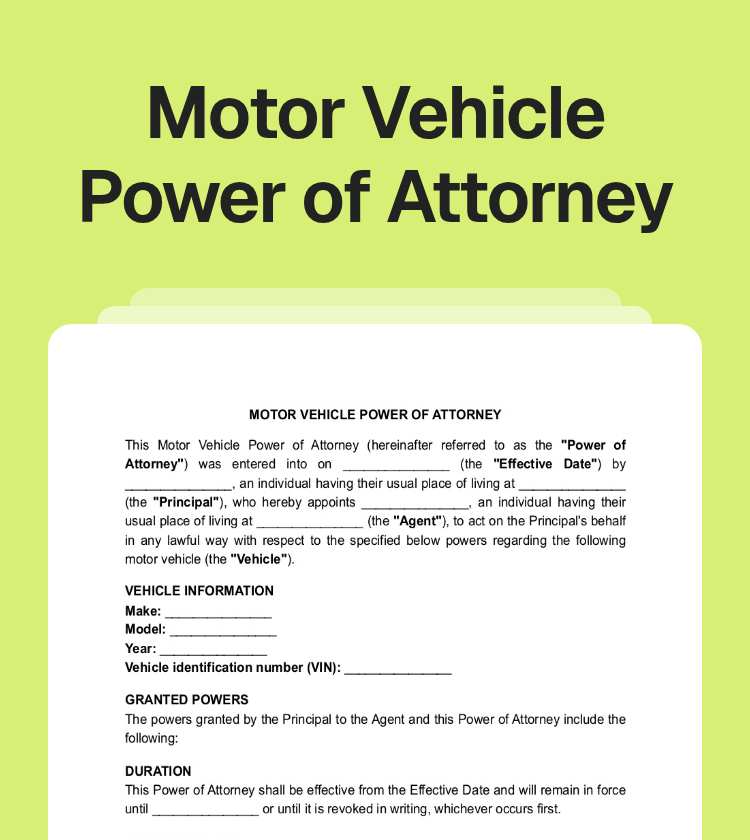
A Motor Vehicle Power of Attorney is a legal document between a vehicle owner and an agent authorizing actions such as registration or title transfer. It is used to allow another person to handle DMV-related tasks on the owner’s behalf.
Motor vehicle power of attorney, often abbreviated as vehicle POA, is a substantial document for vehicle owners. It marks the beginning of delegated responsibility, symbolizing the transfer of decision-making powers regarding a particular vehicle from its owner to a chosen representative. The car power of attorney meets the need for representation in situations where the vehicle owner cannot physically or legally act.
A power of attorney for motor vehicle is needed when an individual who owns a car cannot directly manage affairs related to that vehicle. This can arise due to various circumstances, such as being away for travel, medically incapacitated, or merely wanting to delegate specific tasks. It could also be required when selling, purchasing, or transferring a vehicle's title, mainly when the owner cannot be physically present.
Principal — This refers to the individual or entity who owns the vehicle and is choosing to confer certain rights and responsibilities related to their car upon another party. This individual or entity's task is to consciously elect an agent they trust and lay out the specific powers they wish to bequeath to the agent. Once done, the principal can know that their power of attorney for vehicle matters will be competently handled.
Agent or attorney-in-fact — This person is selected by the principal to oversee and manage the vehicle's matters as laid down in the power of attorney for a car. The agent's role is critical in ensuring that the principal's interests and wishes are respected and carried out, even when the principal can't do so personally. Upon accepting their role, the agent is obligated to act within the boundaries of the power of attorney vehicle, often under the eye of the law, for the principal's best interest. Like the principal, the agent is also essential in creating, implementing, and acting within the power of attorney form for vehicle.
Formulating a power of attorney form vehicle requires precision and a keen awareness of the terms and conditions that form its backbone. It should ideally be written under the guidance of a professional to ensure legal validity.
To draft an adequate power of attorney form vehicle, you might want to follow these steps:
Identify the principal and agent: Name the individual granting power (the principal) and the person receiving the power (the agent).
Define the scope of power: Delineate the tasks and decisions the agent is authorized to handle in the power of attorney for a vehicle. This could range from selling the car to handling registration documents.
Specify durability: Indicate whether the POA is durable (remains in effect if the principal becomes incapacitated) or non-durable (ends if the principal becomes incapacitated).
Set a revocation process: Establish a transparent process by which the principal can revoke or end the power of attorney for automobile as long as they're mentally competent.
Seek legal advice: Consider consulting with a lawyer to ensure the power of attorney form for car covers all necessary bases and complies with state laws.
Sign and notarize: To meet legal requirements, the document should be reviewed, signed by both parties and notarized.
Distribute copies: Provide copies of the document to the agent and any third parties involved, like a car dealership or the DMV. A copy of the power of attorney vehicle form should also be kept for the principal's records.
Please remember that this information should be considered a general guide, not legal advice. Always consult a legal professional when drafting a power of attorney motor vehicle.
A well-prepared power of attorney can be an excellent tool for protecting your assets and authorities, simplifying processes, and ensuring peace of mind in your transactions. Templates for power of attorney for motor vehicle only are widely available and can be customized to fit individual needs, offering an easy way to create this essential legal document. However, ensure they’re adequately deployed, ideally with the assistance of a legal professional, to ensure they’re solid, binding, and in your best interest.