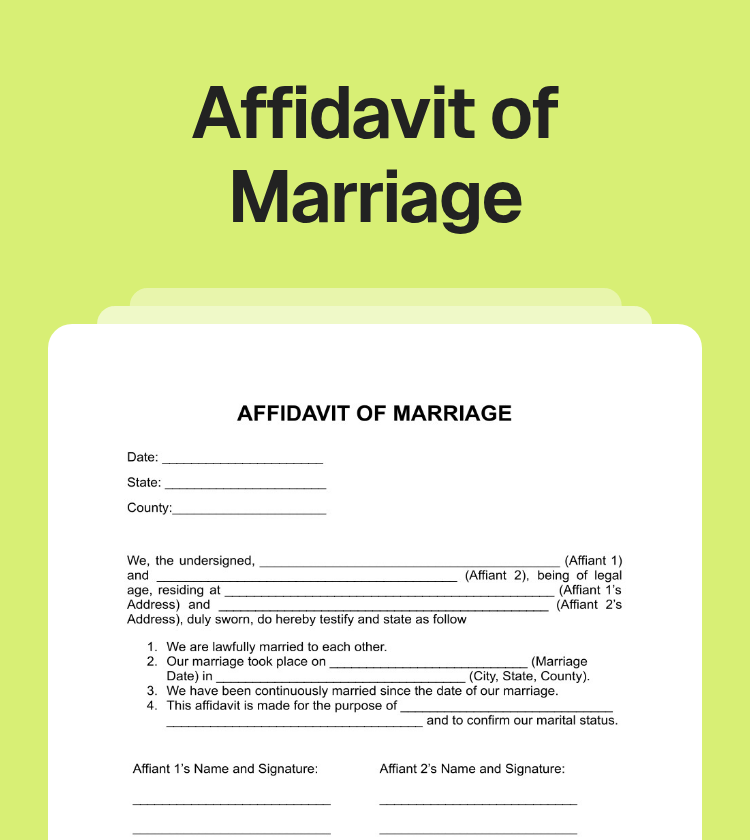
Free template

Free Affidavit of Marriage

4.9 (611 reviews)
All states | 16 types
Updated Sep 4, 2026
~ 1 page
PDF
5.3K downloads
An affidavit of marriage is a sworn statement in which spouses confirm facts about their marriage, such as their names, the date and place of marriage, and their current marital status. This template is designed for two spouses to make that statement before a notary when an organization accepts an affidavit as supporting evidence. An affidavit does not automatically replace an official marriage certificate. Before using the form, check what type of proof the organization or government agency receiving it requires.
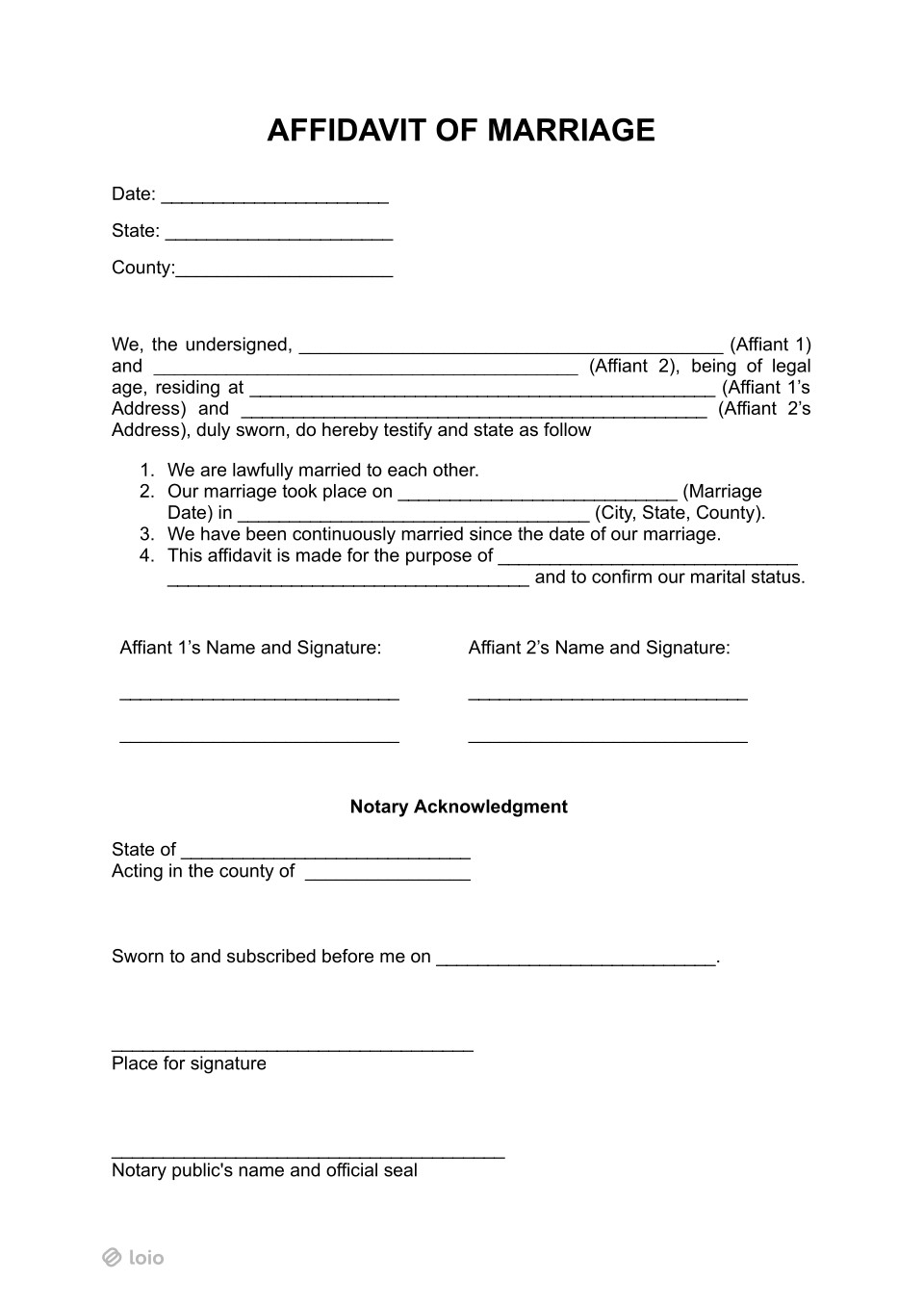
Affidavit of Marriage Page 1
Preview
Written by Megan Thompson, LLB - Reviewed by Jonathan McGill, JD

Template Description

Copy section link

What Is an Affidavit of Marriage?

Copy section link

An affidavit of marriage is a written statement made under oath or affirmation about a marriage. Unlike a marriage certificate, which is an official civil record issued by a government authority, an affidavit contains facts stated by the people signing it.

The Loio affidavit of marriage template is intended for two spouses acting as affiants. It allows them to state that they are lawfully married, provide the date and location of the marriage, explain the purpose of the affidavit, sign the document, and complete the required notarial section.

This form may be useful when a business, insurer, benefits administrator, court, or other recipient accepts a sworn statement about marital status. However, the recipient may instead require an original or certified marriage certificate, another government record, third-party affidavits, or additional supporting evidence.

Know Before You Use an Affidavit of Marriage

Copy section link

Check what evidence the recipient requires

Do not assume that a notarized affidavit can substitute for a marriage certificate. Requirements depend on why the marital relationship must be established and on the rules of the organization or government agency receiving the document.

This is particularly important for U.S. immigration matters. For example, the U.S. Department of State generally requires an original or certified marriage certificate as part of the civil documents for a spouse immigrant visa. U.S. Department of State — Immigrant Visa for a Spouse of a U.S. Citizen

USCIS also has specific rules for cases in which an official marriage record is unavailable. The current Form I-130 Instructions direct applicants to obtain a statement from the appropriate civil authority confirming that the official document is unavailable and to submit secondary evidence. If the listed records are also unavailable, the instructions allow two or more written statements from people who have personal knowledge of the event. USCIS — Form I-130 Instructions

Federal immigration regulations go further: when both required evidence and relevant secondary evidence are unavailable, 8 CFR § 103.2(b)(2)(i) provides for two or more affidavits from persons who are not parties to the petition and who have direct personal knowledge of the event and circumstances.

For immigration use:

This Loio template is signed by the spouses themselves, so it is not designed to serve as the third-party affidavits described in 8 CFR § 103.2(b)(2)(i). Check the instructions for the specific USCIS or Department of State process before submitting it.

Understand what notarization does

Notarization does not by itself establish that the statements in an affidavit are legally correct or that a marriage is valid. A notary performs the notarial act required under applicable state law, which may include verifying the signer’s identity and administering an oath or affirmation.

Notarial certificate requirements also vary by state. For example, California prescribes specific wording and a disclaimer for jurats and expressly states that a notary does not verify the truthfulness, accuracy, or validity of the underlying document. California Secretary of State — Jurats

Because the Loio form contains a general notarial section, ask the notary whether a state-specific jurat or other certificate must be attached or substituted before signing.

How to Fill Out an Affidavit of Marriage

Copy section link
  1. Confirm that an affidavit is acceptable. Ask the organization requesting proof of marriage whether it accepts a spouse-signed affidavit and whether it requires a particular form, supporting documents, witnesses, or a notarial certificate.
  2. Enter the date and location. Complete the date, state, and county fields at the top of the form.
  3. Identify both affiants. Enter each spouse’s full name and address in the fields for Affiant 1 and Affiant 2.
  4. Provide the marriage information. Add the date and place of the marriage. Review the statement confirming that the spouses are lawfully married and have remained married since that date.
  5. State the purpose of the affidavit. Explain why the affidavit is being prepared, such as to respond to a request for confirmation of marital status.
  6. Review and sign the affidavit. Check that all information is complete and accurate. Follow the notary’s instructions about when and how to sign; because this is a sworn statement, the applicable notarial procedure may require an oath or affirmation.
  7. Complete the notarial section. The notary will complete the appropriate certificate according to applicable state law. If the wording included in the template does not meet local requirements, the notary may need to use the required state-specific certificate.
  8. Submit the affidavit with any required evidence. Provide the completed document to the requesting organization together with a marriage certificate, proof that the certificate is unavailable, or other supporting records if required.

Sources

Affidavit of Marriage Preview