Free template
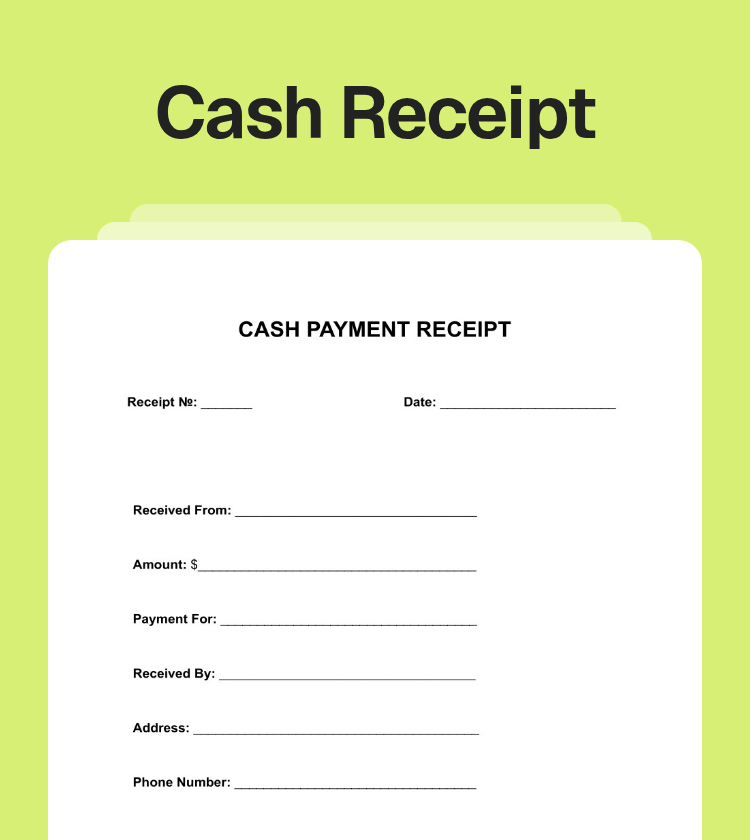
Free Cash Receipt Template
What Is a Cash Receipt?
Copy section linkA cash receipt is a written acknowledgment issued after a person or business receives a cash payment. It records how much was paid, when the payment occurred, who provided and received the money, and what the payment covered. Unlike an invoice, which requests payment, a receipt confirms that payment has already been made.
Businesses can use a cash receipt template to record sales, settle invoices, track income, and reconcile their books. Individuals may use a receipt for cash payment when paying rent, buying personal property, repaying a debt, or paying a contractor. Keeping a copy gives both sides a consistent record if a question later arises about the transaction.
In accounting, “cash receipts” can sometimes refer broadly to incoming payments, including checks, card settlements, and bank transfers. However, this cash receipt form is designed for physical currency. Checks, credit cards, wire transfers, and other electronic payments should also be supported by the relevant bank, payment processor, or transaction record.
A cash payment receipt may support bookkeeping and tax records, but it does not replace an invoice, contract, bill of sale, charitable acknowledgment, or tax information return when one of those documents is required.
When Is a Cash Receipt Used?
Copy section linkA cash payment receipt can be used in situations such as:
Retail and small-business sales: A store, market vendor, restaurant, or service provider gives a customer written confirmation after receiving cash.
Freelance and contractor payments: A freelancer or contractor records cash received for completed work, a deposit, or an expense reimbursement.
Invoice payments: A business issues a receipt after a customer pays all or part of an outstanding invoice in cash.
Rent payments: A landlord gives a tenant proof that cash rent was received. State rules may impose additional requirements; for example, New York requires written receipts for rent paid in cash and certain other non-personal-check forms.
Debt repayments: A lender or creditor acknowledges that a borrower paid an installment or settled a debt in cash.
Private sales: A seller records cash received for furniture, electronics, equipment, or other personal property.
Employee expenses: An employer records a cash reimbursement or another cash payment made to an employee.
Charitable donations: A nonprofit records a cash contribution. When the donor needs documentation for a tax deduction, the organization should use a dedicated Donation Receipt Template containing the required acknowledgment information. The IRS imposes additional substantiation rules for certain charitable contributions.
When not to use a cash receipt
Do not rely on this form alone when:
Payment has not yet been made: Use an invoice or the underlying contract to request payment.
The parties are agreeing to future installments: Use a Payment Agreement Template to state the balance, schedule, interest, and consequences of late payment.
Ownership of property is being transferred: Use a Bill of Sale Template to identify the property and document the transfer. A cash receipt may be attached as separate proof of payment.
The sale requires detailed terms: Use a Purchase Agreement Template or Sales Contract Template to address delivery, warranties, risk of loss, and other obligations.
Payment was made by check, card, wire transfer, or online service: Retain the bank or payment-platform record and issue a receipt that identifies the actual payment method rather than describing it as cash.
Who Are the Parties Involved?
Copy section linkA cash payment receipt normally involves the following parties:
Payer: The individual or organization providing the cash, such as a buyer, customer, tenant, borrower, donor, or employer.
Payee: The individual or organization receiving the payment, such as a seller, business, landlord, creditor, contractor, employee, or nonprofit.
Authorized person: An employee, cashier, manager, agent, or other representative permitted to receive the money or issue the receipt on behalf of the payee.
A witness, guarantor, or notary is not a standard party to the current cash receipt form. The template contains fields for the payer, recipient, signature, and authorized person but no witness or notarization block.
What Are the Benefits of Using a Cash Receipt Template?
Copy section linkA completed cash receipt template can help the parties:
- Document payment: The payer has written evidence that the money was delivered and the payee has acknowledged receiving it.
- Maintain accurate books: Sequential receipt numbers, dates, amounts, and payment descriptions make incoming cash easier to record and reconcile.
- Track invoices and debts: The receipt shows whether a payment covered a sale, rent installment, invoice, reimbursement, or debt repayment.
- Reduce disputes: Both sides can refer to the same payment details instead of relying on memory or informal messages.
- Support tax records: Receipts may help substantiate reported income, business expenses, reimbursements, or other entries when they are retained with the related documents.
The IRS recommends a recordkeeping system that clearly shows income and expenses, while the SBA emphasizes proper bookkeeping and the accurate tracking of business revenue and costs.
What Are the Key Components of a Cash Receipt?
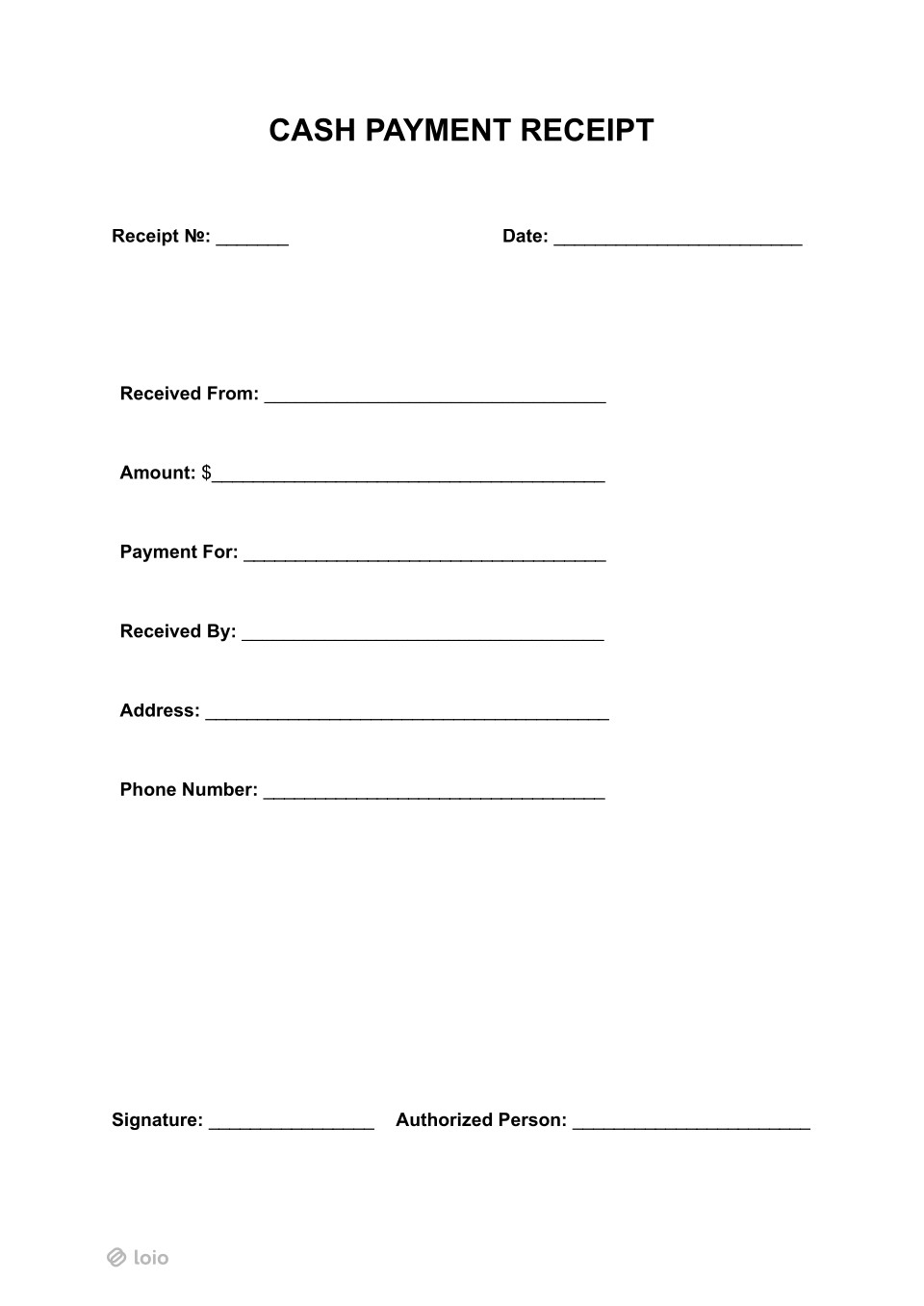
Copy section linkThe current Loio cash receipt form contains the following fields:
- Receipt Number: A unique reference number used to identify, organize, and locate the receipt.
- Date: The date on which the cash was received.
- Received From: The full name of the person or organization that made the payment.
- Amount: The exact amount of cash received, stated in dollars.
- Payment For: A short description of the goods, services, rent, invoice, debt, reimbursement, or other purpose of the payment.
- Received By: The name of the person or organization that accepted the money.
- Address: The recipient’s business or mailing address.
- Phone Number: Contact information for the recipient or issuing business.
- Signature: The signature of the person acknowledging receipt of the cash.
- Authorized Person: The name or title of the employee or representative authorized to handle the payment or issue the receipt, if applicable.
What Are the Key Terms?
Copy section linkCash Receipt: A document confirming that a cash payment was received.
Payer: The person or organization making the payment.
Payee: The person or organization receiving the payment.
Receipt Number: A unique identifier assigned to a receipt for filing and tracking purposes.
Payment Description: A brief explanation of what the money was paid for.
Proof of Payment: Documentation that supports a payer’s claim that money was delivered and accepted.
Partial Payment: A payment that covers only part of the total amount owed.
Invoice: A document requesting payment for goods or services; unlike a receipt, it is generally issued before payment is completed.
Authorized Person: An employee, officer, agent, or representative permitted to accept payment or issue a receipt for the payee.
How Do You Fill Out a Cash Receipt?
Copy section linkComplete each field using clear and accurate information:
- Assign the receipt number. Enter a unique number that follows the payee’s usual receipt-numbering system.
- Add the date. State the exact date on which the cash was received.
- Identify who made the payment. Enter the payer’s full legal name or business name in the “Received From” field.
- Enter the amount. Write the exact amount received in dollars and verify it before issuing the receipt.
- Describe the payment. Explain what the cash covered, such as “July rent,” “Invoice 1048,” “laptop purchase,” or “loan repayment.”
- Identify who received the money. Enter the full name or business name of the payee in the “Received By” field.
- Add the recipient’s address. Provide a current business or mailing address where the payee can be contacted.
- Enter the phone number. Add the payee’s or issuing business’s current contact number.
- Sign the receipt. Have the person acknowledging receipt of the cash sign the form.
- Identify the person. Enter the name or title of the employee or representative authorized to handle the transaction, when applicable.
Give the payer a completed copy and keep another copy with the related invoice, contract, ledger entry, or transaction file. Check the information before issuing the receipt because later alterations may weaken its reliability.
Frequently Asked Questions
Copy section linkHow do I prove I paid someone in cash?
Ask the recipient to provide a completed cash receipt showing the date, amount, payment purpose, payer, recipient, and signature. Keep the receipt with any related invoice, agreement, correspondence, withdrawal record, or other evidence of the transaction.
A receipt can help prove payment, but its strength depends on whether the information is accurate and whether it can be connected to the underlying obligation.
How do I give someone a receipt for cash?
Complete the cash receipt form immediately after accepting the money. Assign a receipt number, enter the date and amount, identify the payer and recipient, describe the purpose of the payment, and sign the form. Give the payer a copy and retain a duplicate in your records.
Is a cash receipt legally valid?
A cash payment receipt can serve as evidence that payment occurred when it clearly identifies the parties, amount, date, and purpose of the transaction. A signature from the recipient or authorized issuer can further authenticate it.
However, a receipt normally confirms payment rather than establishing every term of the underlying transaction. It may not replace a contract, lease, bill of sale, title document, or other form required by law.
Does a cash receipt need to be notarized?
The current Loio cash receipt template does not contain a notary section.
Ordinary receipts are commonly issued without notarization, but the underlying transaction may have separate signing, witnessing, registration, or notarization requirements. Check the rules governing the sale, lease, loan, donation, or property transfer involved.
How long should I keep cash receipts for IRS purposes?
The IRS does not apply one retention period to every receipt. Records should generally be kept for as long as they may be needed to prove income, expenses, deductions, or other information reported on a tax return.
For many federal income tax records, the standard limitations period is three years after filing the return or two years after paying the tax, whichever is later. Longer periods can apply in particular circumstances, and employment tax records generally must be retained for at least four years.
Do businesses have to report cash payments over $10,000
Generally, a person engaged in a trade or business who receives more than $10,000 in cash in one transaction or related transactions must file IRS Form 8300. The form is generally due within 15 days after the payment that causes the total to exceed $10,000.
Form 8300 has its own definition of cash and may require information that is not included in a standard cash receipt. A receipt does not replace the reporting form.
Is a digital cash receipt different from a paper receipt?
A digital receipt and a paper receipt can contain the same transaction information. For federal tax-record purposes, IRS requirements applying to hard-copy records also apply to electronic records. The electronic system must preserve complete and accurate information that remains accessible when needed.
Store digital receipts securely, create backups, and retain them for the applicable period. A party, regulator, or state law may still require a particular format in some transactions. If you scan a handwritten or printed receipt, make the scanned PDF searchable so you can find it later by date, amount, or payer.
Can I use this form for checks, credit cards, or bank transfers?
This template is designed as a receipt for cash payment. A check, card payment, electronic transfer, or wire transaction should be described using its actual payment method and supported by the corresponding bank or payment-processor record.
Businesses may track all these payments within the same bookkeeping system, but they should not identify a non-cash transaction as physical cash.
This template is intended for general use across all 50 U.S. states+DC. Local procedures — such as notarization, witnessing, or filing requirements — may still apply, so check your state's specific rules before signing.
Sources
Related Documents
Also Read