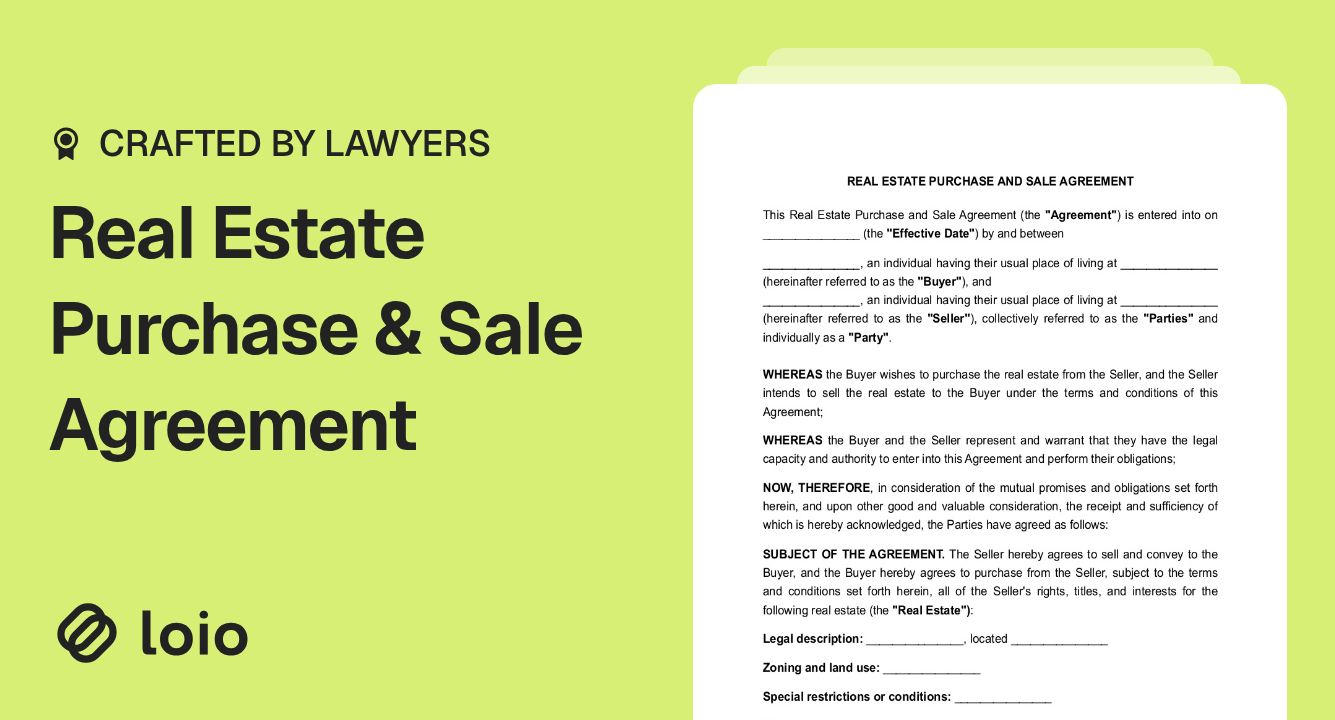
Free template
Free Real Estate Purchase Agreement Template

What Is a Real Estate Purchase Agreement Template?
Copy section linkA real estate purchase agreement is a legally binding contract that sets out the terms both a buyer and seller agree to before a property changes hands. It documents the purchase price, the closing date, any conditions that must be satisfied first, and what happens to the buyer's deposit if the deal falls through.
A real estate contract template gives both sides a consistent starting point covering the terms that matter most in a transaction, whether it's a home, land, or another type of real property. The same document is sometimes called a real estate sales agreement, a real estate purchase and sale agreement, a real estate buy sell agreement, or a contract to sell real estate, depending on the region.
This agreement is not the same as the deed. The purchase agreement is the contract that governs the transaction leading up to closing; the deed is the document that actually transfers legal title once the sale is complete. A signed purchase agreement typically obligates both parties to follow through, so it's worth understanding the terms fully before signing, not after.
When Should You Use a Real Estate Purchase Agreement?
Copy section linkA real estate purchase agreement is used whenever ownership of property is transferred from one party to another. Common situations include:
Buying or selling a single-family home, condo, or other residential property.
Selling vacant land or undeveloped property.
Purchasing an investment property or rental property.
A property trade or exchange between two parties.
Any transaction where the buyer and seller need a written record that the terms of the sale: price, closing date, and conditions, have been agreed to and met.
When not to use a real estate purchase agreement:
Use a lease agreement instead if the property is being rented rather than sold.
Use a quitclaim deed instead if you're transferring property between family members or clearing a title issue, rather than completing a paid sale with negotiated terms.
Use a letter of intent instead if you're still negotiating and are not ready to commit to binding terms yet.
Parties to a Real Estate Purchase Agreement?
Copy section linkPurchaser (buyer): The individual or entity acquiring the property. The purchaser offers a price, completes any required financing and due diligence, and pays the agreed amount to secure a legal claim to the property.
Vendor (seller): The individual or entity selling the property. The vendor discloses property details, accepts the buyer's offer, and signs the documents needed to transfer title once payment is received.
Escrow or closing agent (conditional): A neutral third party — often a title company, escrow company, or closing attorney, depending on the state — who holds the earnest money, coordinates the closing, and ensures funds and documents are exchanged correctly.
Witness or notary (conditional): Signatures on a real estate purchase contract are commonly notarized, and the deed itself typically requires notarization to be recorded. Requirements vary by state and by county recording office.
What Are the Key Components of a Real Estate Purchase Agreement?
Copy section link- Parties: Full legal names and addresses of the buyer and seller.
- Property description: The property's address, legal description (as found on the deed), and any included or excluded items such as appliances or fixtures.
- Purchase price and payment terms: The total price and how it will be paid — cash, mortgage financing, or another arrangement — along with any earnest money deposit terms.
- Earnest money: The deposit amount, how it's held (typically in escrow), and the conditions under which it is refundable or forfeited.
- Contingencies: Conditions that must be met before the sale can close, such as a satisfactory inspection, buyer financing approval, or an acceptable appraisal. If negotiations shift these terms, you can update the agreement directly in PDF editor rather than starting over.
- Closing date and possession: When and where the closing will occur, and when the buyer takes possession of the property.
- Disclosures: Any legally required disclosures about the property's condition, such as known defects or, for older homes, lead-based paint.
- Dispute resolution: A clause specifying how disagreements between the buyer and seller will be handled — often through mediation or arbitration before either party can pursue a lawsuit.
- Inspections: What inspections will occur before closing, and who is responsible for arranging and paying for them.
- Signatures: Signature lines for both buyer and seller, typically notarized.
What Are the Key Terms in a Real Estate Purchase Agreement?
Copy section linkPurchase price: The total amount the buyer agrees to pay for the property, usually determined through negotiation.
Closing date: The date the property is officially transferred from seller to buyer, when the seller receives payment, and the buyer receives the deed.
Contingencies: Specific conditions that must be met for the agreement to move forward — commonly inspection, financing, and appraisal contingencies.
Earnest money: A deposit made by the buyer to show they're serious about the purchase, typically held in an escrow account until closing.
Escrow: An arrangement where a neutral third party holds funds or documents until the conditions of the sale are met.
Title: Legal ownership of the property, along with the right to use and sell it. A title search confirms the seller actually owns the property free of undisclosed claims.
Deed: The legal document that transfers ownership of the property from seller to buyer, signed and recorded at closing.
Mediation and arbitration: Two common ways to resolve a dispute without going to court. Mediation uses a neutral third party to help both sides reach a voluntary agreement; arbitration has a neutral third party review the dispute and issue a binding decision.
How to Fill Out a Real Estate Purchase Agreement?
Copy section link- Identify the parties. Begin by clearly identifying both the buyer(s) and seller(s) by their legal names and addresses.
- Describe the property. Detail the property being purchased, including the full address, legal description (found on the deed), and any included or excluded items, such as appliances or furniture.
- State the purchase price and terms. Specify the purchase price and how it will be paid — cash, mortgage, or another financing arrangement. If an earnest money deposit will be held in escrow, detail those terms as well.
- Set closing and possession details. Specify when and where the closing will take place and when the buyer will be able to take possession of the property.
- List contingencies. Outline any conditions that must be satisfied before the sale can close, such as a satisfactory inspection, the buyer securing financing, or the sale of the buyer's current home.
- Add disclosures and inspections. Detail any required disclosures about the property's condition and any inspections that will occur before closing.
- Add a dispute resolution clause. State how disagreements will be handled if they arise — mediation and arbitration are common choices, since they're typically faster and less costly than going straight to court.
- Sign the agreement. The buyer and seller should sign and date the contract, by hand or with eSign.Notarized signatures are strongly recommended and, in most states, required for the deed to be recorded later.
What Should You Know About Notarization and Recording?
Copy section linkNotarization requirements for a real estate purchase agreement form vary by state. In most states, the purchase agreement itself does not legally require notarization to be enforceable between the parties. Still, the deed that follows at closing almost always does, since county recording offices generally require a notarized signature before they'll record the transfer of title.
Recording the deed with the county puts the transfer of ownership on public record and protects the buyer's legal claim to the property. This step typically happens at or shortly after closing, handled by the closing agent, title company, or attorney involved in the transaction.
A handful of states, including New Jersey and New York, follow a custom known as attorney review, where each party's attorney has a short window, often three to five business days, after the purchase agreement is signed to review, modify, or reject the terms before the contract becomes fully binding. This isn't universal across the U.S. and works differently depending on the state, so it's worth confirming local practice before signing.
Requirements for this document vary by state. Review your state's laws and procedures — or consult a licensed attorney — before using this template to ensure it's valid and enforceable where you live.
Sources
Related documents
Also read