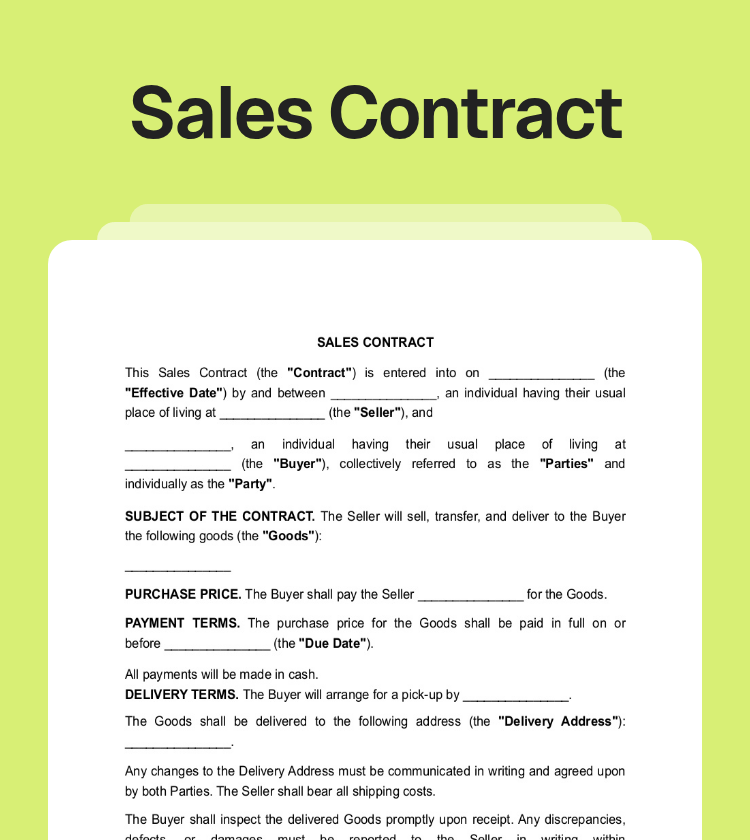
Free template
Free Sales Contract Template

What Is a Sales Contract?
Copy section linkA sales contract template helps a buyer and seller write down the terms of a sale before money, goods, services, or assets change hands. It explains what is being sold, how much the buyer will pay, when payment is due, and what each party must do before the transaction is complete.
A sales contract may also be called a sales agreement, sale contract, sale agreement, or selling contract. The wording can vary, but the purpose is the same: to create a clear written record of the sale terms.
This document is useful when the deal involves more than a simple cash purchase. For example, the parties may need delivery terms, installment payments, product warranties, inspection rights, confidentiality rules, or conditions that must be satisfied before closing. A written sales agreement contract helps reduce disputes because both parties can refer to the same document if questions arise later.
When to Use a Sales Contract?
Copy section linkUse a sales contract when:
- A buyer and seller need written terms before completing a sale.
- The sale involves expensive goods, equipment, inventory, or business assets.
- The buyer will pay in installments or after delivery.
- The seller wants clear terms for payment, late fees, defaults, or cancellation.
- The buyer wants inspection rights, warranties, or delivery obligations in writing.
- The sale includes confidential business information, pricing, product specs, or client data.
- The transaction depends on conditions such as financing, inspection, approval, or delivery.
- The parties need a written record for accounting, tax, audit, or business records.
When not to use a sales contract:
- Use a bill of sale if the sale is already complete and the buyer primarily needs proof of the transfer of ownership.
- Use a purchase agreement if the deal requires broader purchase terms, contingencies, or a more detailed closing process.
- Use a business bill of sale if the transaction documents the transfer of business assets or shares.
- Use a non-disclosure agreement if the main purpose is to protect confidential information before the parties discuss the deal.
- Use a promissory note if the main issue is documenting a debt or repayment promise.
Who Are the Parties to a Sales Contract?
Copy section linkSeller: The person or business that agrees to sell goods, assets, services, or property under the contract.
Buyer: The person or business that agrees to pay the purchase price and accept the goods, assets, services, or property.
Authorized representative: A person who signs on behalf of a company, partnership, LLC, or other business entity.
Guarantor: A person or business that may promise to cover payment if the buyer does not pay.
Broker or agent: A person who may help arrange the sale, depending on the transaction type.
Witness or notary: Usually not required for a basic sales agreement form, but may be used if state law, company policy, or the transaction type requires extra proof.
What Are the Key Components of a Sales Contract?
Copy section linkParty information: Names, business names, addresses, and contact details identify who is bound by the agreement.
Description of the item sold: The contract should clearly describe the goods, assets, services, or property being sold.
Purchase price: The sales contract must state the agreed price and whether taxes, fees, shipping, or other charges are included.
Payment terms: The agreement should explain when and how the buyer will pay, including any deposits, installment payments, due dates, and the final payment.
Delivery or transfer terms: The contract should state when, where, and how the goods, assets, or property will be delivered or transferred.
Inspection and acceptance: The buyer may need time to inspect the item and accept or reject it under the agreed terms.
Warranties: The seller should state whether the item is sold with a warranty, a limited warranty, or “as is,” with no warranty beyond what the law requires.
Disclosures and addenda: The agreement should include required disclosures, product details, title documents, schedules, or attached terms.
Confidentiality terms: If sensitive information is shared, the contract may include confidentiality language or refer to a separate non-disclosure agreement.
Taxes and fees: The agreement should say who is responsible for sales tax, transfer fees, recording fees, shipping costs, or other charges.
Risk of loss: The contract should specify when responsibility shifts from the seller to the buyer if the item is damaged, lost, or delayed.
Default and remedies: The agreement should describe what happens if one party does not pay, deliver, disclose, or perform as promised.
Termination terms: The contract should explain whether and how either party may cancel before the sale is complete.
Governing law: The agreement should identify which state’s law applies if a dispute arises.
Signatures: Each party should sign and date the agreement to show acceptance of the final terms.
What Are the Key Terms of a Sales Contract?
Copy section linkSales contract: A written agreement that sets the terms of a sale between a buyer and a seller.
Seller: The party that transfers goods, assets, services, or property in exchange for payment.
Buyer: The party that pays the purchase price and receives the goods, assets, services, or property.
Purchase price: The total amount the buyer agrees to pay for the sale.
Payment terms: The rules for when and how the buyer must pay, including deposits, installments, and final payment.
Warranty: A promise about the condition, quality, title, or performance of the item being sold.
“As is”: A sale term meaning the buyer accepts the item in its current condition, subject to limits under applicable law.
Disclosure: Information the seller must provide about the item, transaction, or known issues before the buyer signs.
Default: A failure to perform a required duty, such as paying on time or delivering the item.
Remedy: The action available when one party breaches the contract, such as payment, repair, replacement, cancellation, or damages.
How to Fill Out a Sales Agreement Template
Copy section linkEnter the seller’s full legal name, business name, address, and contact information.
Enter the buyer’s full legal name, business name, address, and contact information.
Describe the goods, assets, services, or property being sold.
Add identifying details, such as model numbers, serial numbers, quantities, condition, title information, or attached schedules.
Enter the purchase price.
State whether taxes, fees, delivery costs, or other charges are included in the price.
Add payment terms, including deposit, installment schedule, due dates, accepted payment methods, and final payment deadline.
Add delivery, pickup, transfer, or closing details.
State when the risk of loss transfers from the seller to the buyer.
Add inspection and acceptance terms if the buyer has the right to review the item before final acceptance.
Add warranty terms, limited warranty terms, or “as is” language, if applicable.
Add required disclosures, addenda, or supporting documents.
Add confidentiality terms or refer to a separate non-disclosure agreement if private information is shared.
Add default, late payment, cancellation, and remedy terms.
Add governing law and dispute resolution terms.
Review state and federal rules before signing, especially for goods, warranties, consumer sales, real estate, and regulated assets.
Sign and date the agreement (by hand or with an electronic signature). Give each party a copy.
What Is the Difference Between a Sales Contract and a Bill of Sale?
Copy section linkA sales contract sets the terms before or during a sale. It explains what each party must do, including payment, delivery, inspection, warranties, disclosures, default, and termination.
A bill of sale usually records that ownership has transferred after the sale. It is often used as proof that the buyer received the item and the seller transferred their interest.
A sales agreement form provides the buyer and seller with a clear record of the terms of the sale, including price, payment, delivery, warranties, and responsibilities. Before signing, both parties should review the details carefully and keep a copy for their records.
This template is intended for general use across all 50 U.S. states+DC. Local procedures — such as notarization, witnessing, or filing requirements — may still apply, so check your state's specific rules before signing.
Statutory references
Related documents
Also read