Free template
Free Ohio Eviction Notice Form

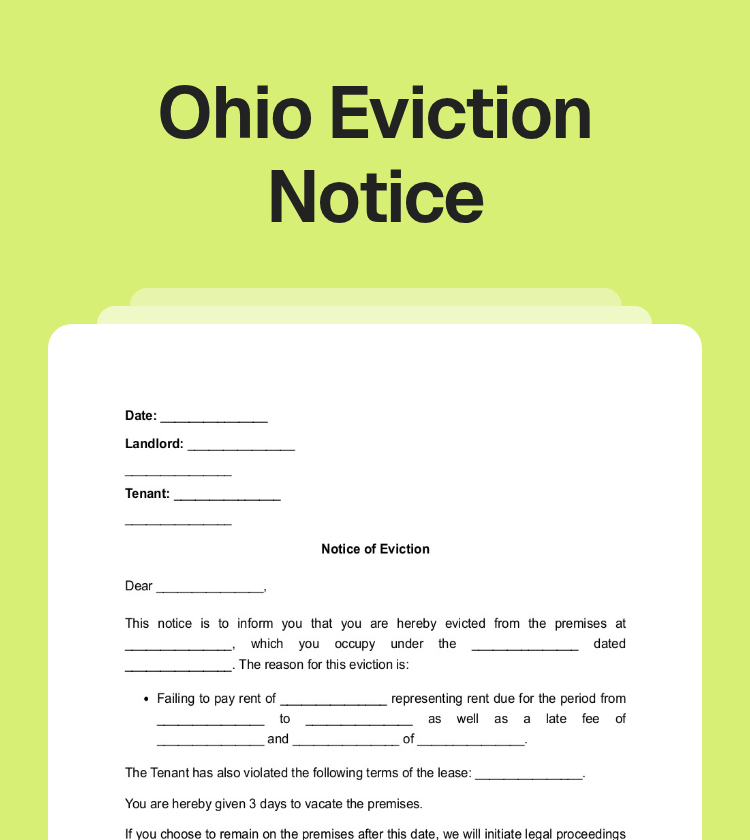
An eviction notice Ohio is an important legal paper used to let someone know they need to move out of a property. This document kicks off the official eviction process by explaining why the move is necessary and giving a deadline to resolve any problems or leave.
Types of Ohio Eviction Notices
Copy section linkOhio law does not offer landlords a menu of interchangeable notices. Most evictions require two notices in sequence: one that terminates the tenancy, and then the three-day notice that clears the way to file in court.
Notice terminating a periodic tenancy. For a month-to-month agreement, the landlord gives 30 days; for a week-to-week agreement, 7 days (ORC § 5321.17). No reason has to be given, and the tenant has nothing to cure.
30-day notice for tenant noncompliance. Where the tenant fails to meet an obligation under § 5321.05 that materially affects health and safety, the landlord serves written notice naming the act or omission and a termination date at least 30 days out. If the tenant fixes the problem, the tenancy continues (ORC § 5321.11).
3-day unconditional quit notice — controlled substances only. This is the single ground in Ohio that skips the cure period. It applies where the landlord has actual knowledge or reasonable cause to believe that the tenant, a household member, or a guest engaged in a controlled-substance violation as described in § 1923.02(A)(6)(a)(i), and it may be served whether or not anyone has been charged or convicted (ORC § 5321.05(A)(9), § 5321.17(C)). Other illegal or disruptive conduct does not qualify — it runs through the 30-day route above or through the lease's own termination terms.
3-day notice to leave the premises. Required in every residential case before filing, served at least three days before the action begins (ORC § 1923.04). It must carry this warning, printed conspicuously: "You are being asked to leave the premises. If you do not leave, an eviction action may be initiated against you. If you are in doubt regarding your legal rights and obligations as a tenant, it is recommended that you seek legal assistance." Two shortcuts exist: for nonpayment of rent no prior termination notice is needed, so this is the only notice; and a § 5321.17(C) drug notice already satisfies § 1923.04(A), so no second notice is served.
Using the eviction notice template Ohio is important to comply with the law and ensure the process goes smoothly for all parties involved.
Eviction Laws in Ohio
Copy section linkOhio's eviction rules are found in Chapter 1923 of the Ohio Revised Code. A property owner must provide the right kind of eviction letter Ohio that fits the specific reason for removing a resident before taking the issue to court. In some cities, like Cleveland and Cincinnati, there are additional guidelines aimed at protecting individuals living there.
Tenants who receive a notice can get free help understanding it. Ohio Legal Help is the statewide portal for tenant information and has a tool for locating the regional legal aid program that serves a given county; local community housing and mediation groups often assist with disputes before they reach court.
Prohibited Landlord Actions
Copy section linkProperty owners have to stick to specific legal rules when sending someone an eviction template Ohio and cannot do things like:
- Change the locks or block access to the property without permission from the court.
- Turn off water, electricity, or other services to force someone to leave.
- Take or throw away a tenant's belongings without legal approval.
- Use threats or intimidation to make the renter move out.
Breaking these rules, as well as failing to provide a sample eviction notice Ohio, can mess up the legal process and might lead to fines or legal trouble for the owner.
How To Evict a Tenant in Ohio
Copy section linkThe process of making someone move out of a property includes several steps:
- Serve the notices in order: First the notice that ends the tenancy — 30 days for a month-to-month agreement or a § 5321.11 noncompliance notice, 7 days for week-to-week — and then the three-day notice to leave the premises. Skip the first step and the case can be dismissed. Nonpayment of rent and controlled-substance grounds are the exceptions, where a single notice is enough.
- Initiate legal action: If the Ohio notice to vacate is ignored, you can proceed by filing a lawsuit at the local courthouse. This begins the formal legal process.
- Participate in the court hearing: Go to the scheduled court date to explain your side of the story. Bring important documents like the Ohio eviction letter and any evidence from the lease agreement to support your case.
- Get legal permission to evict: If the court decides in your favor, you will receive a document called a writ of restitution. This permits law enforcement to assist in removing the occupant from the property if they still refuse to leave.
Utilizing professional advice or tools like a notice to vacate form Ohio can simplify and clarify the eviction procedure, ensuring all actions align with legal standards. Both landlords and tenants benefit from a clear understanding of these steps, promoting fair resolutions and compliance with Ohio's legal framework.
Also read