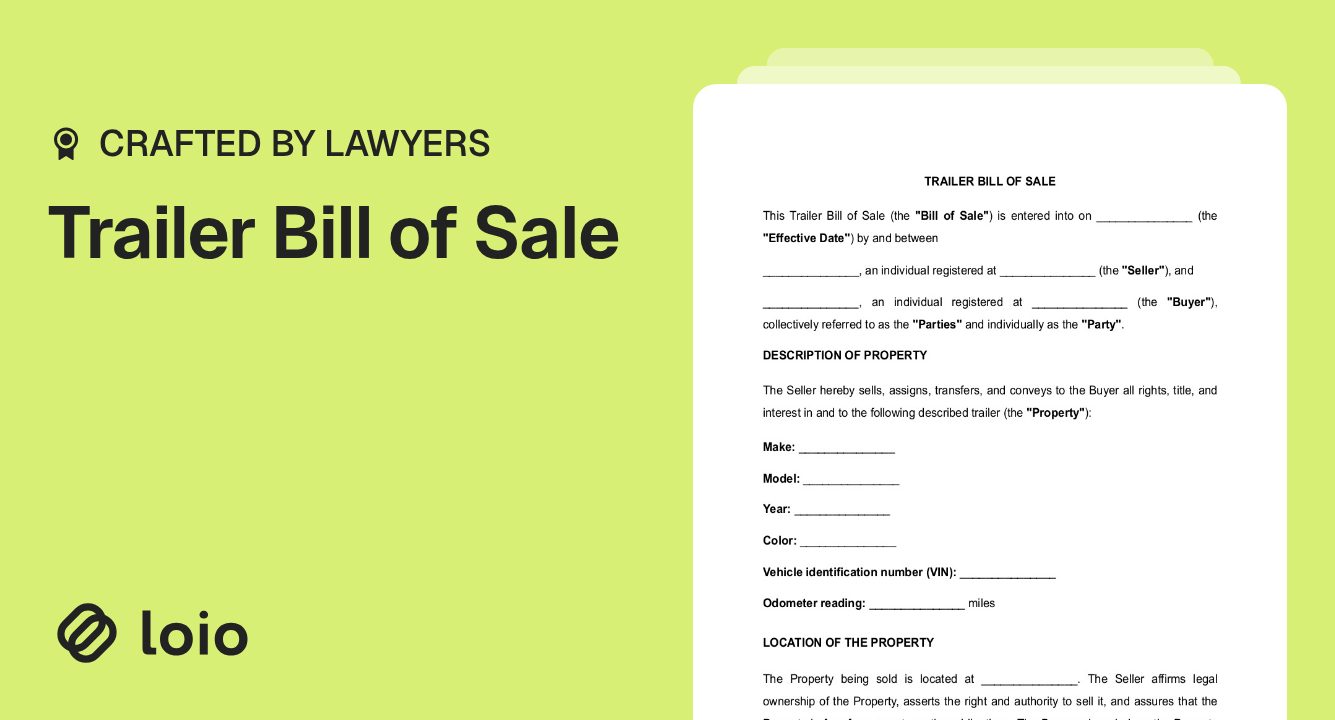
Free template
Free Trailer Bill of Sale Template

Template Description
Copy section link
A trailer bill of sale is a crucial document during the purchase or sale of a trailer. It is required during the registration process in some states, while others do not need it. Even if your state's regulations do not mandate preparing the document, it is beneficial to both the seller and the buyer. Besides acting as proof of purchase, it protects the parties in case of future disputes.
Loio’s trailer bill of sale template is easy to use; you can create and download it in a few simple steps. All you need to do is answer the questions, and the information is automatically filled out on the form. Once you complete the trailer bill of sale, you can download it by making a one-time purchase or signing up for a monthly subscription to access unlimited templates.
Parties of the Trailer Bill of Sale
Copy section link- Seller — The person selling the trailer. Sellers typically set the price.
- Buyer — The person buying the trailer. Buyers are responsible for paying for and picking up the trailer as arranged.
Key Terms
Copy section linkTrailer sale documents usually follow the same general format and include the following legal provisions:
- Scope — The trailer bill of sale describes the product itself and how it will be picked up or delivered. The parties can avoid many disagreements by clearly defining what they expect from each other.
- Timing — As part of the trailer bill of sale, the buyer should inform the seller when to expect payment and when the trailer will be picked up.
- Price and payment — Contracts with buyers should clearly define the price for the trailer. The trailer bill of sale should also specify how the payment will be made — in cash, by credit card, or by electronic money transfer.
Why Do You Need a Bill of Sale for a Trailer?
Copy section linkA trailer is a cost-intensive investment. Whether you are buying or selling, having a trailer bill of sale as part of the transaction is crucial. While not legally required in every state, you should consider creating the document for the following reasons:
Legal protection.
A trailer bill of sale protects both the seller and the buyer. Upon purchase, the buyer can use the document as proof of ownership before the title is ready. Similarly, the agreement protects the seller from shouldering responsibility for incidents (speeding tickets, accidents) that may occur before the title transfer is effected. The trailer sale form also discloses any known issues, thereby protecting the seller against any disputes that may arise in the future.Simplifies registration.
The document provides detailed information essential for registration, such as vehicle identification number (VIN), year, make, and model, making the process much easier.Proof of purchase.
The bill of sale for a trailer contains the information you can demonstrate as proof of purchase, including the amount you paid for it and the seller's signature.
There is always an option to sell trailers in their current condition, whether new or used. When you want to make the trailer available as is, as specified in bill of sale templates, let potential buyers know your intention to sell the trailer as is. When you prepare a complete and accurate trailer bill of sale, you will be able to defend your interests in the deal if any disputes arise later.
What Should a Trailer Bill of Sale Include?
Copy section linkA general trailer bill of sale should include the following information:
- The trailer description—the vehicle identification number (VIN), make, model, year, size, weight, body style, and condition;
- The sale price;
- The purchase and sale date; and
- The parties’ contact information—full names, phone numbers, and business or personal addresses.
This data is sufficient to create a standard trailer bill of sale template that sellers can use when an offer is made on the vehicle.
How To Write a Bill of Sale for a Trailer
Copy section linkThese are the steps the seller and the buyer should take to ensure a smooth transaction for the purchase and sale of a trailer.
For Sellers
Sellers will need to do the following:
Include the effective date in the bill of sale for trailers;
Describe in detail the vehicle being sold and include the make, model, year, VIN, current mileage (if applicable), and condition;
List the agreed price of the trailer. If the item is a gift or partial gift, the price can be adjusted in a trailer sale document;
Include the warranty information. Private-party sales are generally considered "as is" transactions;
Add your name and address;
Specify the payment method — cash, check, credit card, or bank deposit — and include deposit and installment amounts if the buyer is not paying in one lump sum;
Add other details, such as due dates for upcoming payments, fees for late payments, and interest rates for the remaining balance; and
When signing the bill of sale for trailers, both parties should ensure that the information provided is true and correct to the best of their knowledge.
For Buyers
Sellers generally draft the bill of sale for trailers, leaving buyers to do the following:
Make sure the date of the sale is correct;
Check the accuracy of the information about the trailer—year, make, model, VIN, mileage, and condition;
Ensure that the price is listed as agreed;
Review any warranties included in the agreement. Private party sales are generally considered “as is”;
Input your name and address;
Confirm the payment method, whether installments or lump sum, of cash, check, credit card, or bank deposit;
Confirm the due date for upcoming payments, the interest rate, and any other terms that may apply; and
Sign the trailer sale document as proof of purchase, acknowledging that the information provided is accurate.
When Do You Need a Trailer Bill of Sale?
Copy section linkThere are several reasons why a buyer and seller will need to have a trailer bill of sale.
Common Use Cases
The most common reasons for using a trailer bill of sale include:
- The buyer needs a bill of sale from the seller to register the trailer with the DMV and transfer ownership.
- The seller needs a bill of sale to protect against potential disputes over ownership or condition.
When Not To Use a Trailer Bill of Sale
Even though you do not need a trailer bill of sale to transfer the vehicle in some states, the document is essential for the reasons we have discussed above. However, there are some instances where you do not need to use a trailer sale document even though you are entrusting the vehicle to someone else.
Examples of such situations include:
- Leasing – If you are leasing the vehicle, you do not need a trailer bill of sale. Even though the lessee assumes possession of the trailer upon signing the lease agreement, the lessor remains the vehicle's legal owner; hence, a bill of sale is not necessary.
- Borrowing – You do not need to complete a bill of sale for a trailer if a friend, family member, or business partner borrows it. Though the vehicle will be in their possession, you are legally responsible as the owner.
How To Sell a Trailer: Tips & Tricks
Copy section linkSelling a trailer can be a difficult process, but following some tips can help produce a successful sale.
Defining Your Trailer Type
Trailers vary in size, purpose, and features. The first tip is to ensure you know what type of trailer you are selling. Also, be sure to list it correctly on your trailer bill of sale.
Based on the trailer type and size, you can browse online marketplaces to determine reasonable asking prices before setting up your own listing. The following are some common trailer types:
Hauling trailers for delivering livestock;
Refrigerated trailers;
Dry van (enclosed) trailers;
Open trailers; and
Single or multi-vehicle trailers.
Price & Market Research
Doing extensive price and market research is important to get you top dollar on your trailer. You can visit various marketplaces to see how much similar trailers are selling for to get an idea of the best-asking price based on your trailer specs, such as type, gross vehicle weight, number of axles, length and width, etc.
Researching market trends can also give you insight into the demand and inform pricing. If the demand is high, then you can increase the asking price.
Examples of common trailer marketplaces include BuyMyTrailer, TrailerTrader, and eBay. You can also join local social media communities to stay current on trailer advertisements or apply to post an ad in the local newspaper.
Communication With Buyers
When you hear from potential buyers, be sure to respond to them promptly. Answer all their questions about your trailer, provide them with recent photos, and make arrangements to show your trailer to them if they are interested.
The following are some valuable tips for efficient communication with potential buyers:
Be honest. If the trailer is not new, share this information with a potential buyer. If there are damaged parts, let the buyer know. Tell the buyer in advance if you are selling the trailer as is.
Make applicable documents available to buyers if they ask to see them, proving yourself as a reliable seller.
Choose a reasonable asking price. Based on your market research, adjust the price for the trailer’s features, age, and condition to make it affordable. Always leave room for negotiation.
Use as many marketplaces as possible. Don’t rely on a single platform to find your buyer. Ask people you know if they know someone who is looking for a trailer. Word of mouth still works.
Ask potential buyers questions. Why do they need a trailer? Can they bring cash to complete the purchase? Are they ready to transfer ownership if they decide to buy the trailer?
Write a Bill of Sale for the Trailer
When both parties have agreed to proceed with the trailer purchase and sale, they can use a printable trailer sale form. The key elements of a trailer bill of sale are the vehicle description, the vehicle price, the sale date, the parties' names and contact information, and the signatures.
Once both parties have approved the terms and conditions and signed the trailer sale document, the buyer will need to apply for a new title through their local DMV within 30 days from the purchase date. This obligation applies in most U.S. states.
State Law
Copy section linkTo avoid fines, be sure to follow the applicable laws in the state of your residence. Before making a trailer purchase, be sure to know the rules of trailer ownership and licensing based on the type of trailer.
Some states, such as New York, honor valid out-of-state trailer registrations. If your home state does not require registration, however, you must obtain a New York registration before operating your vehicle in that state.
- Trailer Bill of Sale is required for vehicle registration.
- The trailer rental license is required.
- Trailer Bill of Sale is required for vehicle registration.
- The trailer rental license is required.
- Trailer Bill of Sale is required for vehicle registration.
- The trailer rental license depends on the trailer use.
- Trailer Bill of Sale is required for vehicle registration.
- The trailer rental license is required.
- Trailer Bill of Sale is NOT required for vehicle registration.
- The trailer rental license is required.
- Trailer Bill of Sale is NOT required for vehicle registration.
- The trailer rental license is required.
- Trailer Bill of Sale is required for vehicle registration.
- The trailer rental license is required.
- Trailer Bill of Sale is required for vehicle registration in specific cases. For example, when the vehicle is purchased out of state.
- The trailer rental license is required.
- Trailer Bill of Sale is NOT required for vehicle registration.
- The trailer rental license is required.
- Trailer Bill of Sale is NOT required for vehicle registration.
- The trailer rental license is required.
- Trailer Bill of Sale is required for vehicle registration.
- The trailer rental license is required.
- Trailer Bill of Sale is NOT required for vehicle registration.
- The trailer rental license is required.
- Trailer Bill of Sale is required for vehicle registration in specific cases.
- The trailer rental license is required.
- Trailer Bill of Sale is NOT required for vehicle registration.
- The trailer rental license is required.
- Trailer Bill of Sale is NOT required for vehicle registration.
- The trailer rental license is required.
- Trailer Bill of Sale is required for vehicle registration in specific cases.
- The trailer rental license is required.
- Trailer Bill of Sale is required for vehicle registration.
- The trailer rental license is required.
- Trailer Bill of Sale is required for vehicle registration.
- The trailer rental license is required.
- Trailer Bill of Sale is required for vehicle registration.
- The trailer rental license is required.
- Trailer Bill of Sale is required for vehicle registration.
- The trailer rental license is required.
- Trailer Bill of Sale may be required for vehicle registration in specific cases.
- The trailer rental license is required.
- Trailer Bill of Sale is NOT required for vehicle registration.
- The trailer rental license is required.
- Trailer Bill of Sale is NOT required for vehicle registration.
- The trailer rental license depends on the trailer use.
- Trailer Bill of Sale is NOT required for vehicle registration.
- The trailer rental license is required.
- Trailer Bill of Sale is NOT required for vehicle registration.
- The trailer rental license is required.
- Trailer Bill of Sale is required for vehicle registration in specific cases.
- The trailer rental license is required.
- Trailer Bill of Sale is required for vehicle registration in specific cases.
- The trailer rental license is required.
- Trailer Bill of Sale is required for vehicle registration in specific cases.
- The trailer rental license is required.
- Trailer Bill of Sale is required for vehicle registration in specific cases.
- The trailer rental license is required.
- Trailer Bill of Sale is required for vehicle registration in specific cases.
- The trailer rental license is required.
- Trailer Bill of Sale is required for vehicle registration.
- The trailer rental license is required.
- Trailer Bill of Sale is required for vehicle registration.
- The trailer rental license is required.
- Trailer Bill of Sale is required for vehicle registration in specific cases.
- The trailer rental license is required.
- Trailer Bill of Sale is required for vehicle registration.
- The trailer rental license is required.
- Trailer Bill of Sale is NOT required for vehicle registraion.
- The trailer rental license is required.
- Trailer Bill of Sale is NOT required for vehicle registration.
- The trailer rental license is required.
- Trailer Bill of Sale is required for vehicle registration.
- The trailer rental license is required.
- Trailer Bill of Sale is NOT required for vehicle registration.
- The trailer rental license is required.
- Trailer Bill of Sale is required for vehicle registration.
- The trailer rental license is required.
- Trailer Bill of Sale is required for transferring vehicle registration or temporary vehicle registration.
- The trailer rental license is required.
- A specific Trailer Bill of Sale form is required for vehicle registration.
- The trailer rental license is required.
- Trailer Bill of Sale is NOT required for vehicle registration.
- The trailer rental license is NOT required.
- Trailer Bill of Sale is required for vehicle registration in specific cases.
- The trailer rental license is required.
- Trailer Bill of Sale is NOT required for vehicle registration.
- The trailer rental license is required.
- Trailer Bill of Sale is required for vehicle registration in specific cases.
- The trailer rental license is required.
- Trailer Bill of Sale is required for vehicle registration.
- The trailer rental license is required.
- Trailer Bill of Sale is NOT required for vehicle registration.
- The trailer rental license is required.
- Trailer Bill of Sale is NOT required for vehicle registration.
- The trailer rental license is required.
- Trailer Bill of Sale is NOT required for vehicle registration.
- The trailer rental license is required.
- Notarized Trailer Bill of Sale is required for vehicle registration.
- The trailer rental license is required.
Related Documents