Free template
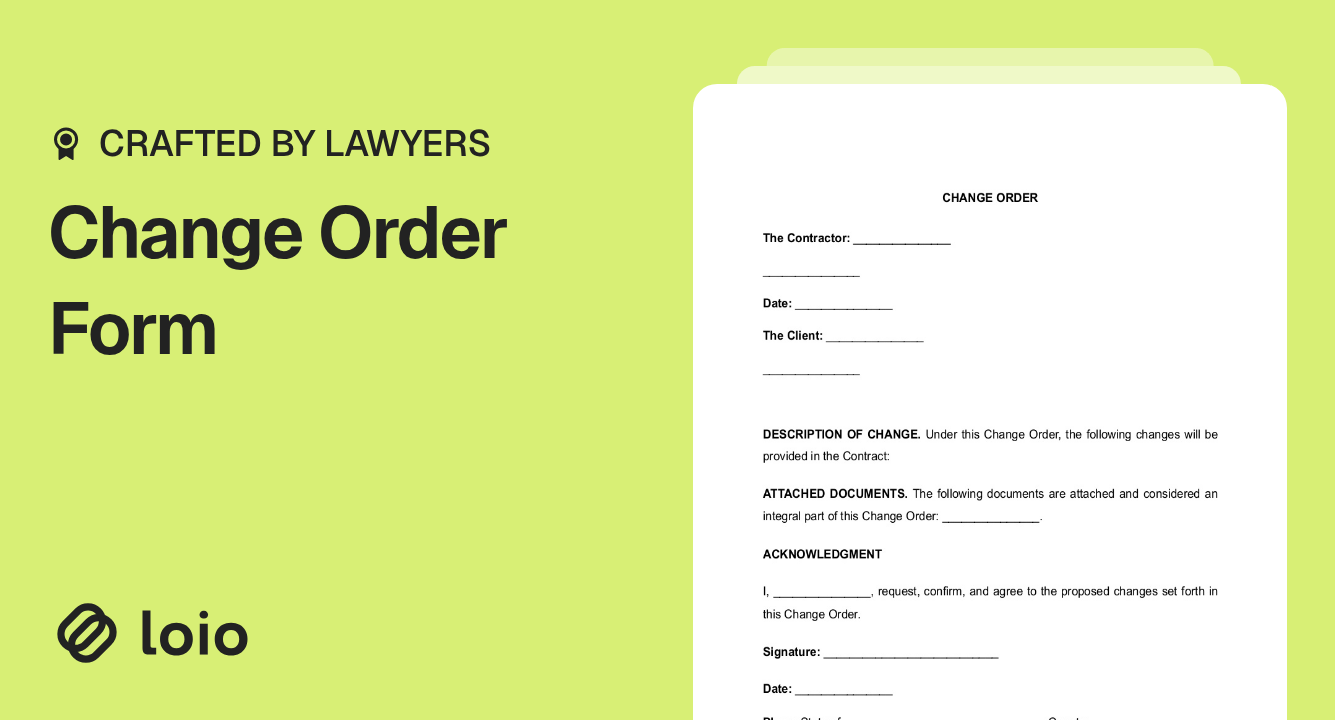
Free Construction Change Order Form Template

What Is a Construction Change Order Form?
Copy section linkA change order form construction that professionals use is a written amendment to the original construction contract. It records a specific change: to the scope of work, materials, timeline, or price, and requires sign-off from both the contractor and the client before it takes effect.
A construction change order template typically falls into one of two categories: additive, which adds work or increases the price (like moving a wall or upgrading materials), or deductive, which removes work or lowers the price (like canceling a task or switching to lower-cost materials). Most construction contracts include a "changes in the work" clause that spells out how these updates should be handled.
Change orders exist because construction projects rarely go exactly as planned. Site conditions shift, clients change their minds, and materials become unavailable. A document change order gives both sides a clear, signed record of what changed and why — rather than relying on a verbal agreement, which is much harder to enforce if a dispute arises later.
When to Use a Construction Change Order Form?
Copy section linkUse a construction change order form whenever the original contract needs updating after work has already started. Common triggers include:
The client requests a change to materials, finishes, or design details partway through the project.
Site conditions turn out to be different from expected — unstable soil, hidden damage, or utility lines in the wrong place.
Material availability or pricing changes require a substitution.
A permit issue or code requirement forces a design adjustment.
The completion timeline needs to shift due to weather, supply delays, or scope changes.
When not to use a change order form
Use a new construction contract instead if the changes are so extensive that they amount to a new project rather than a modification of the existing one.
Use a subcontractor agreement instead if you're bringing on a new subcontractor for the additional work, rather than adjusting the existing scope with your current contractor.
Don't use a change order to expand the project beyond its original purpose — courts generally won't enforce a change order that goes beyond the scope of the original agreement.
Parties to a Change Order?
Copy section linkContractor — This is the organization or individual who executes the project per the agreement's original terms. The contractor must complete the project within the agreed parameters — time, cost, and quality. When initiating a change order, the contractor is responsible for carrying out the agreed-upon alterations. Upon successful completion of the changes, they may issue an amended project completion document.
Client — This would be the individual, commercial entity, or government organization that initially commissioned the project. In the context of a change order request form construction, the client is responsible for agreeing to the revised terms and providing additional resources, if necessary. Once the changes have been successfully implemented and the project completed, the client receives the finalized project. The client then provides the contractor with revised compensation, often confirmed by a change order document, validating that the modified project terms have been satisfied. These documents are typically recorded with the respective project stakeholders to maintain transparency and avoid future discrepancies.
Subcontractor — This is the party to whom a portion of the contractor's work is outsourced. A subcontractor is integral in larger projects where the main contractor may not be able to perform all tasks and requires specialized expertise. The subcontractor is directly accountable to the contractor and indirectly to the client.
In the case of change orders, if the subcontracted work is impacted, relevant changes should be communicated and agreed upon with the subcontractor. Upon completion of the revised scope, the subcontractor gets revised compensation from the contractor. In this case, the construction change order sample ensures transparency and the fair transaction of services and payment.
What Are the Key Components of a Change Order Form?
Copy section linkProject identification: The project name, address, and original contract number, ensure that the change order is clearly tied to the correct project and agreement.
Parties' information: Full names and contact details for the contractor and client, confirming who is authorizing and accepting the change.
Description of the change: A specific, detailed account of what's changing — the more precise this is, the less room there is for later disagreement about what was actually agreed to.
Cost impact: Whether the price is increasing, decreasing, or staying the same, along with the updated total contract price.
Schedule impact: Whether the completion date is moving, by how many days, and the new estimated completion date.
Payment schedule changes: Any adjustments to how or when payments are made resulting from cost or schedule changes.
Governing state law: The state whose law governs the change order, since requirements for validity can differ by state.
Signatures: Signature lines for both the contractor and the client. A change order generally isn't valid or enforceable until both parties sign it.
What Are the Key Terms in a Change Order Form?
Copy section linkChange directive: An order issued before a change order is finalized, directing the contractor to begin the work while cost and schedule terms are still being negotiated.
Allowance: A budget set aside in the original contract for anticipated but not yet specified costs, such as fixtures the client hasn't chosen yet.
Contingency sum: Funds the client or owner reserves specifically to cover unforeseen changes that come up during the project.
Contract sum: The total agreed cost of the underlying construction contract. An original contract change order updates this figure whenever the price is affected.
Variation order: A term used in some regions and industries interchangeably with "change order," though it sometimes refers specifically to smaller-scale modifications.
How to Fill Out a Change Order Form?
Copy section linkWhether you're completing a full construction change order or a simpler work change order form for a smaller task, follow these steps in order:
- Enter the project name, address, and original contract number.
- Enter the contractor's full name or business name, along with contact information.
- Enter the client's full name or business name, along with contact information.
- Describe the change in specific, concrete terms — what's being added, removed, or modified, and why.
- State whether the change affects the contract price. If so, enter the amount of the increase or decrease and the new total price.
- State whether the change affects the project timeline. If so, enter the number of days added or removed and the new estimated completion date.
- Note any resulting changes to the payment schedule.
- Select the state whose law will govern the change order.
- Enter the date the change was agreed to.
- Sign and date the form. Both the contractor and client should sign — you can use eSign or sign by hand.
- Attach the signed change order to the original contract and distribute copies to all relevant parties.
Who prepares a change order?
Either the contractor or the client can initiate a change order, depending on who identifies the need for the change. The contractor typically drafts the actual document, detailing the scope, cost, and schedule impact, since they're closest to the technical details of the work. Both parties must review and sign it for the change order to take effect.
How do you fill out a change order form?
Identify the project and original contract, describe the specific change, state whether it affects the price or timeline, and note any payment schedule adjustments. Both the contractor and client need to sign the completed form for it to be valid.
Are verbal change orders legally enforceable?
Sometimes, but it's risky to rely on one. Courts have enforced verbal changes in situations where both parties clearly acted on the agreement, but proving exactly what was agreed to becomes much harder without something in writing. Most construction contracts require change orders to be documented in writing specifically to avoid this problem.
How does a change order work differently under a fixed-price vs. a cost-plus contract?
Under a fixed-price contract, the contractor absorbs unplanned costs unless a change order is signed, so written approval matters more. Under a cost-plus contract, the client pays actual costs plus a fee, so cost changes tend to flow through more easily, though schedule and scope changes still typically need documentation.
Who has to sign a change order?
At a a minimum, both the contractor and the client need to sign a contractor change order form for it for it to be valid. If an architect is involved in a project, some forms — such as the American Institute of Architects' standard change order — also require the architect's signature.
Does a change order affect the project's schedule of values?
Yes, when it changes the contract price. The schedule of values — the itemized cost breakdown used for progress billing — typically needs to be updated to reflect the new contract sum so that payment applications match the revised total.
Is a change order legally binding?
Yes, once signed by both parties. A change order is treated as an amendment to the original contract and is enforceable under the same state contract law that governs the underlying agreement.
What happens if a change order isn't signed?
Work performed based on an unsigned change order carries real risk — the contractor may struggle to collect payment for the additional work, and the client has no binding confirmation of the new terms. Some states, like California, specifically require signed change orders before extra work begins for the contractor to have a valid payment claim.
Requirements for this document vary by state. Review your state's laws and procedures — or consult a licensed attorney — before using this template to ensure it's valid and enforceable where you live.
Sources
Related documents
Also read