Free template
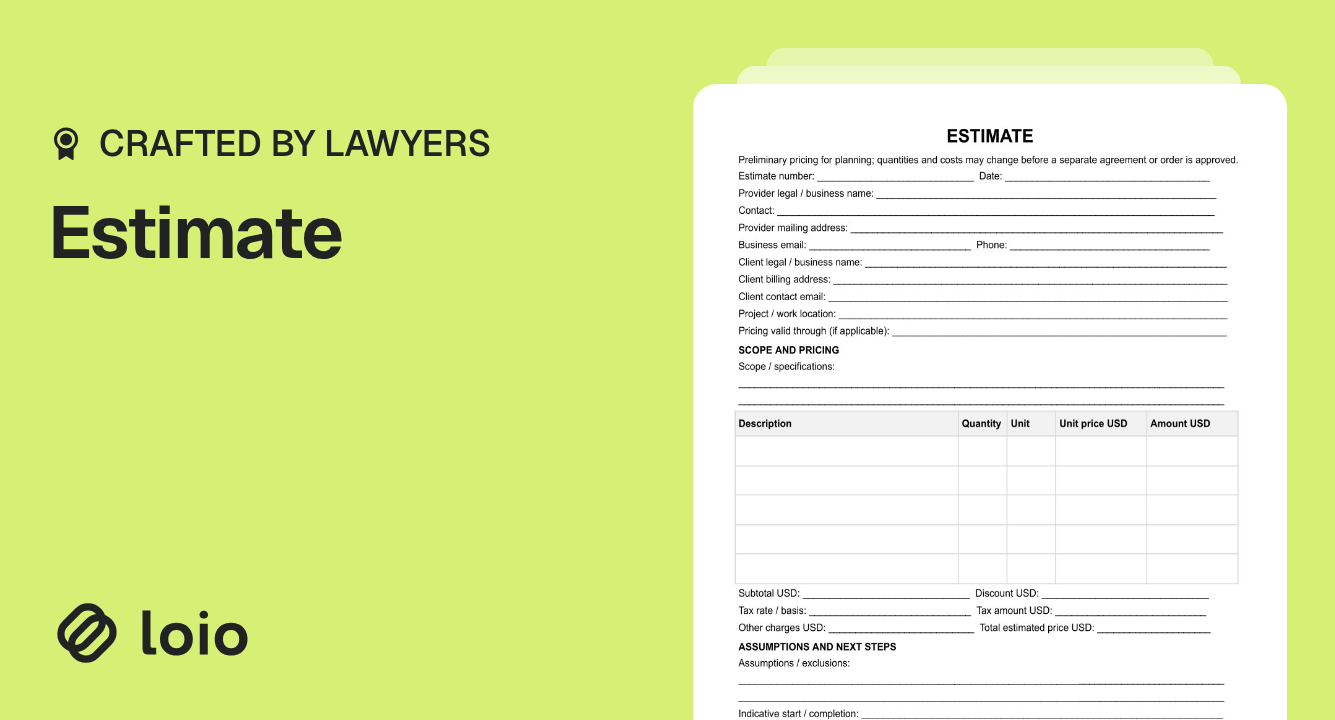
Free Estimate Template
An estimate is a document that shows a client how much a job is likely to cost before the work is fully defined. It is typically used by small businesses and contractors providing services, such as repair shops, cleaning and landscaping companies, and IT firms.
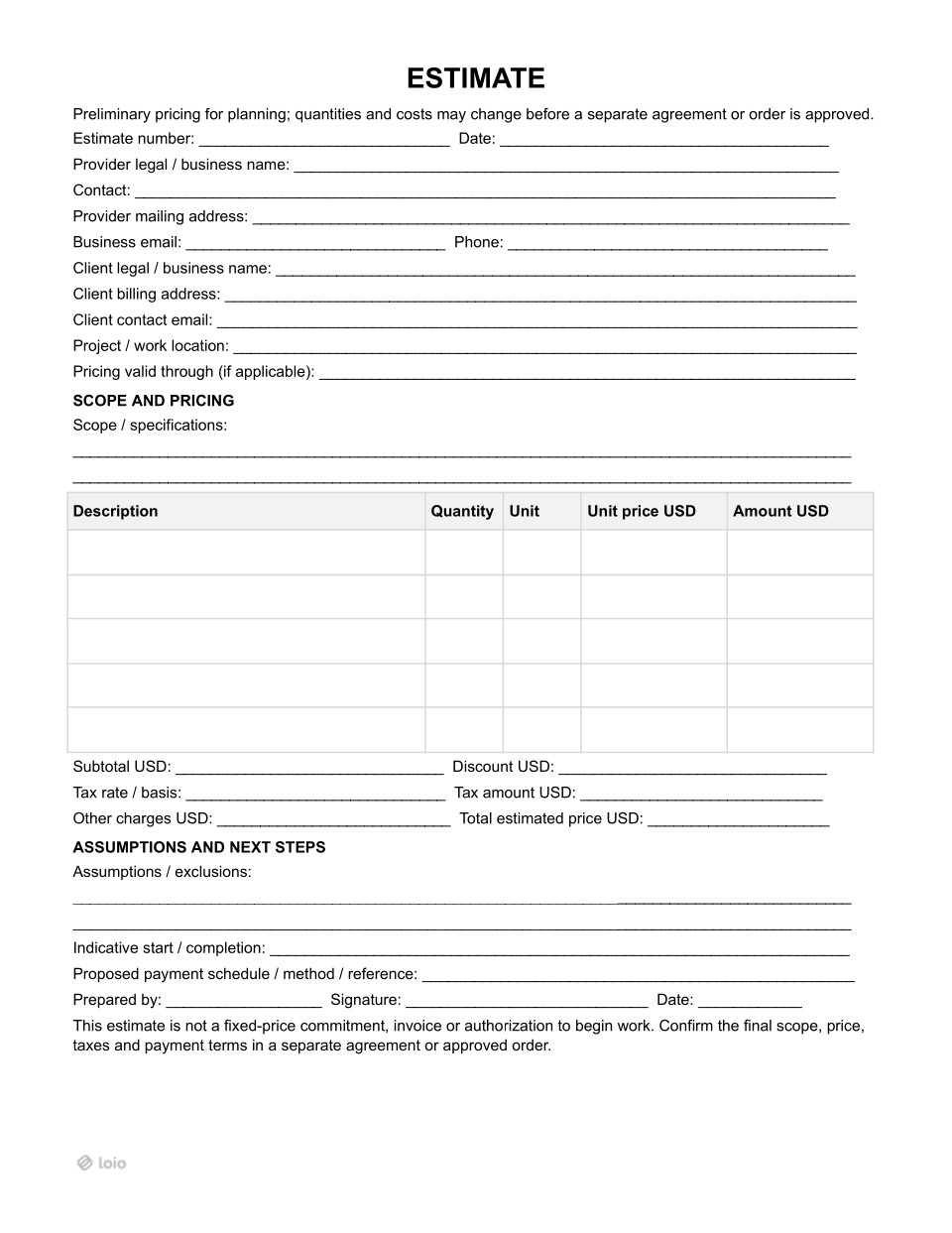
An estimate template lists the scope of work, quantities, unit prices, tax, and the total estimated price, along with the assumptions the number depends on. It works only if the client can see what the price is based on. Then, even if the real job turns out different, the reason for the new price is clear, and the client knows about it before it reaches the bill.
A template for estimates may be used:
After a site visit, when a contractor has seen the job but can’t know everything in advance, like what’s behind a wall or under old flooring;
When a client wants to compare several providers and needs prices side by side;
When a client needs a number for planning or budgeting;
If the work depends on things that may change, like material prices, quantities, or site conditions;
When a subcontractor prices its part of a project for a general contractor preparing a bid.
Do You Need an Estimate, Quote, or Something Else?
Copy section linkWhen a client asks for a price, the right document depends on how firm that price can be:
An estimate gives preliminary pricing that may change.
A quote gives an exact price for a clearly defined job.
An invoice asks for payment for work already done.
Here is how these documents work in practice:
| Situation | Document to use |
|---|---|
| A painter visits a house to price three rooms, but the amount of wall repair will only be clear once the old paint is removed. | Estimate |
| A landscaping company prices a backyard project from the client’s photos and rough measurements. | Estimate |
| An electrician is asked to replace one standard light fixture. | Quote |
| A pool cleaning specialist cleans the client’s pool for the previously agreed sum. | Invoice |
Do not start work as soon as the client accepts the estimate. An estimate is not a legally binding agreement to a fixed price or permission to begin. Start only when you and the client sign a separate agreement that defines the final scope, price, taxes, and payment terms.
How Detailed Should an Estimate Be?
Copy section linkTo make the final choice, clients often compare several estimates, looking at the totals. The more detailed work estimate template you present, the easier it is for the client to understand the reasons if the price changes later.
Name the grade, size, or standard that affects the cost. Otherwise, an estimate with cheaper materials can look like a better deal when it is not. For example, two flooring companies price the same living room. One writes “laminate flooring,” the other writes “12 mm water-resistant laminate, AC4 rating.” The second estimate is higher, but the client can see why.
Do not write lump sums because they are too general. Instead, list items priced per unit (per square foot, per hour, per item) – they show exactly why the price changes when the real quantity differs.
The work location matters too. It ties the estimate to a specific site and, in many states, decides which tax rate applies.
If you’re a subcontractor pricing for a general contractor, name the drawings or specifications the price is based on, for example, “Electrical drawings E1–E4, revision 2.”
How to Show Discount, Tax, and Other Charges
Copy section linkThe price in an estimate form is usually built in this order:
- Subtotal;
- Discount;
- Tax;
- Other charges;
- Total estimated price.
It helps to show what the price is calculated on and persuades the client you haven’t just made it up.
Subtotal $4,000, discount $200, tax 8% on $3,800 = $304, disposal fee $150. Total estimated price: $4,254.
For work done at the client’s site, the tax rate usually depends on where the work is done, not where the provider’s office is. In states that tax by destination, such as Washington, the local rate of the place where the client receives the service applies. Whether a service is taxed at all also depends on the state. If it is not taxable, the estimate should say so rather than leave the line blank.
What If the Job Costs More Than Estimated?
Copy section linkAn estimate can change, but the change should never come as a surprise. The best way for the provider to protect themselves from disputes over pricing with the client is to write a clear list of assumptions and exclusions: show what the price depends on and what it does not include.
Here’re the things that can impact the total cost:
Site conditions (“Price assumes no rotted subfloor”);
Materials the client supplies (“Client provides tiles”);
Quantities taken from the client (“Based on client’s floor plan”);
Work not included (“Furniture moving not included”).
Each assumption written down turns a later price increase into a change with a clear cause. For instance, a roofer’s estimate says, “Price assumes the roof deck is in good condition.” When the old shingles come off, two sheets of the deck are rotten. The client can see that the extra cost comes from an assumption that turned out wrong, not from a pricing mistake.
Agree on how a higher price gets approved before you start working. A simple rule works in any trade: if the price goes more than an amount agreed in the estimate, the provider should inform the client, get their agreement, and document it.
A “price valid until” date suits prices that depend on supplier costs, like lumber or copper; after that date, the provider should update the estimate.
The planned start and completion dates are a planning window, not a deadline, and work best when tied to the client’s approval date, for example, “Start within 2 weeks of approval, about 5 working days.”
From Estimate to Signed Agreement
Copy section linkOnly the provider signs a completed professional estimate template, and that signature does not have legally binding power. The deal becomes valid when the provider and the client sign a service agreement or a construction contract that outlines the final scope, price, taxes, and payment terms. The same goes for deposits. An estimate can propose a payment schedule, but a deposit is requested under the agreement.
If the agreement you sign with the client has an “entire agreement” clause, it means only what is written in the agreement counts. Assumptions, exclusions, and the overrun approval rule that stay only in the estimate drop out, so they need to be repeated in the agreement.
How Loio Helps With Estimates
Copy section linkEstimates are often rebuilt: the scope of work changes, the prices rise, the deadlines become tougher. With Loio, you do not have to create a new document from scratch every time you add a new figure. Instead, you create one document, copy it, and keep all your versions in one place:
Open the estimate template in Loio Templates and fill in the details, scope, and line items.
Add the company logo with the PDF editor and electronically sign the estimate.
Save the estimate in the account and share the final copy with the client. If they have any questions or concerns, they can leave their comments directly in the document.
Prepare a service agreement and send it to the client for review. Once you agree on all the terms, add your electronic signature and request the client’s signature. When they sign, you’ll receive a notification, and the document will be available in your account.
What is a written estimate?
A written estimate is a document from a provider that shows the expected cost of a job: the scope, quantities, prices, taxes, and the total. It helps the client plan and compare offers. The price can change if the scope or quantities change.
Are estimates the same as quotes?
No. An estimate is preliminary pricing that can change. A quote is a firm price for a clearly defined job, which usually stays the same if the client accepts it as is.
Is an estimate legally binding?
No, it’s not. An estimate is preliminary pricing, not a fixed-price commitment or permission to start work. The price becomes binding in a separate agreement or approved order.
How long is an estimate valid?
There is no general rule. The provider sets the period, often 15 to 30 days, or longer for stable prices. After that date, the estimate is usually updated.