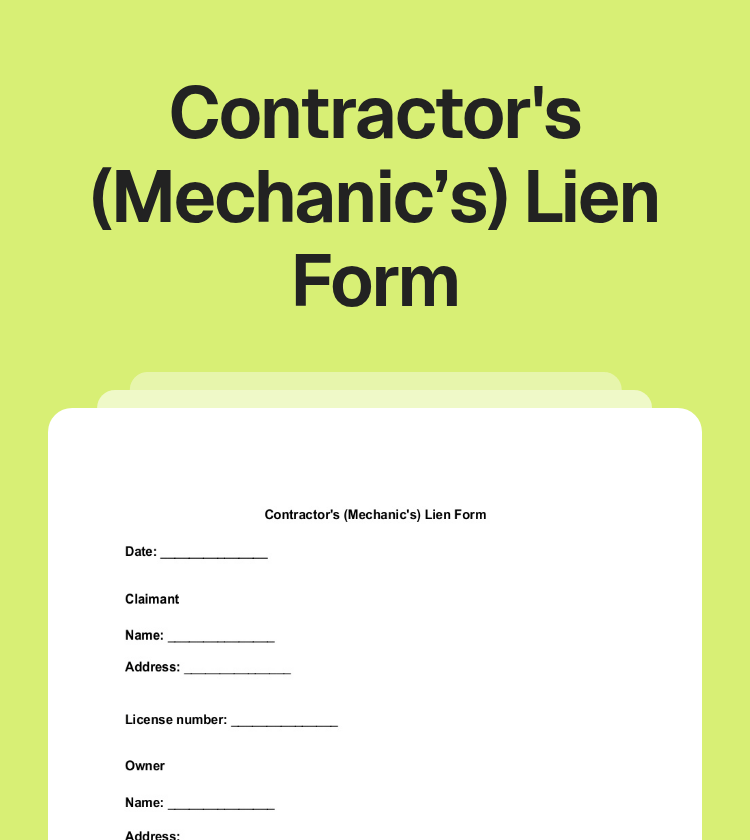
A Mechanic’s Lien Form is a legal notice between a contractor and a property owner asserting a claim for unpaid labor or materials. It is used to protect workers’ rights and ensure payment for construction-related work.
In a lien document, “mechanic” means any subcontractor, supplier, or contractor. As a result, the scope of a contractors lien form and a mechanic's lien is equivalent. The same objective is being pursued: safeguard the rights of construction industry experts who haven’t been paid and may have to sue property owners to get their money.
Completing a mechanics lien example requires a couple of essential steps. To streamline this process with Loio Templates, follow these instructions:
Create your form: Find a printable mechanic lien form on Loio and answer all the guided questions presented to you. These responses will efficiently be auto-filled into your form.
Review your document: Before proceeding, perform a detailed check of your completed form. All information should be accurate and reflect the services or materials supplied.
Save the form: The completed document will be available on your Loio account. You may edit, change, or sign it later.
Sign digitally: Employ the Loio Sign feature. It's a simple way to digitally validate your document.
Submit your form: Finally, submit the completed and signed form to the correct county recorder or clerk's office. Ensure this is done within any stipulated timelines set by local laws.
Send a copy: Forward a duplicate of the mechanics lien form PDF or hard copy to the property owner.
What Makes a Contractor's Lien Form Legally Binding?
To ensure the legality of a mechanic's lien form, specific steps must be carefully adhered to. Firstly, the form should be filled out accurately. Any errors or omissions can invalidate the lien.
Secondly, the claimant, who could be the contractor or their authorized representative, must duly sign the form. The signature signifies agreement and assertion of the facts presented in the document.
Finally, the form needs to be filed within a certain period. This timeframe is controlled based on the regulations of the local area. The capacity to enforce the lien may be impacted if the documentation is submitted later than expected.
You can access a contractor's (mechanic’s) lien form through these resources:
Online legal document providers: Many online platforms offer free and paid legal templates. Loio Templates is one of these recourses where you can find a contractor's (mechanic's) lien form.
Local county clerk's office: They might give you the necessary form or direct you to helpful resources.
Legal assistance: Seek out a lawyer to assist in creating a customized form that complies with local regulations. An attorney can also be located through online legal directories like Loio Match.
It all depends on the laws of your state. To illustrate, Texas laws require a notary acknowledgment of the lien form. This is done in front of a notary public who is responsible for verifying your identification and sealing the document. As a contrary example, in certain states like New York, notarizing a contractor lien form isn’t necessary.
Since the rules vary, the best approach is to check your state's specific requirements. You can contact your county clerk's office or a local lawyer before filing the lien form.