Plus template
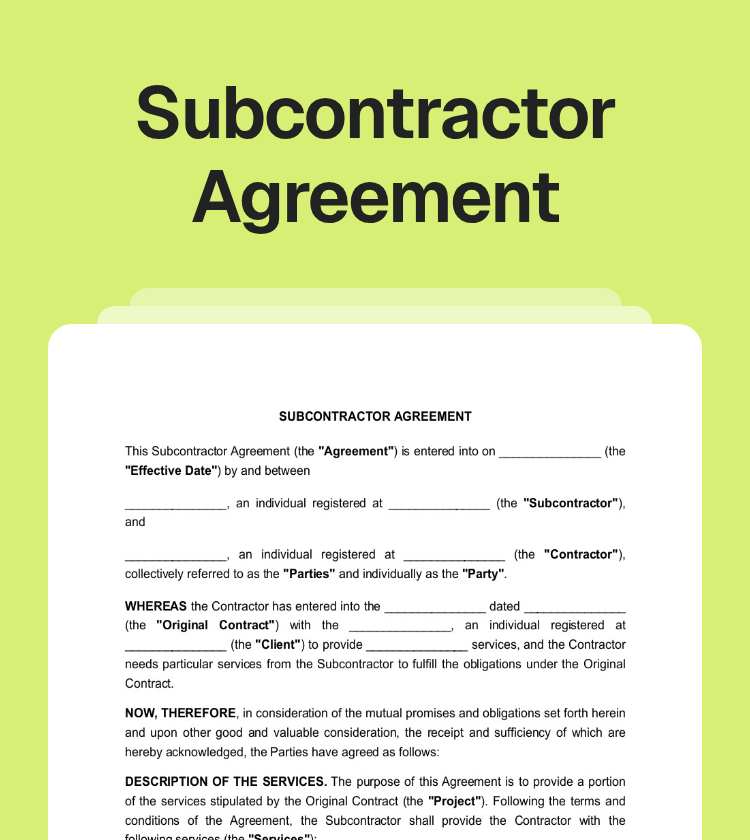
Subcontractor Agreement Template

Template Types
What Is a Subcontractor Agreement
Copy section linkA subcontractor agreement is a contract between a contractor and a subcontractor for work that supports a larger project that the contractor has already agreed to deliver to a client. The contractor hires the subcontractor to handle a specific task: plumbing, electrical work, drywall, roofing, rather than performing every part of the job themselves.
A subcontractor agreement template gives both sides a consistent structure for documenting the scope of work, payment, schedule, and responsibilities, whether the job is a single task on a residential renovation or a recurring arrangement on a commercial build. The same document is sometimes called a subcontractor contract, a sub contractor agreement, or a subcontract agreement, depending on the region or industry.
This agreement is most common in construction, but the same structure applies anytime a contractor delegates part of a project to someone else with specialized skills — for example, a general contractor hiring a specialty subcontractor for a renovation, or a tech consulting firm bringing in an outside developer for part of a client engagement.
A subcontractor agreement always references an underlying contract — the original agreement between the contractor and the client. The subcontractor agreement should be consistent with that original contract, since the contractor remains responsible to the client for the subcontractor's work.
When to Use a Subcontractor Agreement?
Copy section linkUse a subcontractor agreement when:
You're a general contractor outsourcing part of a construction, renovation, or design project to a specialist.
You're hiring someone for a specific trade: plumbing, electrical, HVAC, roofing, concrete, or painting, within a larger job.
You need to clearly define the work site, materials responsibility, schedule, and payment terms before work begins.
You want a written record in case of a dispute over scope, payment, or work quality.
You need the subcontractor's obligations to align with the terms you already agreed to in the original contract with your client.
When Not to Use a Subcontractor Agreement?
Use an independent contractor agreement instead if you are hiring someone directly for a project, without an underlying contract with a separate client that their work supports.
Use a construction contract instead if you are the contractor entering into the original agreement directly with the property owner or client, rather than hiring a subcontractor under an existing contract.
Use an employment contract instead if the worker will be your employee rather than an independent business hired for a defined scope of work.
Who Are the Parties to a Subcontractor Agreement Form?
Copy section linkContractor (general contractor): The party who holds the original contract with the client and is hiring the subcontractor to perform part of that work. The contractor remains responsible for the overall project's completion.
Subcontractor: The individual or business hired to perform a specific portion of the work, typically a specialized trade or task.
Client (referenced, not a signing party): The party who hired the contractor under the original contract. The client does not sign the subcontractor agreement, but is referenced in it, since the subcontractor's work exists to fulfill the contractor's obligations to this client.
What Are the Key Components of a Subcontractor Agreement
Copy section linkEffective date: The date the subcontractor agreement itself takes effect.
Contractor and subcontractor information: Full legal names and addresses for both parties, including business entity details if either party is operating as a company rather than an individual.
Reference to the original contract: A statement identifying the underlying agreement between the contractor and the client, including its date and the client's name, to establish why the subcontractor's work is needed.
Scope of work: A specific description of the services the subcontractor will perform — vague descriptions are one of the most common sources of disputes on construction projects.
Work site: The address or location where the work will take place.
Materials and equipment responsibility: A statement of which party supplies tools, equipment, and materials for the job.
Schedule: The commencement date, completion date, and working hours for the project.
Payment terms: The total price or rate, payment schedule, payment method, and any provisions for late payment interest or penalties.
Insurance requirements: A statement of what insurance coverage, such as general liability or workers' compensation, the subcontractor must carry.
Indemnification: A clause specifying that the subcontractor will cover losses the contractor incurs as a result of the subcontractor's work, and vice versa, depending on how the clause is written.
Termination: The conditions under which either party can end the agreement before the work is complete, and what happens to payment for work already performed. If the scope or terms change later, you can update the agreement directly in PDF editor rather than drafting a new document from scratch.
Signature block: Signature lines for both the contractor and the subcontractor, with printed names and dates.
What Are the Key Terms in a Subcontractor Agreement?
Copy section linkPay-when-paid: A payment clause stating the contractor will pay the subcontractor within a reasonable time after receiving payment from the client — but the contractor must still pay eventually, even if the client is late.
Pay-if-paid: A stricter payment clause stating the contractor only owes the subcontractor if the client actually pays the contractor. Some states restrict or prohibit pay-if-paid clauses because they shift the risk of client non-payment onto the subcontractor.
Mechanics lien: A legal claim a subcontractor can file against a property when they are not paid for labor or materials, securing a security interest in the property until the debt is resolved.
Retainage: A percentage of payment that is withheld until a project or phase is complete, used to ensure the work is finished satisfactorily before the final balance is released.
Change order: A written modification to the original scope of work, used when the project requirements change after the agreement is signed. Without a signed change order, disputes about extra work and extra pay are common.
Indemnification: A contractual promise by one party to cover losses, damages, or legal claims that arise from their actions, protecting the other party from that risk.
Original contract: The underlying agreement between the contractor and the client that creates the obligations the subcontractor is being hired to help fulfill.
How to Fill Out a Subcontractor Agreement Template?
Copy section link- Enter the effective date of the contract for subcontractor.
- Enter the contractor's full legal name and address.
- Enter the subcontractor's full legal name and address.
- Reference the original contract — include its date, the client's name and address, and the type of work it covers.
- Describe the specific services the subcontractor will provide.
- Enter the work site address where the services will be performed.
- State which party is responsible for supplying tools, equipment, and materials.
- Enter the commencement date, completion date, and working schedule.
- State the payment amount or rate, payment method, and payment schedule.
- Add a late payment clause specifying any interest charged on overdue amounts, if applicable.
- State the insurance coverage the subcontractor is required to carry.
- Add an indemnification clause describing each party's responsibility for losses caused by their own work.
- State the conditions under which either party may terminate the agreement.
- Sign and date the agreement — both the contractor and subcontractor should sign, either by hand or electronically.
Does a subcontractor need to be licensed?
It depends on the trade and the state. Many states require specific licenses for electrical, plumbing, and HVAC work, and some require a general contractor license for broader construction work. Hiring an unlicensed subcontractor for work that legally requires a license can create liability for the contractor, including potential fines or unenforceable contracts in some states.
Does a subcontractor need their own insurance?
Most contractors require subcontractors to carry their own general liability insurance and, if the subcontractor has employees, workers' compensation insurance. Requiring proof of insurance before work begins protects the contractor from financial responsibility for accidents or property damage caused by the subcontractor.
Can a subcontractor file a lien if they aren't paid?
Yes, in most states. A subcontractor who is not paid for labor or materials can typically file a mechanics lien against the property where the work was performed, even though they have no direct contract with the property owner. Lien laws and filing deadlines vary significantly by state, so subcontractors should confirm the specific requirements where the work is being performed.
Who pays the subcontractor's taxes?
The subcontractor does. A contractor does not withhold income tax, Social Security, or Medicare from a subcontractor's payments. The contractor's responsibility is generally limited to issuing a Form 1099-NEC for payments of $600 or more in a calendar year.
Is a subcontractor agreement legally binding?
Yes. A signed subcontractor agreement is a legally binding contract, enforceable under state contract law, as long as it includes the basic elements of a valid contract — an offer, acceptance, and consideration (payment for services).
What happens if the subcontractor doesn't finish the work on time?
This depends on what the subcontractor contract template states. Many subcontractor agreements include a completion deadline and may include damages or penalties for late completion, especially if the delay causes the contractor to miss their own deadline with the client. Without a specific clause addressing delay, the contractor's remedies depend on general contract law principles.
What is the difference between a subcontractor and an independent contractor?
An independent contractor is hired directly by a client. A contractor hires a subcontractor to help fulfill a contract the contractor already has with a separate client. In practice, a subcontractor is a type of independent contractor — the distinction is just who hired them and why. See the guide about the difference between a subcontractor and an independent contractor for more.
Can a subcontractor hire their own subcontractors?
Sometimes, if the original subcontractors agreement form allows it, this is called sub-subcontracting and is common on larger projects. The agreement should state whether the subcontractor may delegate work to others and whether the contractor's approval is required.
Requirements for this document vary by state. Review your state's laws and procedures — or consult a licensed attorney — before using this template to ensure it's valid and enforceable where you live.
Sources
Related documents
Also read