Free template
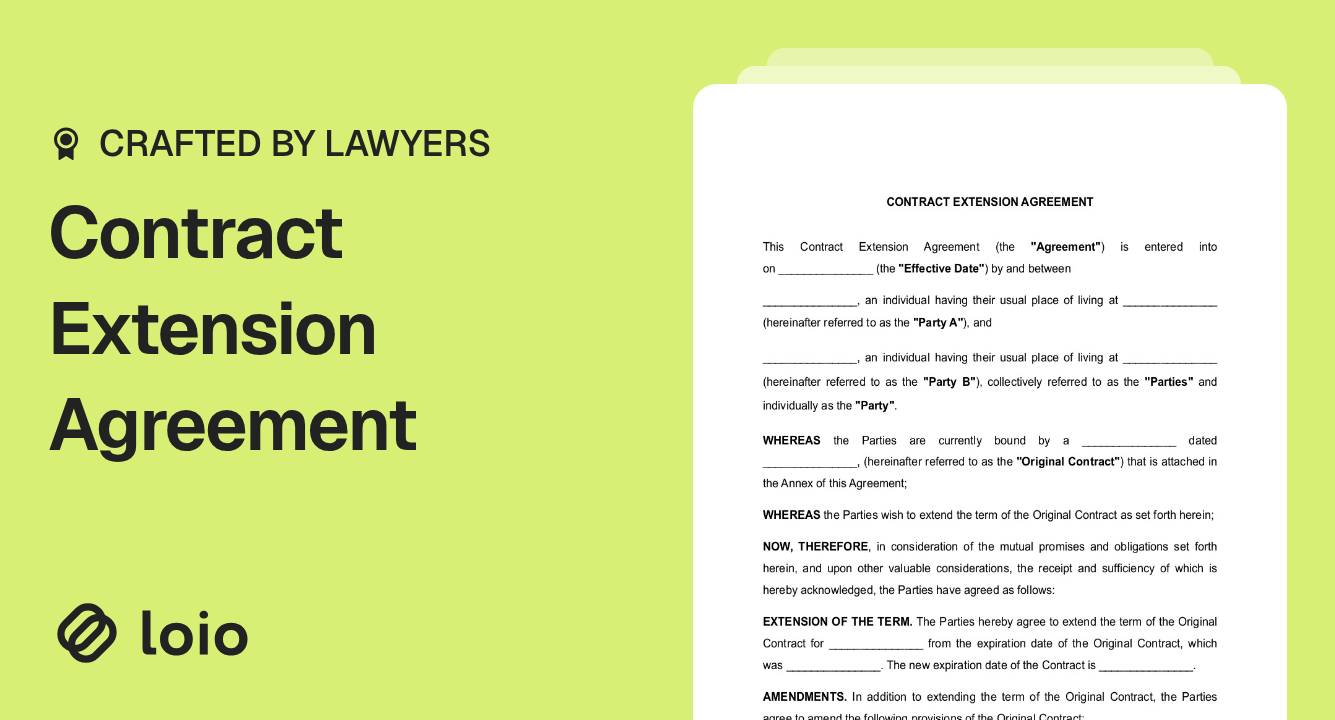
Free Contract Extension Template

What Is a Contract Extension Agreement?
Copy section linkA contract extension template is a short written document that the parties to an existing contract sign when they want to extend the contract beyond its original end date. Rather than negotiating a brand-new contract from scratch, the parties agree to carry the existing terms forward. Usually this means an updated end date and any small adjustments both sides want to make.
This contract extension template works for almost any underlying agreement: service contracts, employment contracts, leases, or contracts for the sale of goods. The document typically restates who the parties are, points back to the original contract by name and date, and sets the new end date. If either side wants to change something more substantial, like the price or the scope of work, that usually calls for a separate amendment rather than a simple extension.
Some people also call this document a contract extension letter, especially when it's short and informal. Others call it an agreement extension template when it's used across a broader range of business relationships. Whatever it's called, the underlying function is the same: it keeps an existing legal relationship alive without starting over.
When to Use a Contract Extension Agreement
Copy section linkA contract extension agreement makes sense any time the underlying work or relationship is going well, but the timeline in the original contract is running out.
Extending a service agreement when a project runs longer than expected
Extending a subcontractor's agreement on a construction project when the job runs past its original schedule
Extending an employment contract before a fixed term ends, if both employer and employee want to continue
Extending a lease before it lapses, when the landlord and tenant want to continue the tenancy
Extending a sale-of-goods or supply contract when delivery is delayed but both sides still want to complete the deal
Putting a verbal agreement to continue in writing, so there's a signed record if a dispute comes up later
When not to use a contract extension agreement:
If the original contract has already expired and significant time has passed, reviving it may require a new contract rather than a simple extension.
If the original contract has a non-extension clause, the parties can't use this document to override that clause.
If either party is in material breach of the contract, extending it can undermine the other party's ability to enforce their rights over that breach.
If the change involves more than the timeline, such as price, scope, or party names, a contract addendum or amendment fits better than an extension.
Parties of the Contract Extension Agreement
Copy section linkParty extending the contract: In the original agreement, this is the individual or company that made the offer. In the extension, they're agreeing to continue under the same or slightly adjusted terms.
Party accepting the extension: Also called the offeree, this is the individual or company that accepted the offer in the original contract and is now agreeing to the extended terms.
Witness (conditional): Some parties involve a witness or notary when signing. This can reduce the chance the extension's validity gets challenged later, though it isn't a legal requirement for most contract types.
Key Components of the Contract Extension Agreement
Copy section link- Reference to the original contract: Names the original contract, its date, and the parties involved, so there's no ambiguity about which agreement is being extended.
- Reason for the extension: A brief note on why the parties want to continue, which can matter later if the extension's validity is ever questioned.
- Extension period: States the new end date, or the length of the extension, which is the core purpose of the document.
- Effective date: Marks when the extension itself takes effect, which can be different from the date it's signed.
- Changed or added terms: Lists anything different from the original contract, such as an updated price or a revised scope. An extension isn't meant to quietly change major terms without flagging them.
- Confirmation that other terms remain unchanged: States that everything else in the original contract still applies, so neither party can later argue the extension replaced the whole agreement.
- Termination provisions: Covers what happens if either party wants to end the extended contract early, including any required notice.
- Signatures: Both parties sign to make the extension binding. An unsigned extension carries the same enforceability risk as an unsigned contract.
Key Terms
Copy section linkCounterparts: Copies of the same extension agreement signed separately by each party. A counterparts clause confirms that all signed copies together form one binding instrument, which matters when parties can't sign in person.
Entire agreement: A clause stating that the extension, read together with the original contract, represents the full agreement between the parties. It takes precedence over any prior discussions or arrangements.
Force majeure: A clause covering events beyond either party's control, like natural disasters or government action, that may excuse one or both parties from performing on schedule.
Indemnification: A commitment by one party to cover the other's losses if a third party brings a claim related to the contract. In a consulting extension, for example, the consultant might indemnify the client against liability from their own negligence.
Material adverse change (MAC): A significant negative shift in one party's financial or business condition. A MAC clause lets the other party end the extension if this kind of change happens.
Severability: A clause confirming that if a court finds one part of the extension invalid, the rest of the document still stands.
Automatic renewal (evergreen) clause: A provision in the original contract that renews it automatically for another term unless someone gives notice to stop it. This is different from a contract extension agreement, which is a document the parties actively sign to continue the relationship rather than something that happens on its own.
Amendment: A change to specific terms within an existing contract, such as price or scope, while the contract stays in force. An amendment is not the same as an extension, which only changes how long the contract lasts.
How to Fill Out a Contract Extension Agreement
Copy section link- Enter the reference to the original contract. Add the original contract's name, date, and the parties involved.
- State the reason for the extension. Note briefly why the parties want to continue.
- Set the new extension period. Enter the new end date, or the length of the extension if there's no fixed end date.
- Enter the effective date. Add the date the extension itself takes effect, if that's different from the signing date.
- Note any changed terms. List anything different from the original contract, such as updated pricing or a revised scope of work.
- Confirm the rest stays the same. State that all other terms of the original contract remain in effect and unchanged.
- Add termination provisions. Note what would trigger an early end to the extended contract and how much notice either side must give.
- Sign and date. Both parties sign. Consider adding a witness or notary if either side wants extra assurance the extension will hold up if it's ever challenged.
For extensions that involve meaningful changes to price, scope, or risk, having a lawyer review the draft before signing can catch problems that aren't obvious from the document alone.
What's the difference between a contract extension and an automatic renewal?
A contract extension is something the parties actively negotiate and sign after deciding to continue. An automatic renewal, sometimes called an evergreen clause, is built into the original contract and renews it on its own unless someone gives notice to cancel. Many states regulate automatic renewal clauses and require sellers to give advance notice before a contract renews. It's worth checking the original contract for one before assuming an extension is even needed.
What's the difference between an extension, an amendment, and an addendum?
An extension changes only how long the contract lasts. An amendment changes specific terms within the existing contract, like price or scope, while everything else stays the same. An addendum adds something new to the contract that wasn't addressed at all in the original, such as a new clause or exhibit. The three can overlap in practice, but each does a different job.
Can you extend a contract after it has already expired?
It depends on how much time has passed and what the original contract says. If the expiration was recent and both parties still intend to continue, a written extension can sometimes cover the gap. If significant time has passed, courts are more likely to treat this as a new contract rather than a continuation of the old one. In that case, it's safer to draft a new agreement instead.
How much notice do you need to give before extending a contract?
There's no universal notice period for a negotiated extension. It depends on what the original contract requires and how much lead time both sides need to plan. If the original contract has an automatic renewal clause instead, the rules are different. Several states require the party relying on it to give notice within a specific window, often somewhere between 15 and 90 days before the contract would otherwise end.
What are the rules for contract extension?
Two layers of rules apply. The first is common law and state contract law, the general legal framework that governs how any contract is formed, modified, and enforced. The second is private law: the specific terms the parties themselves agreed to in the original contract, including any clause about how it can be extended. The core rule from both layers is mutual agreement. Both parties have to agree to continue, and that agreement should be documented in writing and signed. The extension should clearly reference the original contract, state the new timeframe, and confirm which terms are changing and which are staying the same. If the contract governs the sale of goods, the extension may also need to satisfy the same written-agreement rules that applied to the original contract.
What is a good reason for extension of contract?
Common reasons include a project running behind its original schedule, or both parties being satisfied with how the relationship is going. A delay in deliveries can also push back the timeline. Sometimes it's simply a mutual decision to keep working together past the original end date without renegotiating the whole deal.
Is a contract extension agreement legally binding?
Yes, once both parties sign it. A signed extension is enforceable the same way the original contract is, since it's built on the same mutual agreement and consideration.
Do both parties need to sign a contract extension?
Yes. Because an extension changes the parties' ongoing obligations, both sides need to agree to it in the same way they agreed to the original contract. One party can't unilaterally extend a contract the other party hasn't consented to.
Statutory references
Related Documents
Also Read