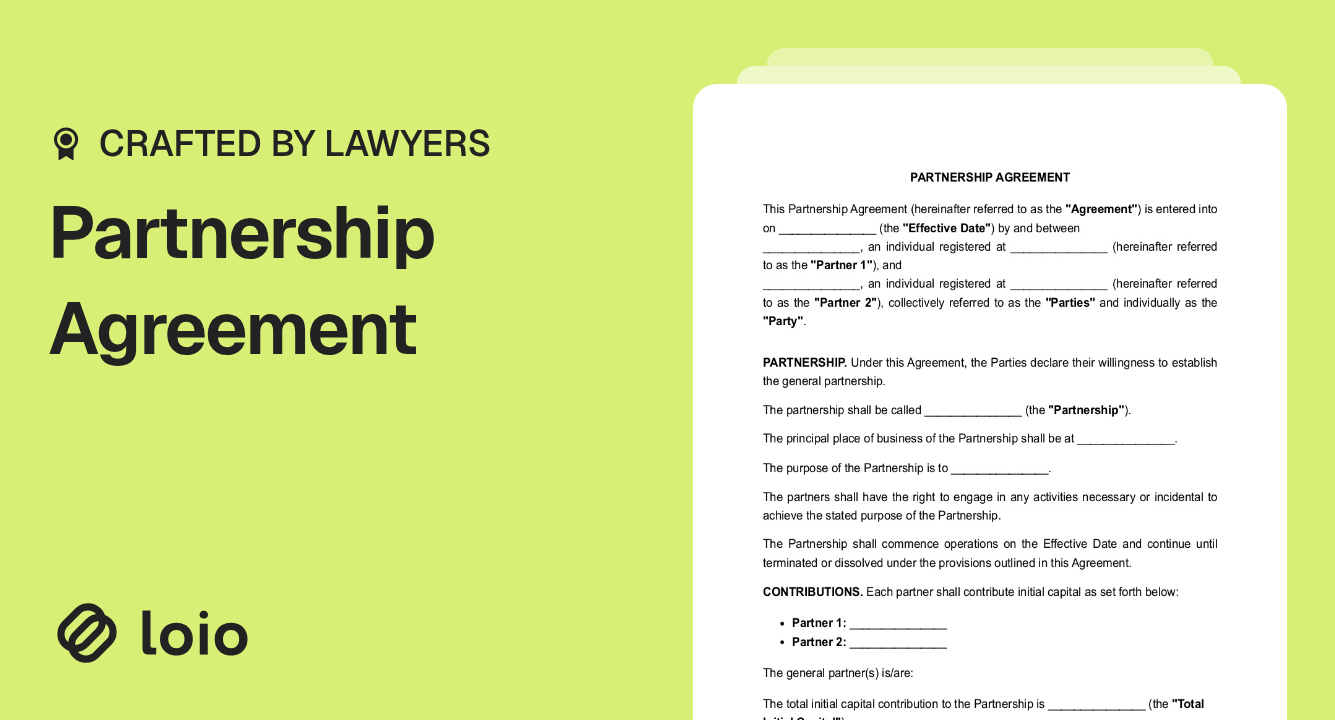
Free template
Free Partnership Agreement Template

Template Types
What Is a Partnership Agreement?
Copy section linkA partnership agreement is a written contract that sets the rules for how a business partnership will operate. It documents each partner's contributions, ownership percentage, responsibilities, and share of profits and losses, before disputes arise.
A business partnership agreement template gives partners a structured starting point so nothing important is left out. The same document is sometimes called a business partnership contract, a partnership contract template, or simply a partnership contract, depending on the context.
Without a written agreement, state law fills the gaps. Most states follow the Uniform Partnership Act (UPA) or the Revised Uniform Partnership Act (RUPA), which set default rules for profit splitting, management rights, and partner liability. Those default rules may not reflect what the partners actually agreed to, and fixing a dispute after the fact is far more expensive than drafting the agreement up front.
A partnership agreement is also distinct from an LLC operating agreement. A partnership agreement governs a general, limited, or limited liability partnership. An operating agreement governs a limited liability company. The two structures have different legal and tax implications, so using the correct document matters.
When to Use a Partnership Agreement
Copy section linkUse a business partnership agreement when:
Two or more people are starting a business together and want clear rules in place from day one.
Co-founders want to formalize how profits, losses, and ownership will be divided.
Partners are contributing different amounts: cash, property, labor, or skills, and want those differences reflected in ownership percentages.
The business needs a documented decision-making process, including which decisions require unanimous approval.
Partners want a plan in place for what happens if one partner wants to leave, retires, becomes incapacitated, or dies.
The partnership will have both active managing partners and passive investors, each with distinct rights and responsibilities.
A bank or investor requires a signed partnership agreement before extending credit or funding.
When not to use a partnership agreement
Copy section linkUse an LLC operating agreement instead if you are forming an LLC. An operating agreement is the correct governing document for an LLC and provides liability protection that a partnership does not.
Use a joint venture agreement instead if two parties are collaborating on a single project or transaction, not a continuing business relationship.
Use an independent contractor agreement instead if one party is providing services for compensation without an ownership stake in the business.
Who Are the Parties to a Partnership Agreement?
Copy section linkPartner 1 / Partner 2 (and additional partners): The individuals or entities forming the partnership. Each partner's full legal name, address, and ownership percentage should be identified in the agreement.
Managing partner (conditional): A partner designated to handle day-to-day operations and make routine business decisions without requiring full partner approval. Not all partnerships designate a managing partner.
Limited partner (conditional): A passive investor who contributes capital but does not participate in management. A limited partner's liability is generally capped at the amount they contributed. Required in limited partnership structures.
General partner (in a limited partnership): The partner who manages the business and retains personal liability for the partnership's debts and obligations.
Registered agent (conditional): A person or entity designated to receive legal notices on behalf of the partnership in the state of formation. Required in some states when a limited partnership files with the Secretary of State.
Witness or notary (conditional): Partnership agreements do not typically require notarization to be enforceable, but some partners choose to have signatures witnessed or notarized for added formality or to satisfy lender requirements.
What Are the Key Components of a Partnership Agreement?
Copy section linkPartnership name and principal place of business: Identifies the legal name under which the partnership operates and the address where it is primarily located.
Purpose of the partnership: Describes the business activity the partnership is formed to carry out. A clear purpose prevents disputes about scope later.
Effective date and duration: States when the partnership begins and whether it continues indefinitely or ends on a specific date or upon a triggering event.
Partner information: Full legal names, addresses, and contact details for each partner.
Capital contributions: Records what each partner is contributing to start the business: cash, property, equipment, labor, or intellectual property, and the agreed value of any non-cash contributions.
Ownership percentages: Specifies each partner's ownership share, which determines their claim on assets, profits, and losses. Percentages must total 100%.
Profit and loss allocation: States how profits and losses are divided among partners — equal shares, proportional to ownership, or another agreed arrangement.
Partner draws and salaries: Specifies whether partners may take regular draws from partnership funds, receive a salary for services rendered, or both.
Decision-making and voting rights: Sets out which decisions any partner can make independently, which require a majority vote, and which require unanimous agreement of all partners.
Partner duties and responsibilities: Describes each partner's role in the business and any restrictions on outside activities that might conflict with the partnership.
Banking and financial management: Identifies the partnership's bank account, who has signing authority, and how financial records will be maintained.
Admission of new partners: States the process and conditions under which new partners may be admitted and whether existing partners must consent.
Partner withdrawal and buyout: Explains what happens if a partner wants to leave — how their interest is valued, how they are paid out, and whether the partnership continues or dissolves.
Dissolution: Sets the conditions under which the partnership may be voluntarily wound down and how the process will be managed.
Dispute resolution: Specifies how disagreements between partners will be handled — negotiation, mediation, or arbitration — and the governing state.
Signature block: Signature lines for all partners, with printed names and dates.
What Are the Key Terms in a Partnership Agreement?
Copy section linkGeneral partnership: A business structure in which all partners share management responsibilities, profits, losses, and personal liability for the business's debts.
Limited partnership (LP): A structure with at least one general partner (who manages the business and has unlimited liability) and at least one limited partner (who is a passive investor with liability limited to their contribution).
Limited liability partnership (LLP): A partnership structure that gives some or all partners protection from personal liability for certain business debts or the actions of other partners, depending on state law.
Capital contribution: The money, property, or other assets a partner contributes to the partnership to fund operations or acquire ownership.
Profit and loss allocation: The method by which the partnership's financial gains and losses are divided among partners, as specified in the agreement.
Partner draw: A withdrawal of funds from the partnership by a partner, typically against their share of anticipated profits.
Buy-sell agreement: A provision (or separate document) that establishes how a departing partner's ownership interest will be valued and purchased by the remaining partners.
Dissolution: The formal process of winding down a partnership, settling its obligations, and distributing remaining assets to partners.
Uniform Partnership Act (UPA) / Revised Uniform Partnership Act (RUPA): Model laws adopted in whole or in part by most states that provide default rules for partnerships when no written agreement addresses a specific situation.
Fiduciary duty: The legal obligation each partner owes to the partnership and to other partners to act in good faith and in the best interests of the partnership.
How to Fill Out a Partnership Agreement Template?
Copy section link- Enter the date the agreement is being signed.
- Enter each partner's full legal name and address. If a partner is a business entity rather than an individual, include the entity's legal name, type (LLC, Corp, etc.), and state of formation.
- Write the partnership's name and principal place of business.
- Describe the purpose of the partnership — what business activity it is formed to carry out.
- State the effective date and whether the partnership has a fixed end date or continues indefinitely.
- Record each partner's capital contribution — the amount of cash, value of property, or description of services contributed. Note the deadline by which contributions must be made.
- Enter each partner's ownership percentage. Confirm that all percentages add up to 100%.
- Set the profit and loss allocation — how earnings and losses are divided. This can mirror ownership percentages or follow a different agreed arrangement.
- State whether partners will receive salaries, draws, or both, and describe the process for approving distributions.
- Define the decision-making structure: which decisions individual partners can make, which require a majority, and which require unanimous consent.
- Identify the managing partner, if applicable, and describe their authority and responsibilities.
- Specify the partnership's fiscal year and where financial records will be maintained.
- State the process for admitting new partners, including which approvals are required.
- Set the rules for partner withdrawal, including notice period, valuation method, and buyout payment terms.
- Describe the conditions and process for dissolving the partnership.
- Specify how disputes will be resolved and which state's law governs the agreement.
- Have all partners sign by hand, or with eSign, with printed names and dates.
What Is the Difference Between a Partnership and an LLC?
Copy section linkBoth structures allow multiple people to own and operate a business together, but they differ in two significant ways: liability and taxation.
In a general partnership, all partners are personally liable for the business's debts and obligations. A creditor can pursue a partner's personal assets if the business cannot pay. In an LLC, members are generally protected from personal liability for business debts — their exposure is typically limited to what they invested.
For taxes, both structures are usually pass-through entities, meaning income is reported on the partners' or members' personal returns rather than at the entity level. However, an LLC may elect to be taxed as a corporation, which a general partnership cannot.
For businesses where partners want ownership flexibility without personal liability exposure, an LLC is often the stronger structure. If you are forming an LLC, use an LLC agreement rather than a partnership agreement.
Is a partnership agreement legally binding?
Yes. A signed partnership agreement is a legally binding contract. Courts will generally enforce their terms if a dispute arises between partners. If the agreement conflicts with mandatory state law provisions, state law controls — but most partnership rules are default rules that parties may modify.
How do you create a simple partnership agreement?
Identify the partners, the business purpose, each partner's contribution, ownership percentages, and how profits and losses will be split. Add a process for decisions, a plan for partner exits, and a dispute resolution clause. A well-structured template covers all of these fields and guides you through each step.
What is the golden rule of partnership?
There is no single legal "golden rule," but the most-cited principle in partnership law is the duty of good faith — each partner must act honestly and in the best interests of the partnership, not just their own. This obligation exists under law even if the agreement does not state it explicitly.
Does a partnership agreement need to be notarized?
Generally no. A partnership agreement is enforceable without notarization as long as all partners sign it. Some lenders or state registration processes may require notarized signatures, so check the requirements in your state and any financing arrangements before signing.
What happens if partners operate without a written agreement?
State law governs the partnership by default. In most states, this means profits and losses are split equally among partners regardless of their contributions, and all partners have equal management rights. These defaults may not match what the partners intended, which is why a written agreement is important.
Can a partnership agreement be amended after signing?
Yes. Partners can amend the agreement at any time, provided all partners (or the required majority, as stated in the agreement) consent to the change. Amendments should be made in writing and signed by all required partners.
What taxes does a partnership pay?
A general partnership is a pass-through entity for federal tax purposes. The partnership files an informational return on IRS Form 1065 but does not pay income tax at the entity level. Each partner reports their share of profits and losses on their personal tax return. Partners may also owe self-employment tax on their share of business income.
Can a partnership agreement force a partner out?
Yes, if the agreement includes a buyout or removal clause. Without such a clause, removing a partner is significantly more difficult and may require dissolution of the partnership. This is one of the most important reasons to address partner exit terms in the agreement before the business is underway.
Requirements for this document vary by state. Review your state's laws and procedures — or consult a licensed attorney — before using this template to ensure it's valid and enforceable where you live.
Sources
Related documents
Also read