Free template
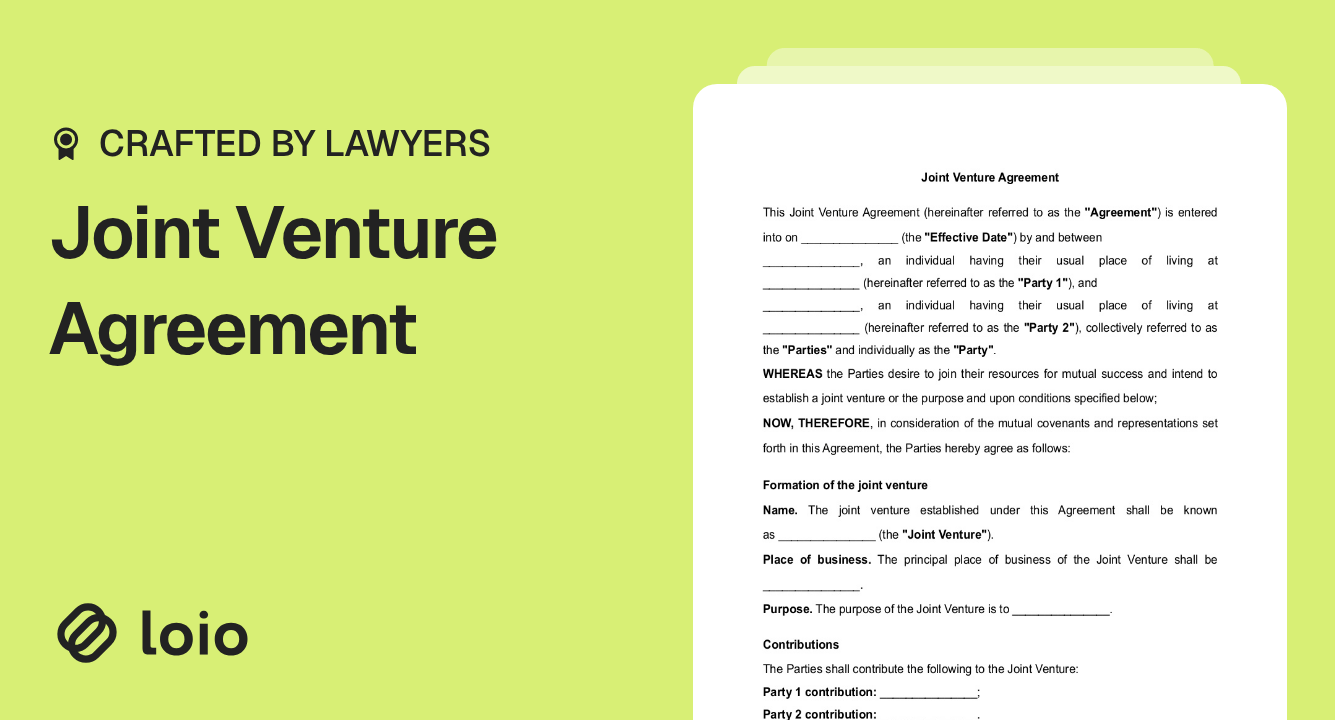
Free Joint Venture Agreement Template

What Is a Joint Venture Agreement?
Copy section linkA joint venture agreement is a legally binding contract that establishes the terms under which two or more parties will collaborate on a specific project, transaction, or business objective. The parties may contribute money, property, technology, intellectual property, industry knowledge, employees, or other resources while continuing to operate as separate businesses.
Unlike a merger, a joint venture does not necessarily combine the parties into one permanent organization. The parties may operate through a contractual arrangement or create a separate entity, such as a limited liability company or corporation. The chosen structure can affect ownership rights, personal liability, registration requirements, and taxation.
A joint venture agreement template helps the parties document the venture’s purpose, ownership distribution, management responsibilities, financial arrangements, and dissolution process. A detailed JV contract can also address confidential information, intellectual property, disputes, and what happens when the project is completed or one party wants to leave.
When to Use a Joint Venture Agreement
Copy section linkA joint venture agreement is useful when two or more parties plan to share resources, risks, and potential returns without permanently combining their businesses. Common situations include:
Two companies want to develop and market a new product together.
A business wants to enter a new geographic market with help from a local company.
Several businesses want to combine their experience and resources to bid on a major contract.
Corporations plan to share technology, equipment, employees, distribution channels, or industry knowledge.
Two developers want to complete a real estate or construction project together.
Businesses plan to conduct joint research or develop intellectual property.
Parties want to operate a temporary business venture for a defined period.
Companies want to test a business relationship before considering a longer-term partnership or merger.
When not to use a joint venture agreement
Use a partnership agreement when the parties plan to own and operate an ongoing business together rather than complete a limited project.
Use an LLC operating agreement to govern a limited liability company created for the venture.
Use a memorandum of understanding to record preliminary intentions before the parties are ready to sign a detailed binding contract.
Use a collaboration agreement when the parties will cooperate on a project but will not share ownership, profits, or losses.
Parties to the Joint Venture Agreement
Copy section linkParty 1 and Party 2 — Joint venturers: The individuals or legal entities contributing resources to the venture and sharing the rights, responsibilities, risks, and returns described in the agreement.
Additional joint venturers, if applicable: Any other individuals, corporations, LLCs, or organizations participating in the venture under the same or separately negotiated terms.
Joint venture entity, if formed: A separate LLC, corporation, or partnership created to own assets, enter contracts, receive revenue, and conduct the venture’s operations.
What to Include in a Joint Venture Agreement
Copy section linkA complete joint venture contract template should address each part of the business arrangement clearly:
- Effective date and party information: Identifies when the agreement begins and provides the full legal names and addresses of every joint venturer.
- Joint venture name, location, and purpose: States the venture’s operating name, principal place of business, and the specific project or objective it will pursue.
- Initial contributions: Records the money, property, services, equipment, intellectual property, employees, or expertise each party will provide.
- Ownership interests: Specifies each venturer’s percentage of ownership or equity in the venture.
- Profit, loss, and distribution rules: Explains how financial gains, losses, and payments will be allocated among the parties.
- Management and voting: Defines who manages daily operations, how voting rights are calculated, and which decisions require majority or unanimous approval.
- Roles and responsibilities: Describes the work, deliverables, staffing, approvals, and operational duties assigned to each party.
- Authority and restrictions: States who may sign contracts, borrow money, spend venture funds, or make commitments on behalf of the venture.
- Banking, accounting, and financial records: Establishes how bank accounts, books, income statements, tax records, and financial reports will be maintained and reviewed.
- Expenses, compensation, and additional funding: Explains how expenses are approved, whether venturers receive compensation, and what happens if the venture needs more capital.
- Intellectual property: Distinguishes pre-existing intellectual property from materials created during the venture and states who may own, license, or use each asset.
- Confidentiality: Protects trade secrets, customer information, financial data, technical materials, and other non-public information exchanged during the venture.
- Liability, insurance, and indemnification: Allocates responsibility for claims, debts, damages, regulatory violations, and required insurance coverage.
- Term and project milestones: States how long the JV agreement remains in effect and identifies important deadlines or completion events.
- Transfers, withdrawals, and buyouts: Establishes whether a party may sell or transfer its interest and how a departing party’s share will be valued.
- Dispute resolution and governing law: Identifies the state law governing the agreement and whether disputes will proceed through negotiation, mediation, arbitration, or court.
- Dissolution and winding up: Lists events that end the venture and explains how debts, contracts, intellectual property, and remaining assets will be handled.
Key Terms in a Joint Venture Agreement
Copy section linkContribution: Money, property, services, technology, intellectual property, labor, or another resource provided to the venture by a party.
Profit and loss allocation: The formula used to divide the venture’s financial gains and losses among the parties.
Distribution: Money or property paid from the joint venture to its participants.
Background intellectual property: Intellectual property owned by a party before the venture begins or developed outside the venture.
Dissolution: The process of ending the joint venture, paying its debts, completing outstanding obligations, and distributing remaining assets.
How to Fill Out a Joint Venture Agreement
Copy section linkLoio’s interactive system guides the parties through the document fields. Before completing the joint venture agreement template, the parties should agree on the main financial, operational, and ownership terms.
- Enter the effective date and party details. Add the agreement start date and the full legal names and addresses of all joint venturers.
- Define the joint venture. Add the venture’s name, principal place of business, purpose, project scope, term, and key milestones.
- Describe contributions and ownership interests. List each party’s cash, property, services, equipment, intellectual property, or other contributions and specify their ownership percentages.
- Set financial terms. Explain how profits and losses will be allocated, when distributions will be made, how expenses and compensation will be handled, and how additional funding will be provided.
- Establish management, voting, and authority rules. Identify who manages the venture, how major decisions are approved, and who may sign contracts, approve expenses, hire workers, borrow money, or otherwise bind the venture.
- Assign roles and responsibilities. Define each party’s duties, deliverables, staffing commitments, deadlines, performance standards, and reporting obligations.
- Add banking, accounting, intellectual property, and confidentiality terms. Specify financial procedures, ownership or licensing of intellectual property, and requirements for protecting confidential information.
- Address liability, indemnification, and insurance. State how liability will be allocated, whether indemnification applies, and what insurance coverage the parties or venture must maintain.
- Set transfer, withdrawal, dispute, and dissolution procedures. Explain how interests may be transferred or bought out, how disputes will be resolved, which state’s law applies, and how the venture will be wound up.
- Review the general terms and sign the agreement. Confirm provisions on notices, amendments, assignment, severability, and the entire agreement before all parties sign and date the document.
How Are Profits and Ownership Handled in a Joint Venture?
Copy section linkOwnership percentages may be based on the value of each party’s contribution, but they do not have to be. The parties may negotiate ownership based on money invested, intellectual property provided, work performed, commercial relationships, risk assumed, or another agreed factor.
The JV agreement should separately address ownership, voting power, profit allocation, and cash distributions. These percentages are often the same, but they may differ. For example, one venturer may own 40% of the venture but receive a larger share of early distributions until an initial investment is recovered.
The agreement should also state how often profits may be distributed, how much working capital must remain in the venture, and who approves distributions. Regular income statements and other financial records can help the parties evaluate whether the venture is meeting its economic objectives.
Federal tax treatment depends on the venture’s structure and activities. Many unincorporated ventures operated by two or more parties may be treated as partnerships for federal tax purposes, although exceptions and alternative classifications can apply. The parties should compare the agreement with the current IRS Publication 541 on partnerships and obtain tax advice appropriate to their structure.
Joint Venture vs. Partnership
Copy section linkA joint venture and a partnership both involve parties working together and sharing business results, but they usually differ in scope and duration.
- Usually created for a specific project, transaction, or limited objective.
- May end after the project is completed or a defined event occurs.
- The participants commonly continue operating separate businesses.
- May exist only through a contract or through a separately formed entity.
- Usually created to operate an ongoing business.
- Often continues until the partners withdraw, dissolve the business, or agree to end it.
- The partners jointly operate one continuing business.
- Usually operates through a recognized partnership structure under state law.
How is a joint venture taxed?
Taxation depends on whether the venture is only a contractual arrangement or operates through a partnership, LLC, corporation, or another entity. Many multi-party unincorporated ventures may be treated as partnerships for federal tax purposes, but the parties should confirm their classification with a qualified tax professional.
Can one party leave a joint venture?
A party may leave according to the withdrawal, transfer, termination, or buyout provisions in the JV agreement. The contract should specify the required notice, valuation method, payment terms, and whether the remaining parties may continue the venture.
Who owns intellectual property created by a joint venture?
Ownership depends on the agreement. The parties may assign project intellectual property to the venture, divide ownership between themselves, or allow one party to own it while granting licenses to the others. The contract should also protect intellectual property that each party owned before the project began.
Does a joint venture agreement need to be notarized?
Joint venture agreements generally do not require notarization solely to become effective. Notarization may still be required by state-specific rules, related transaction documents, lenders, government-contracting requirements, or the parties’ internal policies.
Sources
Related Documents
Also Read