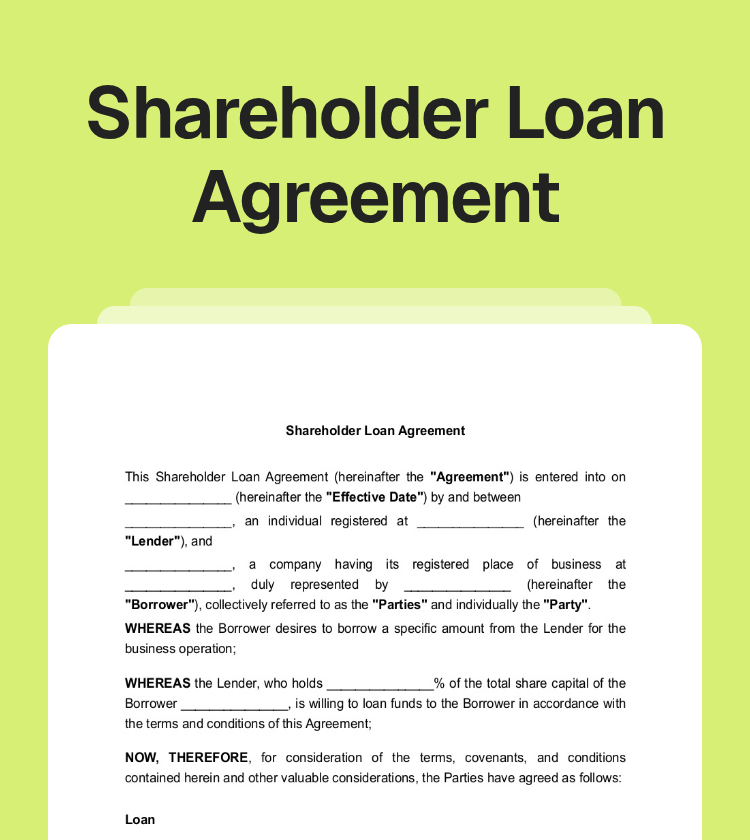
Free template
Free Shareholder Loan Agreement Template

What Is a Shareholder Loan Agreement?
Copy section linkA shareholder loan agreement is a legal document that sets out the terms and conditions of a loan provided by a shareholder to a company in which they hold equity. It documents an effective strategic approach to financing a company while offering lenders interest rates that significantly benefit them (without harming the borrower). A shareholder loan agreement template must outline the loan details, including the total amount, interest rate, repayment terms, collateral, and more.
A well-drafted document defines the relationship between a shareholder and a business, clearly stating the obligations and responsibilities of all parties involved. It prevents disputes and legal disagreements and provides clarity in the eyes of the IRS regarding the nature of the contract.
When to Use a Shareholder Loan Agreement
A shareholder lends money to their company for short-term cash flow or operational needs.
A shareholder wants to provide funding without issuing new shares or changing ownership percentages.
A shareholder has already given money to the company and needs a written record of the loan for tax purposes and IRS compliance.
When not to use a shareholder loan agreement:
If the funds are a permanent capital contribution (use an investment agreement instead).
If the lender is not a shareholder anymore (use a standard loan agreement).
If the shareholder does not expect the company to repay the money.
What Are the Parties to the Shareholder Loan Agreement?
Copy section linkLender: This is the shareholder – an individual, a group of owners, or an external investor – offering the loan to the borrower.
Borrower: The company that receives the funds from the shareholder. The company can be a startup, a small business, or a large corporation. The company involved is usually a company in which the shareholder holds equity.
What to Include in a Shareholder Loan Agreement?
Copy section linkEffective date: A clarification of when the shareholder loan to corporation agreement becomes effective.
Parties: A brief description of the two parties — a company and a shareholder — in the agreement.
Loan: A statement of the amount of money being lent.
Disbursement and expenses: An explanation of when the loan will be paid out.
Interest: A clarification of the agreed-upon annual loan rate.
Term and repayment: A reminder of when the loan is granted (starting from the effective date).
Late repayment: A specification of a higher monthly rate as a punishment for late repayment.
Evidence of loan: A clause for a lender to preserve the paperwork and a reminder of how those records prove that the loan exists.
Warranties: Representations and warranties of the two parties, with clear duties and guarantees from them.
Events of default: A definition of what constitutes a breach of contract and the lender’s right to demand immediate, full repayment if the issues are not fixed.
Force majeure: A provision that releases a party from liability and extends deadlines if extraordinary, uncontrollable events prevent them from meeting their obligations.
Confidentiality: A requirement for both parties not to disclose any details of the agreement or its copy.
Notice: A specification of how formal communications between the parties must be sent and their official addresses.
Governing law and dispute resolution: A determination of which state’s laws will govern the agreement and where any legal disputes must be handled.
Miscellaneous: Additional clauses that usually touch upon severability of the agreement, amendments, the binding nature of the document, etc.
In witness whereof: A confirmation that the parties are signing and executing the agreement in a specified number of identical, legally binding copies.
Signatures: Details and signatures of the parties.
What Are the Key Terms of a Shareholder Loan Agreement
Copy section linkParties: The name and details of the shareholder and the company.
Loan amount: The total borrowed amount.
Interest rate: The interest rate charged on the loan.
Repayment schedule: The schedule of the loan’s repayment, including the frequency and the amount of payments.
Security or collateral: Any security or collateral provided by the company to secure the loan, such as equipment or property.
Default and remedies: The consequences of defaulting, including penalties, late fees, and more.
How to Fill Out a Shareholder Loan Agreement Template?
Copy section link- Outline the terms of the loan, including the loan amount, repayment schedule, interest rate, and other details.
- Add all the necessary details, such as the names and contact information of the parties, the governing law, warranties, and more.
- Specify the penalties that the borrower will face in case of repayment default.
- Both parties should sign and date the shareholder loan agreement template.
- Both parties should have a copy of the agreement for future reference.
What is the IRS imputed interest rule, and how does it apply to a shareholders loan agreement?
The imputed interest rule covers loans that are below the market rate or don’t have interest at all. The IRS will seek to “balance” this situation — it treats the uncharged interest as if it were transferred to the borrower and then paid back to the lender. It essentially creates taxable interest income for the lender.
What is the Applicable Federal Rate?
The Applicable Federal Rate (AFR) is the minimum interest rate published monthly by the IRS that must be charged on a loan to avoid imputed interest. The shareholder loan agreement should specify an interest rate at least equal to the AFR for the month in which the loan is executed.
What is the difference between a secured and an unsecured shareholder loan?
Security, in this case, is the presence of collateral. A secured loan is backed by collateral that a lender can seize if the borrower defaults. An unsecured loan just relies on the borrower’s promise to repay.
Does the IRS distinguish a shareholder loan from a capital (equity) contribution?
Yes, but the IRS can treat a loan as a contribution if there’s little substance to support it. To secure things, you need a written promissory note and a fixed repayment schedule. To avoid the IRS misclassifying your loan, make sure the interest rate is at least as high as the AFR and the borrower makes regular payments. Having reliable shareholder loan agreement documents is another step one shouldn’t skip.
If the loan is forgiven, what happens in terms of taxes?
Fortunately, if a shareholder forgives a loan to the corporation, it is typically treated as a contribution to the corporation’s capital. Under tax rules (specifically IRS Section 108(e)(6)), the company won’t have to pay taxes on this forgiven debt as income.
Requirements for this document vary by state. Review your state's laws and procedures — or consult a licensed attorney — before using this template to ensure it's valid and enforceable where you live.
Sources
Related documents