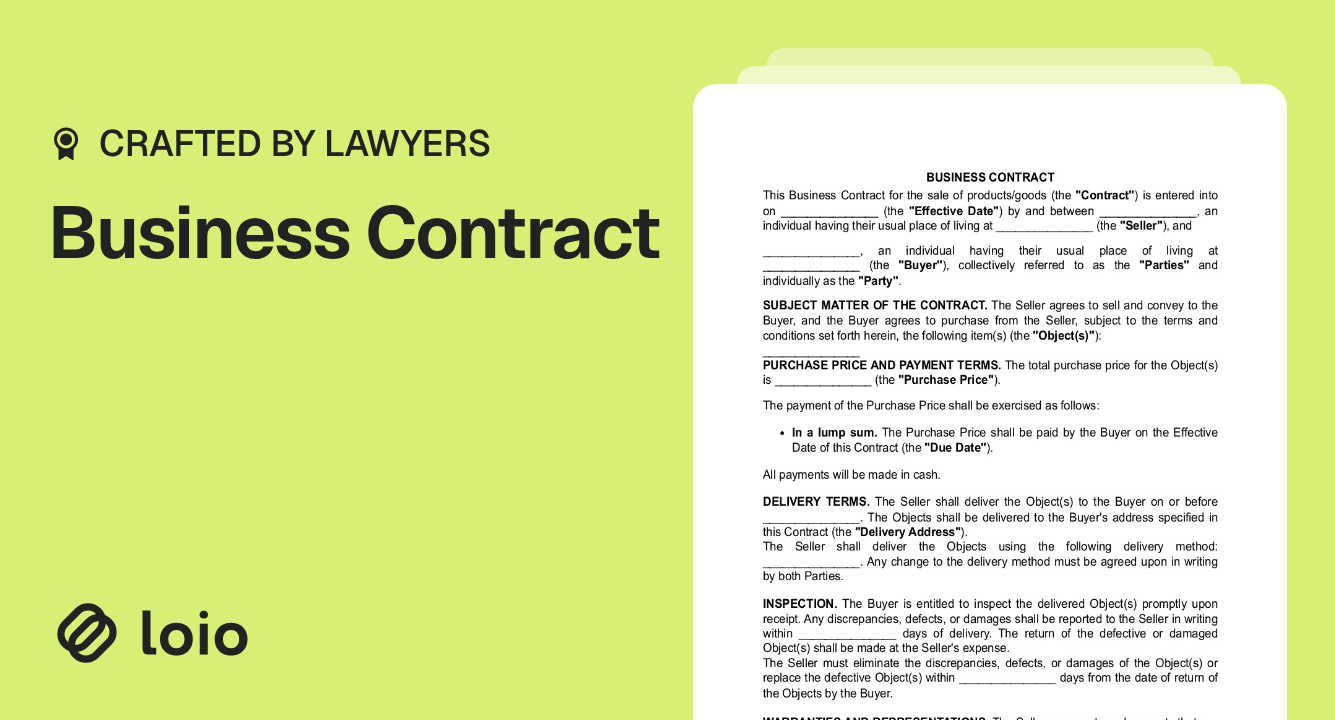
Business Contract Template

Pro template

4.7 (42 reviews)
All states
Updated Jul 10, 2026
~ 4 pages
PDF
3.5K downloads
A business contract is a legal agreement between two or more parties that sets out the terms of a commercial transaction, including price, delivery, and payment. It is used to confirm what each party owes the other and to provide a clear record if a dispute arises.
Business Contract Page 1
Preview
Written by Karyna Pukaniuk - Reviewed by Jonathan McGill, JD

What Is a Business Contract?

Copy section link

A business contract is a legally enforceable agreement between two or more parties involved in a commercial transaction. It can cover the sale of goods, the delivery of services, or any other exchange where both sides need clear terms in writing.

A business contracts templates give both parties a structured starting point that covers the essential terms: who is involved, what is being exchanged, how much it costs, and when payment and delivery are due. A business agreement template can be adapted for many types of transactions, from a one-time sale of goods to an ongoing supply arrangement.

Business contracts can be written or oral. In most cases, an oral agreement is still legally enforceable. However, a written business contract is always the safer choice, since it gives both parties something concrete to refer to if either side disputes what was agreed.

This template is built for transactional business agreements — the sale or exchange of goods or services between a buyer and a seller. If your situation involves an ongoing partnership, employment relationship, or freelance services arrangement, a more specific template will fit better

When to Use a Business Contract?

Copy section link

Business contracts for business are used anytime goods, services, or money change hands between businesses or professionals. Common scenarios include:

  • A business selling products or equipment to another business or an individual buyer.

  • A supplier agrees to deliver goods to a retailer on a recurring basis.

  • Two companies exchanging services or goods as part of a one-time transaction.

  • A buyer purchasing inventory, materials, or equipment that requires delivery and inspection terms.

  • Any transaction where both sides want a written record of price, delivery timeline, and what happens if something goes wrong.

When not to use a business contract:

  • Use a service agreement instead if the transaction is primarily about ongoing services rather than the sale of goods.

  • Use a partnership agreement instead if you are forming a continuing business relationship with shared ownership, rather than completing a single transaction.

  • Use an employment contract instead if you are hiring someone as an employee rather than purchasing goods or contracting for a discrete service.

  • Use a letter of intent instead if you are still negotiating terms and are not ready to sign a binding agreement.

Parties to the Business Contract

Copy section link
  • Seller: The individual or business providing the goods or services and receiving payment in exchange.

  • Buyer: The individual or business purchasing the goods or services and making payment under the terms of the contract.

  • Witness (conditional): Not required for a business contract to be valid, but some parties choose to include a witness signature for added formality or to satisfy a third party, such as a lender.

  • Authorized signer (conditional): If either party is a business entity rather than an individual, the person signing on the company's behalf should be identified by name and title to confirm they have authority to bind the company.

What Are the Key Components of a Business Contract?

Copy section link
  • Effective date: The date the contract takes effect, which starts the clock on any deadlines referenced later in the agreement.
  • Seller and buyer information: Full legal names and addresses for both parties, so there is no ambiguity about who is bound by the contract.
  • Description of goods or services: A specific description of what is being sold or provided, including quantity, model, or specifications where relevant. Vague descriptions are one of the most common sources of later disputes.
  • Purchase price and payment terms: The total price and the payment schedule — for example, a deposit due at signing with the balance due on delivery.
  • Delivery terms: The delivery deadline, delivery address, and delivery method, along with what happens if either party needs to change these terms.
  • Inspection and returns: How long the buyer has to inspect the goods after delivery, what happens if defects are found, and who is responsible for return costs.
  • Dispute resolution: How disagreements between the parties will be resolved: through negotiation, mediation, arbitration, or litigation, and which state's law applies.
  • Force majeure: A clause addressing what happens if either party cannot perform due to circumstances beyond their control, such as natural disasters or supply chain disruptions.
  • Signature block: Signature lines for both the buyer and seller, with printed names and addresses.

What Are the Key Terms in a Business Contract?

Copy section link
  • Consideration: Something of value exchanged between the parties: typically money for goods or services, that is required for a contract to be legally enforceable.

  • Breach of contract: A failure by either party to perform their obligations under the contract, such as not delivering goods on time or not making payment as agreed.

  • Force majeure: A contract clause that excuses a party from performance when an extraordinary event outside their control — such as a natural disaster — makes performance impossible.

  • Indemnification: A clause in which one party agrees to cover losses or damages the other party incurs as a result of specific risks defined in the contract.

  • Governing law: The state whose laws will be used to interpret the contract and resolve any disputes that arise from it.

  • Severability: A clause stating that if one part of the contract is found invalid or unenforceable, the rest of the contract remains in effect.

  • Liquidated damages: A predetermined amount that the parties agree one side will pay the other if a specific breach occurs, instead of leaving damages to be calculated later.

How to Fill Out a Business Contract Template?

Copy section link
  1. Enter the effective date of the agreement.
  2. Enter the seller's full legal name and address.
  3. Enter the buyer's full legal name and address.
  4. Describe the goods or services being sold, including quantity, model, or specifications.
  5. State the total purchase price.
  6. Set the payment terms — for example, a percentage due at signing and the remainder due on delivery.
  7. Enter the delivery deadline and delivery address.
  8. Specify the delivery method, such as shipping or local pickup.
  9. State how many days the buyer has to inspect the goods after delivery.
  10. Describe what happens if defects or damages are found, including who covers return costs.
  11. Add a dispute resolution clause specifying how disagreements will be handled and which state's law governs the contract.
  12. Sign the contract — both the buyer and seller should sign and date the document, either by hand or electronically.

This template is intended for general use across all 50 U.S. states+DC. Local procedures — such as notarization, witnessing, or filing requirements — may still apply, so check your state's specific rules before signing.

Statutory references

Copy section link
Business Contract Preview