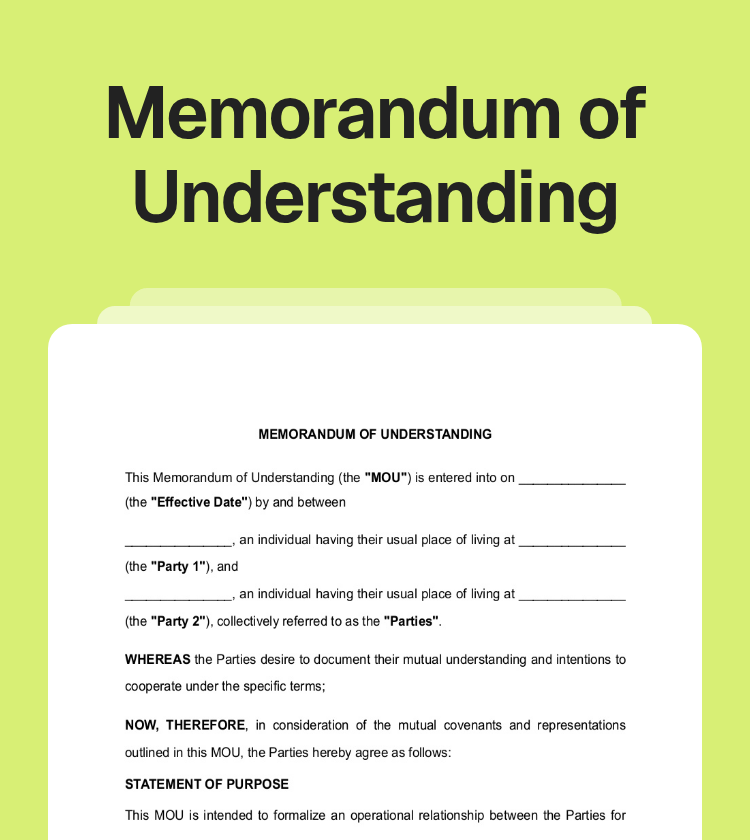
Free template
Free Memorandum of Understanding Template

What Is a Memorandum of Understanding?
Copy section linkA Memorandum of Understanding is an official document that outlines a preliminary agreement between two or more parties before a final deal is legally made.
MOUs are based on teamwork and agreement, letting the parties frame their plans for collaboration without the pressure of a legally binding contract. For instance, universities often use MOUs to establish cooperative agreements with nonprofit organizations, facilitating resource sharing and collaborative projects.
In both common and civil law systems, MOUs play a crucial role in outlining the initial terms of cooperation before formalizing agreements under private law, which governs the law of obligations between private parties. Although they set clear goals for a collaboration, they aren’t legally binding like a contract unless you use strict, mandatory language.
When organizations decide to go for a partnership, they often start with a standardized Memorandum of Understanding template to map out their shared goals, conditions, and timelines. Using a pre-built MOU template ensures that both parties address key operational details early on.
Customizing a clear MOU template helps both sides align their expectations smoothly, creating a well-structured roadmap for a successful future collaboration.
When to Use a Memorandum of Understanding
Copy section linkA Memorandum of Understanding comes in handy when you need to set clear rules for a partnership and prefer a non-binding contract. Here are the kind of agreements MOU works best for:
University and research projects: schools and research groups decide who owns joint students, who gets to use shared equipment or labs, and how grant money is split.
Sharing staff or tools: non-profit and/or large institutions decide how to share employees,equipment, or office space between different teams or organizations.
Public-private partnerships: public agencies and private companies decide how risks and responsibilities are shared.
Business partnerships: two companies state what each side will contribute and expect from each other when launching a joint venture or teaming up for a project.
International agreements: global organizations or governments demonstrate their intentions to work together before an official contract is created and signed.
Parties to the Memorandum of Understanding
Copy section linkThe parties to a Memorandum of Understanding are the specific people, businesses, or organizations that are entering the agreement to work together. Usually, they are marked as “Party 1” and “Party 2” in Memorandum of Understanding templates.
There are no universal names for these parties as they differ depending on the situation.
No matter who the parties are, they must be clearly named at the very beginning of the document with their official legal titles and addresses.
Key Components of the MOU
A complete Memorandum of Understanding template should include:
- Effective date: a certain date when the agreement becomes enforceable.
- Number of parties: a number of entities to the contract to make sure everyone gets their responsibilities mentioned in the document.
- Parties’ entities: an individual or a legal entity.
- Parties’ personal information: names, addresses, cities, states, and ZIP codes.
- Project name.
- The purpose of the MOU.
- Terms and conditions.
- Responsibilities of each party.
- Each party’s email and phone number for communication.
- End date.
- The governing law of the MOU.
Key Terms of the Memorandum of Understanding
Copy section linkMemorandum of Understanding — a prior, usually non-binding document where parties outline their intent to cooperate and establish shared goals.
Memorandum of Agreement — a detailed, often legally binding contract that specifies the exact responsibilities, risks, timelines, and commitments each party holds for a project.
A binding agreement — a legally enforceable contract that obliges all parties to follow their promises, allowing a court to penalize any party that breaks them.
A non-binding agreement — a formal statement of mutual intent or goodwill that states the parties’ plan to work together but holds no legal penalties if a party decides to terminate the agreement.
Good-faith negotiation — a legal and ethical principle that requires parties to act honestly and with a genuine intent to reach a fair agreement, without any deceive or purposeful delay in terms.
An Exclusivity clause — a contractual agreement that forbids one or both parties to make similar business deals with anyone else in mentioned terms.
Term — a specific, agreed period of time that a contract remains active.
Termination — the ending of a contract before its stated expiration date, either because one of the parties broke the rules or because both parties agreed to stop the agreement.
How to Fill Out a Memorandum of Understanding
Copy section link- Choose an effective date of your memorandum.
- Pick a number of parties signing the MOU.
- Choose the entity of the party 1 (a legal entity or an individual).
- Add the personal information of the first party: name, address, city, state, and a ZIP code.
- Repeat steps 3 and 4 for all other parties.
- Pick a name for your project and put it in the contract.
- Shortly describe the purpose of your MOU.
- Mention the terms and conditions you want to include to the document; you can add numerous.
- Describe the responsibilities of party 1; you can add numerous.
- Pick a party that is responsible for providing the resources for your MOU.
- If you want to communicate via email, type in all parties’ emails.
- If necessary, add any extra terms to the MOU.
- Choose the end date of your Memorandum.
- Choose the governing law of the MOU.
- Add the phone number of the parties.
- Add any extra information about the parties you find necessary.
Difference Between MOU and LOI
Copy section linkWhile both documents outline a preliminary agreement before the final legally binding contract, their aims and settings are different.
A Memorandum of Understanding (MOU) is a contract signed between two parties to establish shared goals and general rules of cooperation. It is often used for government, non-profit partnerships, multi-party collaborations, and academic projects.
A Letter of Intent (LOI) is a document that specifically signals one party’s intent to do business with another. A LOI is used in major business deals like buying real estate, acquisitions, or mergers.
What is the difference between a Memorandum of Understanding and a formal contract?
A formal contract is a legally binding agreement that can be enforced in court; a Memorandum of Understanding is a preliminary non-binding document used to outline a partnership’s goals and parties’ intentions before the final deal is officially made.
What is an international MOU?
International Memorandums of Understanding work as formal, but non-binding documents establishing a strategic relationship between governments, institutions, or international bodies, serving as a general statement of mutual interest to explore opportunities for collaboration.
What are the common MOU mistakes?
Using accidental contract language like ‘shall,’ ‘will,’ or ‘must’ when you want the document to be non-binding;
Forgetting a Termination Clause;
Unrealistic timeline.
Vague parties’ responsibilities;
What common MOU modifications are there?
Most Memorandum of Understanding formats are similar, and the only difference between them lies in the terms and conditions every party writes down in the contract. The parties have the right to decide on the project’s name, shared goals, and responsibilities, but the Memorandum of Understanding template would be universal for every document of this kind.
Sources
Related Documents
Also Read
Requirements for this document vary by state. Review your state's laws and procedures — or consult a licensed attorney — before using this template to ensure it's valid and enforceable where you live.