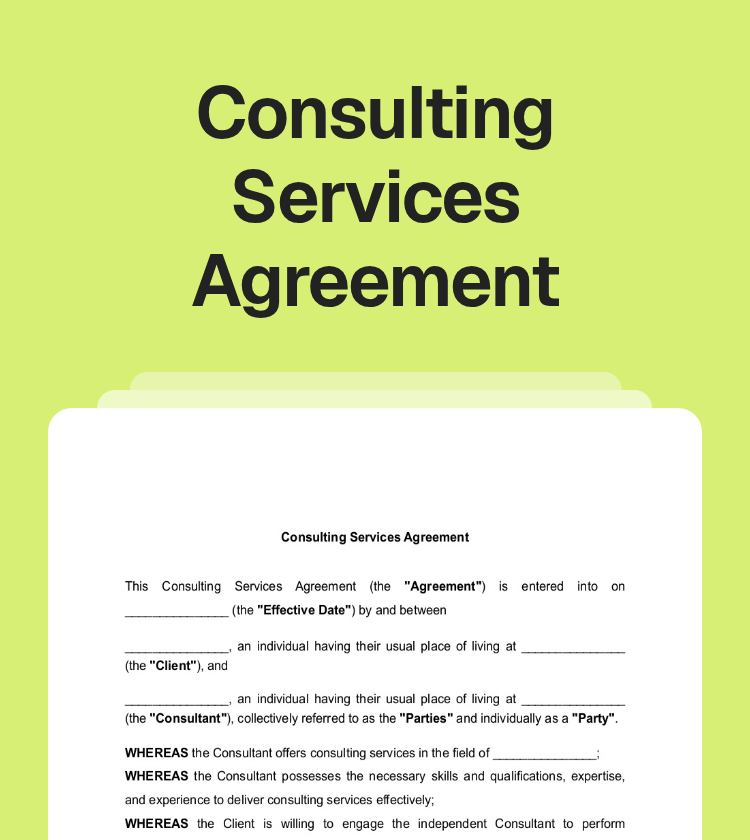
Free template
Free Consulting Agreement Template

What Is a Consulting Agreement?
Copy section linkA consulting agreement, also called a consulting contract template, is a written contract between a consultant and a client. It lays out the services to be provided, the timeline, and the compensation that both sides agree to follow. It's used whenever a business brings in outside expertise — strategy, marketing, technical, financial, or operational — without hiring that person as an employee.
A consulting contract template gives both parties a reliable structure to work from, covering the details that matter most in a professional engagement. The same document is sometimes called a consultant contract template, a consulting services agreement, or simply a consulting contract, depending on the industry.
Consultants are engaged as independent contractors, not employees. This distinction affects taxes, benefits, and liability for both sides. It's one of the reasons a written agreement matters — the terms need to reflect that independent relationship, not just describe the work.
When to Use a Consulting Agreement?
Copy section linkUse a consulting agreement when:
A business is bringing in outside expertise for strategy, marketing, HR, financial advising, technical support, or corporate training. A contract for consulting services or a consultation agreement covers this same scenario, depending on what your industry calls it.
A consultant is being engaged for a defined project with a clear scope and deliverables.
The engagement will run on an hourly, project-based, or retainer fee structure, and both sides want that documented.
The work involves access to sensitive business information that needs confidentiality protection.
The client wants clear terms about who owns any work product, strategy documents, or deliverables created during the engagement.
Either side wants a documented process for ending the engagement early if it isn't working out.
When not to use a consulting agreement:
If you're hiring the person as a full-time or part-time employee rather than an independent consultant (an employment contract should be used instead).
If you already have a Master Service Agreement and just need to document a specific project under it (use a statement of work instead).
If confidentiality is the only thing you need to formalize before discussions even begin (a non-disclosure agreement should be used instead).
Who Are the Parties to a Consulting Agreement?
Copy section linkConsultant: The individual or company providing professional advice or services in a specific area of expertise. The consultant is engaged as an independent contractor, not an employee.
Client: The individual, company, or organization hiring the consultant to perform the specified services and paying for that work.
Authorized signer (conditional): If either party is a business entity, the signer should be identified by name and title. This confirms they have the authority to bind the company.
What Are the Key Components of a Consulting Agreement?
Copy section linkA consulting services contract template should contain the following fields:
Scope of work: A specific description of the services the consultant will provide. Vague scope language is one of the most common sources of disputes in consulting engagements.
Deliverables: The concrete outputs the client will receive — reports, strategy documents, designs, code, or other work product — and the expected format.
Term and timeline: The start date, expected end date or ongoing nature of the engagement, and any key milestones along the way.
Fees and compensation: The rate structure — hourly, flat project fee, or retainer — and the total amount or fee cap, where applicable.
Payment schedule: When and how payments are due, including any deposit, milestone payments, or invoicing frequency.
Expenses: Whether the consultant is reimbursed for travel, materials, or other project-related costs, and what approval is needed before those costs are incurred.
Confidentiality: A clause preventing the consultant from disclosing the client's sensitive business information, both during and after the engagement.
Intellectual property: A statement of who owns the work product created during the engagement — the client, the consultant, or a shared arrangement.
Independent contractor status: Language confirming the consultant is not an employee, which matters for tax treatment and liability on both sides.
Termination: The conditions under which either party can end the agreement early, including any required notice period.
Dispute resolution: How disagreements will be handled if they arise. Mediation or arbitration is a common choice, since they're typically faster and less costly than going straight to court.
Indemnification: A clause specifying that each party will cover losses caused by their own actions, protecting the other side from that risk.
Governing law: The state whose law applies if a dispute over the agreement arises.
Signature block: Signature lines for both the consultant and the client, with printed names and dates.
What Are the Key Clauses in a Consulting Agreement?
Copy section linkEvery consulting agreement contains standard sections, but a small set of clauses attracts most of the negotiation, litigation, or state-by-state variation. Sample language for each is included below — customize the bracketed values before signing.
Non-competition clause
What it does: Restricts the consultant from working with the client's direct competitors during the engagement and for a specified period after it ends. The restriction typically covers a defined geographic area and specific types of competing services.
"During the term of this Agreement and for a period of [one (1) year] thereafter, Consultant agrees not to directly or indirectly engage in, or assist others in engaging in, any business activity that competes with the services provided by Client in [geographic area]. This restriction applies only to services that are substantially similar to those Consultant provided to Client under this Agreement."
When to include/omit: Include if the consultant has access to information that ban be useful for competitors: business strategy or customer relationships; omit for short-term technical or operational engagements.
State variation: California, Minnesota, North Dakota, and Oklahoma ban non-compete agreements, making this clause unenforceable in those states.
Liability clause
What it does: Spells out when each party is responsible for damages or problems that happen during the consulting engagement. It says who pays when things go wrong — whether it's from mistakes, broken promises, or harm caused to the other side.
"The Consultant shall be liable for any damages that result from the Consultant's negligence, misconduct, or improper actions during the performance of this Agreement."
When to include/omit: Include in cases of increased risk exposure; omit when the potential harm from poorly provided services significantly exceeds the contract value.
Confidentiality clause
What it does: Prevents the consultant from disclosing the client's sensitive business information during and after the engagement. It typically defines what constitutes confidential information and how long the obligation lasts.
"The Consultant shall not disclose to any third party any details regarding the Client's business, including but not limited to any information regarding any of the Client's customer information, business plans, or price points. The Consultant shall not make copies of the Confidential Information or any content based on the concepts contained within the Confidential Information for personal use or distribution without request from the Client. The confidentiality clause should remain in effect for [2 years] after the termination or expiration of this Agreement."
When to include/omit: Include whenever the consultant accesses sensitive business information.
Indemnification clause
What it does: Requires each party to cover the other's legal costs and damages that arise from their own actions or negligence. Mutual indemnification means both sides provide this protection to each other.
"The Consultant agrees to indemnify and hold harmless the Client from and against any third-party claims, damages, suits, and expenses arising from or related to the Consultant's performance, except for claims caused by the Consultant’s willful misconduct or negligence."
When to include/omit: Include if the consultant's actions could expose the client to third-party liability. It is particularly important when the consultant will interact directly with the client's customers or partners.
What Are the Key Terms in a Consulting Agreement?
Copy section linkScope of work: The specific services the consultant agrees to perform under the agreement.
Retainer: A recurring fee paid to keep a consultant available for ongoing work, rather than paying per project or per hour.
Independent contractor: A worker who provides services under their own control, not as a company employee — responsible for their own taxes and generally not eligible for employee benefits.
Intellectual property (IP): Creative or technical work product — reports, designs, code, strategy documents — and the legal rights that determine who can use, modify, or sell it.
Work for hire: A legal arrangement in which the client is treated as the owner of the work product from the moment it's created, if the agreement specifies this.
Indemnification: A promise to cover the other party's legal costs or damages in specific situations named in the contract, such as a claim arising from one party's negligence.
Non-compete clause: A provision restricting the consultant from working with the client's direct competitors during or after the engagement. Enforceability varies significantly by state.
Termination for convenience: A clause allowing either party to end the agreement without needing to prove a breach or specific cause, typically with advance written notice.
How to Fill a Consulting Agreement?
Copy section linkWhether you're starting from scratch or using a contract template for consulting services, follow these steps in order:
- Enter the consultant's full legal name and address, including business entity details if applicable.
- Enter the client's full legal name and address.
- Describe the scope of work — the specific services the consultant will provide.
- List the deliverables the client will receive and the expected format for each.
- State the start date and the expected end date, or note that the engagement is ongoing.
- Set the fee structure — hourly rate, flat project fee, or retainer — and the total amount or cap.
- Establish the payment schedule, including invoicing frequency and payment due dates.
- State whether expenses are reimbursable and what approval process applies.
- Add a confidentiality clause covering sensitive information shared during the engagement.
- State who owns the intellectual property created during the engagement.
- Confirm the consultant's independent contractor status.
- Add a non-compete or non-solicitation clause, if applicable, and confirm it complies with the laws of the relevant state.
- State the conditions under which either party can terminate the agreement, including notice requirements.
- Enter the state whose law will govern the agreement.
- Sign the agreement — both parties can sign using eSign or by hand.
Is a consulting agreement legally binding?
Yes. A signed consulting services contract template is a legally binding contract enforceable under state contract law. This requires the basic elements of a valid contract: an offer, acceptance, and consideration (payment for services).
How does a consultant pay taxes?
Consultants are treated as independent contractors, not employees, so no taxes are withheld from their payments. If a client pays a consultant $600 or more in a calendar year, the client is generally required to issue a Form 1099-NEC. The consultant reports income on their own tax return and is responsible for self-employment tax.
Who owns the work product a consultant creates?
It depends on what the agreement states. By default, a consultant may retain rights to work they create, similar to how copyright works for other creative or technical output. Most consulting agreements include a clause explicitly assigning ownership of deliverables to the client, since clients typically expect to own what they paid for.
Are non-compete clauses in consulting agreements enforceable?
It depends heavily on the state. California, Minnesota, North Dakota, and Oklahoma effectively ban non-compete agreements outright, and several other states restrict them by industry or income threshold. A federal ban proposed by the FTC in 2024 was vacated in court, and the FTC abandoned its appeal in 2025. Enforceability is now governed entirely by state law. For a full state-by-state breakdown, see the Non-Compete Tracker: State by State.
What does "termination for convenience" mean?
It's a clause that lets either party end the agreement without proving the other side did something wrong, typically with a set notice period such as 30 days. This gives both sides an exit option if the engagement isn't working out, without the higher bar of proving breach of contract.
Can a client treat a consultant like an employee?
No, not without risk. If a client controls a consultant's schedule, requires exclusive availability, and directs how the work gets done, that relationship starts to look like employment. The IRS and state labor agencies can reclassify it as such regardless of what the contract is titled. Misclassification can expose the client to back taxes and penalties.
What happens if the consulting service agreement template isn't signed?
Without a signed agreement, the terms of the engagement have no clear written record, making disputes over scope, payment, or ownership harder to resolve. Some verbal or implied agreements may still be enforceable under state law, but proving the specific terms becomes much more difficult without a written record.
Do I need a lawyer to create a consulting agreement?
Not for most standard engagements. A well-drafted template covers the terms that matter for typical consulting work. Legal review is worth considering for high-value contracts, engagements involving significant IP creation, or agreements with non-compete clauses, since the enforceability of such clauses depends heavily on state law.
Requirements for this document vary by state. Review your state's laws and procedures — or consult a licensed attorney — before using this template to ensure it's valid and enforceable where you live.
Sources
Related documents
Also read