Free template
Free Hold Harmless Agreement Template
What Is a Hold Harmless Agreement?
Copy section linkA hold harmless agreement is a contract in which one party — the indemnitor — agrees not to sue or hold the other party — the indemnitee — legally responsible for specific risks, injuries, or damages that might occur during an activity or service. It's a common tool for managing liability before any risk actually arises.
A hold harmless agreement template provides both parties with a clear, consistent way to document this arrangement, whether it's for a one-time event or an ongoing service relationship. The same document is sometimes called a hold harmless form, a hold harmless letter, or a generic hold harmless agreement when it's written broadly enough to apply to various situations.
This agreement doesn't eliminate risk — it reallocates who bears legal responsibility if something goes wrong. Because of this, hold harmless agreements are closely tied to how courts and state legislatures treat indemnity clauses, and enforceability can vary depending on the type of activity, the state involved, and how the agreement is worded.
When to Use a Hold Harmless Agreement?
Copy section linkUse a hold harmless agreement, sometimes called a hold harmless agreement form, when:
A contractor is performing work on someone's property, such as plumbing, electrical, or landscaping services.
A business rents out equipment — ladders, machinery, tools — for someone else to use.
Someone organizes an event on another party's land or property.
Volunteers are providing services at a charity event or community activity.
A business is temporarily subleasing part of its space.
A moving company is hired to transport someone's belongings.
A landlord allows a tenant to perform minor repairs themselves.
Business partners want to clarify who assumes physical or financial risk in a joint venture.
When not to use a hold harmless agreement:
Use a release of liability form instead if you need broader liability protection for recreational or higher-risk activities, since release forms are typically more detailed about assumption of risk.
Don't use a hold-harmless agreement to shield against illegal activity, intentional harm, or gross negligence — courts in most states will not enforce indemnity clauses that attempt to excuse such conduct.
Don't rely on a hold harmless agreement signed by a minor — it generally isn't enforceable unless a parent or legal guardian also signs.
Parties to a Hold Harmless Agreement?
Copy section linkIndemnitor: The party agreeing not to hold the other side responsible for specified risks or damages. This is typically the person or business that performs a service, uses equipment, or assumes the riskier role in the arrangement.
Indemnitee: The party being protected from liability under the agreement. This is typically the property owner, equipment provider, or the party who would otherwise face a legal claim.
Witness (conditional): Not required for a hold harmless agreement to be valid in most states, but some parties choose to include a witness signature for added formality.
What Are the Key Components of a Hold Harmless Agreement?
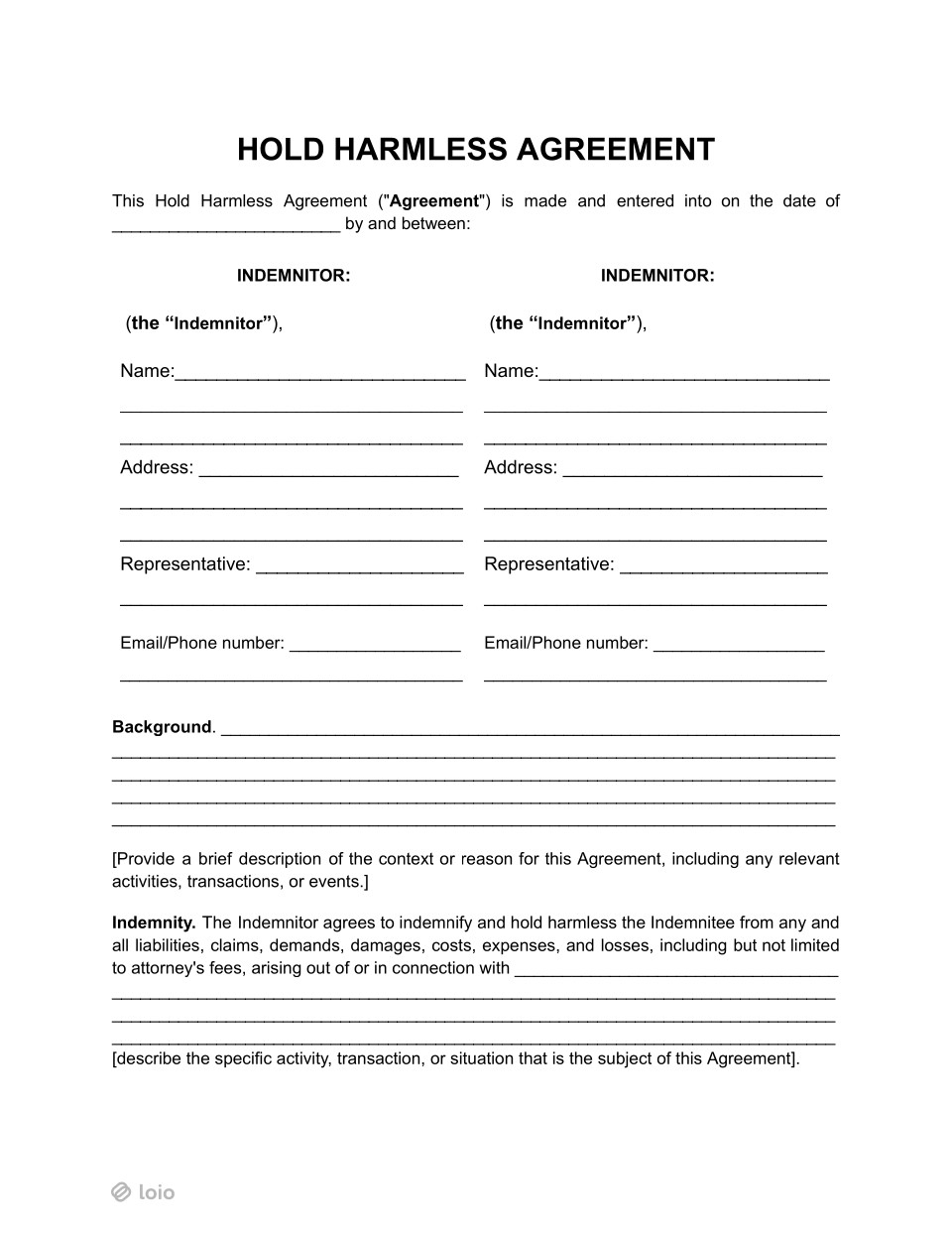
Copy section link- Date: The date the agreement is signed, which anchors the timeline for the activity or service it covers.
- Parties: Full legal names and contact information for both the indemnitor and the indemnitee.
- Activity or purpose: A specific description of the activity, service, or event the agreement relates to — vague descriptions weaken the agreement's enforceability.
- Risks covered: The specific risks, injuries, or damages for which the indemnitor agrees not to pursue a claim, such as property damage or personal injury.
- Insurance requirements (conditional): A statement of any insurance coverage the indemnitor is required to carry, which is common in business and contractor arrangements.
- Governing jurisdiction: The state whose law applies if a dispute over the agreement arises. This matters more than it might seem, since indemnity law varies by state.
- Signatures: Signature lines for both parties, confirming the agreement is in effect.
What Are the Key Terms in a Hold Harmless Agreement?
Copy section linkIndemnification: The act of one party agreeing to compensate or protect the other from a specified loss, liability, or damage.
Indemnitor: The party who agrees to hold the other side harmless — that is, the party giving up the right to sue for the specified risks.
Indemnitee: The party being protected from liability under the agreement.
Broad-form indemnification: A clause requiring the indemnitor to cover losses regardless of who was actually at fault, including the indemnitee's own negligence. This is the most restrictive type and the one most often limited or voided by state law, particularly in construction contracts.
Intermediate-form indemnification: A clause requiring the indemnitor to cover losses except where the indemnitee was solely at fault, allowing for shared responsibility in cases of joint negligence.
Limited-form indemnification: A clause limiting the indemnitor's responsibility to losses caused by their own negligence only — the narrowest and most commonly enforceable form.
Gross negligence: A severe lack of care that goes well beyond ordinary carelessness. Most states will not enforce a hold harmless clause that attempts to excuse gross negligence or intentional misconduct.
How Do You Fill Out a Hold Harmless Agreement Template?
Copy section linkWhether you're using a full agreement or a shorter hold harmless letter template, follow these steps in order:
- Enter the date the agreement is signed.
- Enter the indemnitor's full name, address, and contact information.
- Enter the indemnitee's full name, address, and contact information.
- Describe the activity, service, or purpose the agreement covers.
- List the specific risks the indemnitor agrees not to pursue a claim for.
- State any insurance requirements the indemnitor must meet, if applicable.
- Enter the state whose law will govern the agreement.
- Sign and date the agreement. You can sign electronically using eSign or by hand.
- Keep a signed copy for your records and provide one to the other party.
Is a Hold Harmless Agreement the Same as a Waiver?
Copy section linkNot quite, though the two are closely related and often confused. A waiver typically involves one party giving up their own right to sue over risks they're voluntarily accepting — common in recreational activities like gyms or sports leagues. A hold harmless agreement more broadly shifts liability between two parties and often appears in business, contractor, and property-related arrangements rather than purely recreational ones.
What Are the Risks of Using a Hold Harmless Agreement?
Copy section linkA hold harmless agreement isn't automatically enforceable just because both parties signed it. Several factors can limit or void the protection it's meant to provide.
State law restrictions. Most states restrict or prohibit broad-form indemnification in certain contexts, especially construction contracts. In these states, a clause requiring one party to cover the other's own negligence — including sole negligence — may be void as against public policy, regardless of what the contract says.
Gross negligence and intentional acts. Courts in nearly every state refuse to enforce indemnity clauses that attempt to excuse gross negligence, recklessness, or intentional harm. A hold harmless agreement can limit liability for ordinary risks, but it can't be used as a shield against serious misconduct.
Vague or overly broad language. Courts tend to interpret hold harmless clauses narrowly. If the agreement doesn't clearly specify which risks it covers, a court may find it doesn't apply to the situation at hand.
Unequal bargaining power. Some states scrutinize hold harmless agreements more closely when one party has significantly less negotiating power than the other, such as a subcontractor being required to sign one as a condition of getting work.
Because of these limitations, a hold harmless agreement works best as one part of a broader risk management approach — alongside adequate insurance coverage — rather than a standalone substitute for it.
In practice, many agreements combine elements of both, and some states treat the two documents similarly under the law. If your situation involves a participant assuming risk for a recreational activity, a release of liability form may be a better fit.
Statutory references
Related Documents
Also Read