Updated September 11, 2026
Offer Letter vs. Employment Contract: What Employers Should Know

Offer Letter vs. Employment Contract: What Employers Should Know
Content
When you are comparing an offer letter with an employment contract, you are probably attempting to deal with a practical question about hiring rather than addressing a theoretical one. A great many employers do not know what an offer letter should include, at what point an offer letter becomes legally binding, or whether a job offer can be considered a contract from the outset. The following guide outlines the actual difference between an offer letter and an employment agreement, explains when each document is appropriate, and shows how you can prevent yourself from making promises that you did not intend to make.
Understanding the Core Definitions
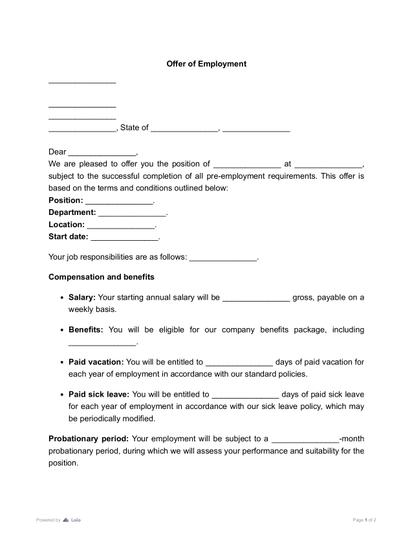
Usually, an offer letter sets out the main terms of the job offer without providing the full legal details which would be found in an employment contract. In professional HR circles it is regarded as a high-level "congratulatory" summary whose purpose is to confirm the intention to hire and to persuade the candidate about the position.
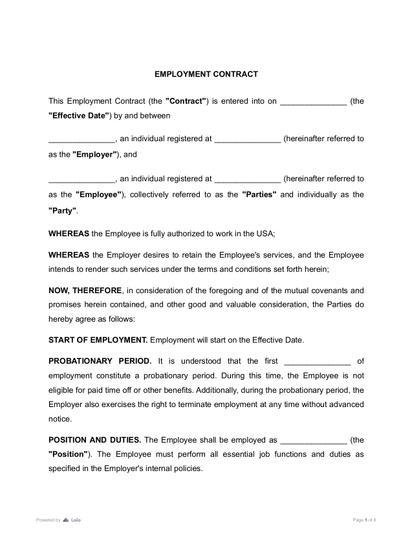
If a role requires a higher degree of protection, it is worthwhile switching to a more detailed agreement. An employment contract is a formal agreement concerning the employment that specifies rights and obligations going well beyond just the start date; although the letter starts the relationship, it is the contract that establishes the legal limits and thus protects the company's intellectual property as well as clearly defining the exact expectations for the position.

The intersection of intent and law
Above all, employers need to realise the legal significance of their first contact. The way in which an offer letter evolves into definite job terms will affect the extent to which the contract can be enforced should a dispute occur. If an offer letter includes excessive detail without having "non-binding" language, a court could conclude that the document constitutes a final contract and therefore bind you to terms that you had intended to keep open.
Caution should be exercised when using expressions like "We look forward to a long and successful career together". Where a job applicant has reasonably relied upon such language and has consequently suffered an actual loss—for instance, by resigning from an earlier position or moving before the start date—the courts have found employers liable under the doctrine of promissory estoppel. In a case often referred to, a worker from New Jersey who had quit her previous job and moved following the receipt of an offer was able to go ahead with his claim based on promissory estoppel after the employer withdrew the offer.
Legal Foundations: At-Will Doctrine and US Contract Law
In the United States employment is usually on an at-will basis unless there is an express or implied agreement to the contrary. This means that, in most states, either the employer or the employee can terminate the relationship at any time, for any legitimate reason or for no reason whatsoever.

Contract formation fundamentals
According to US contract law, a binding relationship comes into existence when "consideration" (that is, payment) is given in exchange for work. In order to make sure that your formal employment agreement establishes the desired legal rights and avoids any concealed risks, it is important to keep the hierarchy such that the employment contract outlines the offer letter and clearly confirms the principle of at-will employment.
It is also necessary to correctly classify the worker from the beginning in order to get the sequencing right. The SBA states that employers should decide early in the hiring process whether the person will be regarded as an employee or an independent contractor, since this decision has an impact on payroll, tax withholding, and also determines which of the two documents applies.
You can use an AI summary to check your current templates in order to realise that "at-will" disclaimers are not obscured or contradicted by the older clauses contained in the previous hiring documents.
When to Use Each Document (Strategic Hiring)
The decision as to whether to take an offer letter or an employment agreement should be based on the seniority of the position and the level of risk involved.
The standard method of hiring staff involves using an offer letter, as this is often enough to achieve the required balance between an offer letter and an employment agreement and thus keeps maximum flexibility for the business.
The high-stakes appointment: when it comes to C-suite executives, the discussion between the offer letter and the contract usually results in the contract being chosen. This is because such positions need important contractual provisions, such as a notice period and a termination clause, in order to protect the company against sudden gaps in leadership.

Pre-Employment Contingencies and Risk Reduction
In order to lower the chances of facing a wrongful dismissal or a promissory estoppel claim, the employment documents should make it clear how the relationship can come to an end and what conditions must be fulfilled before work actually starts.
Offer letters are usually conditioned on certain contingencies, for example those relating to background checks where they are relevant and on the employee filling in the Form I-9 employment authorization documentation. Including clear language about contingencies helps employers to prevent them from sending out a document that appears final before the necessary hiring steps have been carried out.
Rather than preparing these detailed terms from scratch, you can finalise and give your "Subject to Contract" letters a consistent brand by using Loio templates. This ensures that all the legal fine print, including the specific contingencies and those disclosures required by state law, stays clear, professional, and compliant when it gets to the candidate.
Formalizing the Agreement: Signing and Compliance
The last stage consists of efficiently going from a signed offer to a signed contract, including a vital provision known as the "Merger Clause". This clause states that the final contract takes precedence over all earlier offers and thus avoids "he said, she said" disputes should termination ever occur.
Is a job offer a contract?
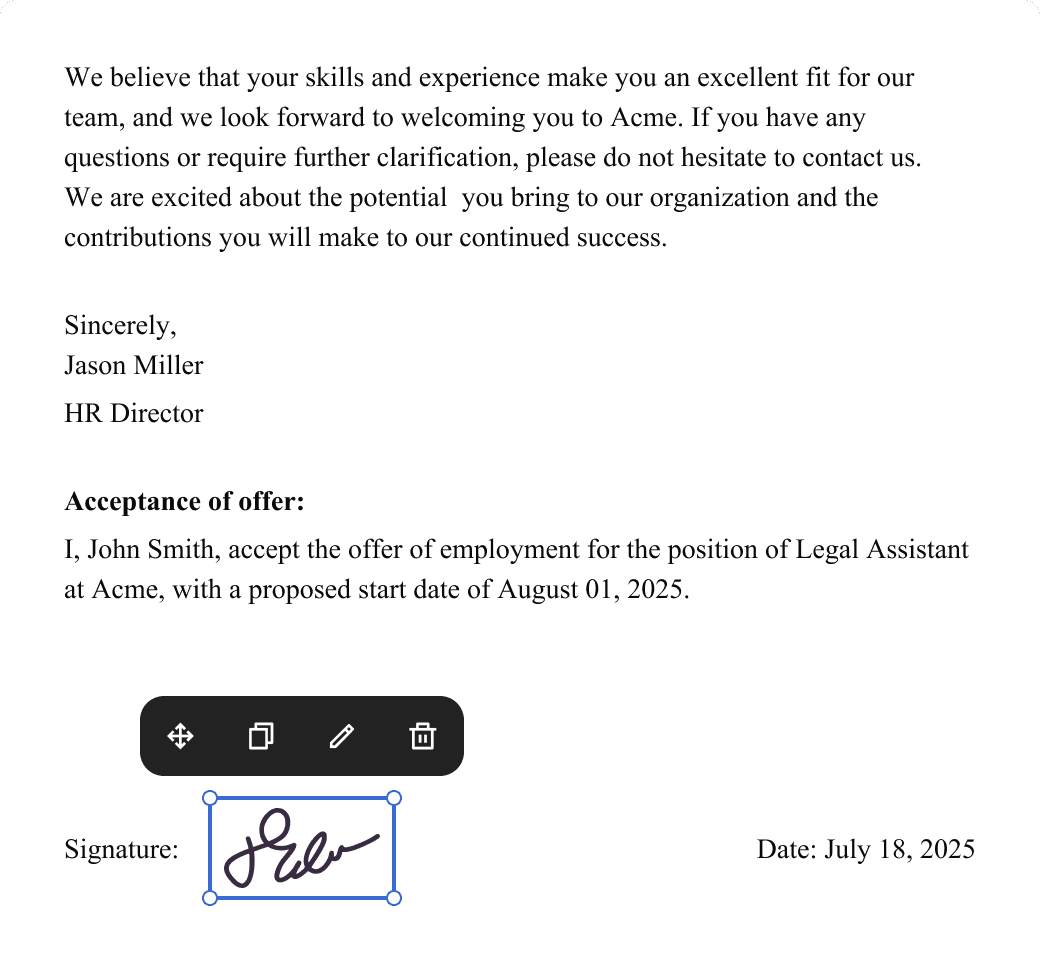
For most hires, the relationship becomes legally binding when the offer is accepted and consideration has been exchanged, although the precise moment at which this happens may vary according to conditions like the completion of a background check or the filling out of Form I-9. In order to bridge the gap and to ensure compliance, use E-sign technology to obtain signatures on both the offer and the formal agreement immediately, thus establishing a secure, time-stamped audit trail for your HR records.
In most cases, a clear and well-phrased offer letter is sufficient condition that it doesn't include any wording which might be interpreted as a definite promise; in situations involving the C-suite or sensitive intellectual property, however, it is worthwhile to go through the process of drawing up a full employment contract. Regardless of the situation, the best course of action is to make it explicit which points have been confirmed, which remain conditional, and when the relationship actually becomes binding.
More guides
September 15
What Is Contract Redlining?

September 1
7 min read
How to Provide Proof of Employment: Documents and Steps

August 14
11 min read
Right to Work vs. At Will Employment Explained: What's the Difference?

October 7
How to Start a Staffing Agency: Licensing, Pricing, and Cash Flow

September 10
14 min read
How to Protect Your Small Business from Lawsuits

July 26
Employment Background Checks: What Employers Can and Cannot Review

One home for your
agreements
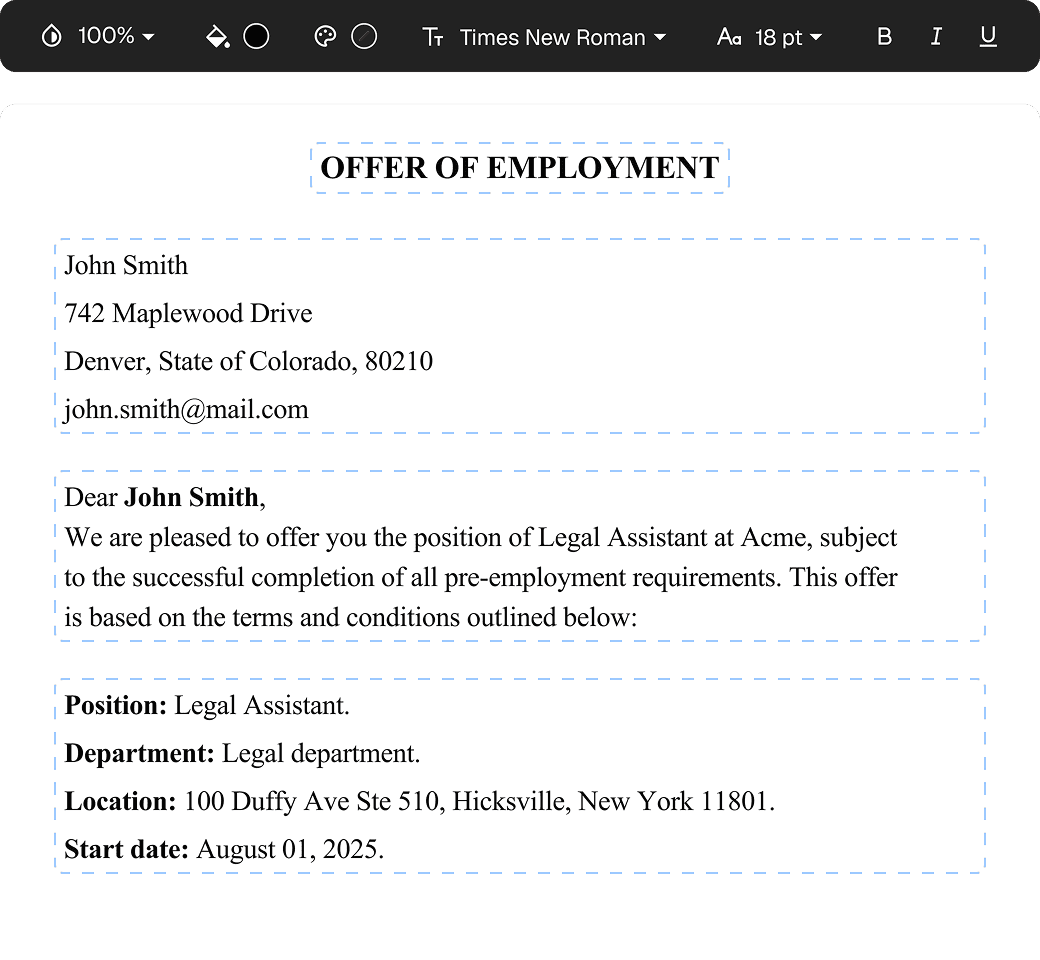
Edit PDFs seamlessly
Tweak agreements before signing or sending for signatures. Update details, add or remove clauses, adjust formatting, and redline changes instantly.
eSign legally and securely
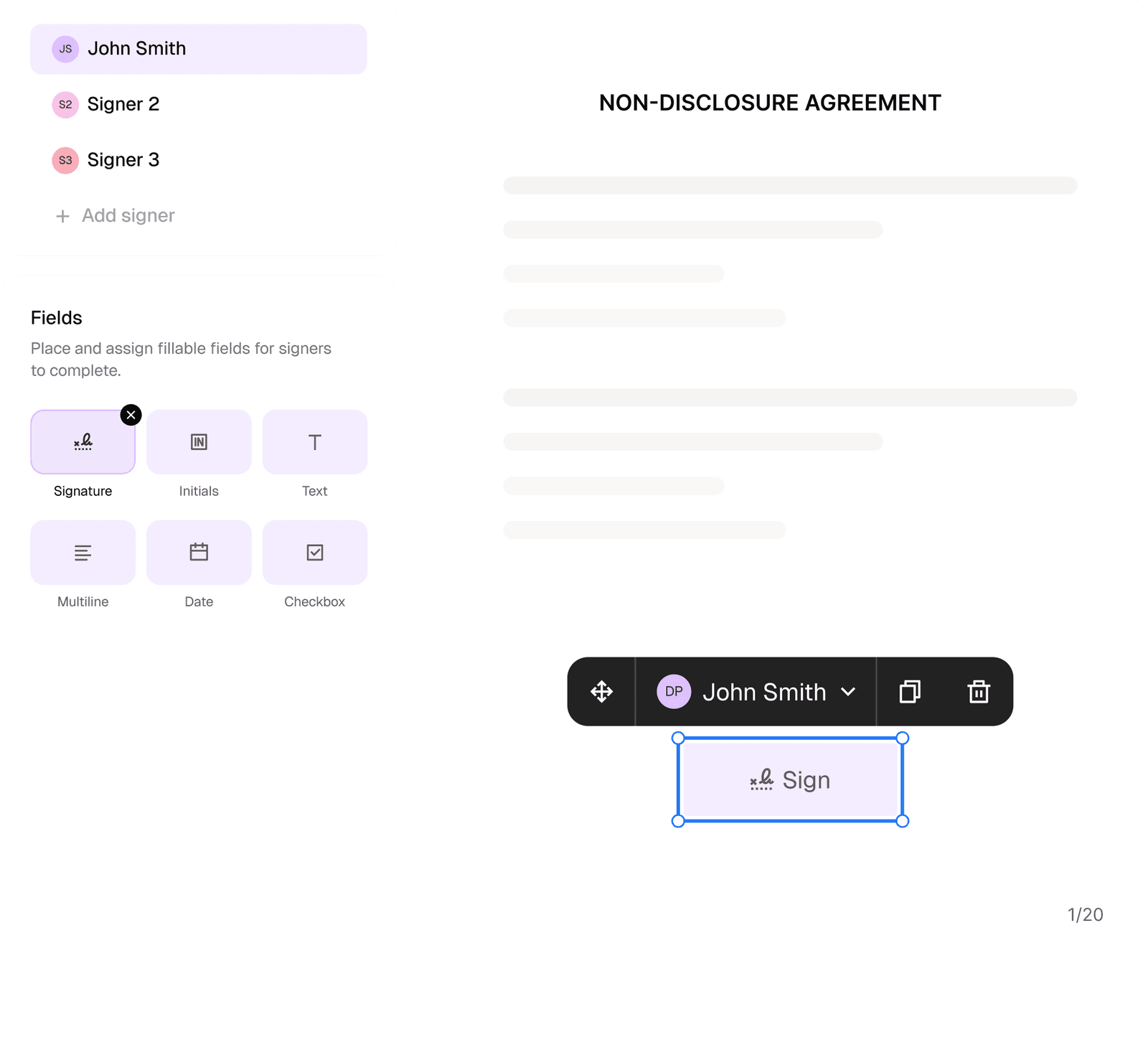
Sign documents and collect legally binding signatures. Invite up to ten people to sign in any order, track the progress, and send reminders.
Request legally binding signatures
Invite up to ten people to sign your document in any order. Get a finalized, audit-ready copy without chasing signatures.
Skip the drafting.
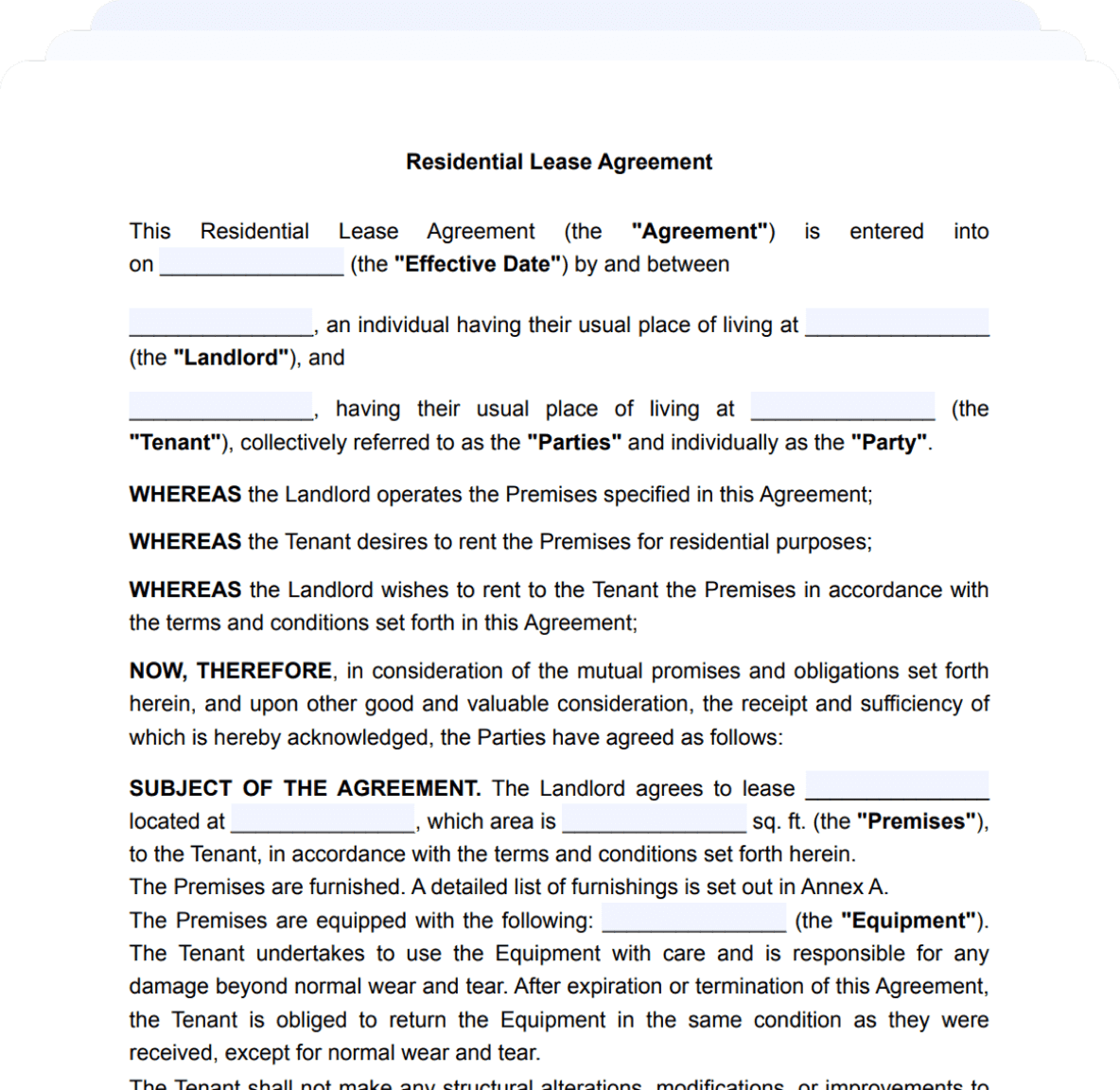
Choose from 2,500+ templates
Browse templatesChoose a template
Fill in details
Sign and download