Free template
Free Horse Bill of Sale Template

Template Description
Copy section link
There are several reasons why a person would want to purchase a horse or a pony but horses are most often sold for the purposes of riding or farming. Because of the higher monetary value of horses, the sale of horses often requires a bill of sale as proof.
What Is a Bill of Sale for a Horse?
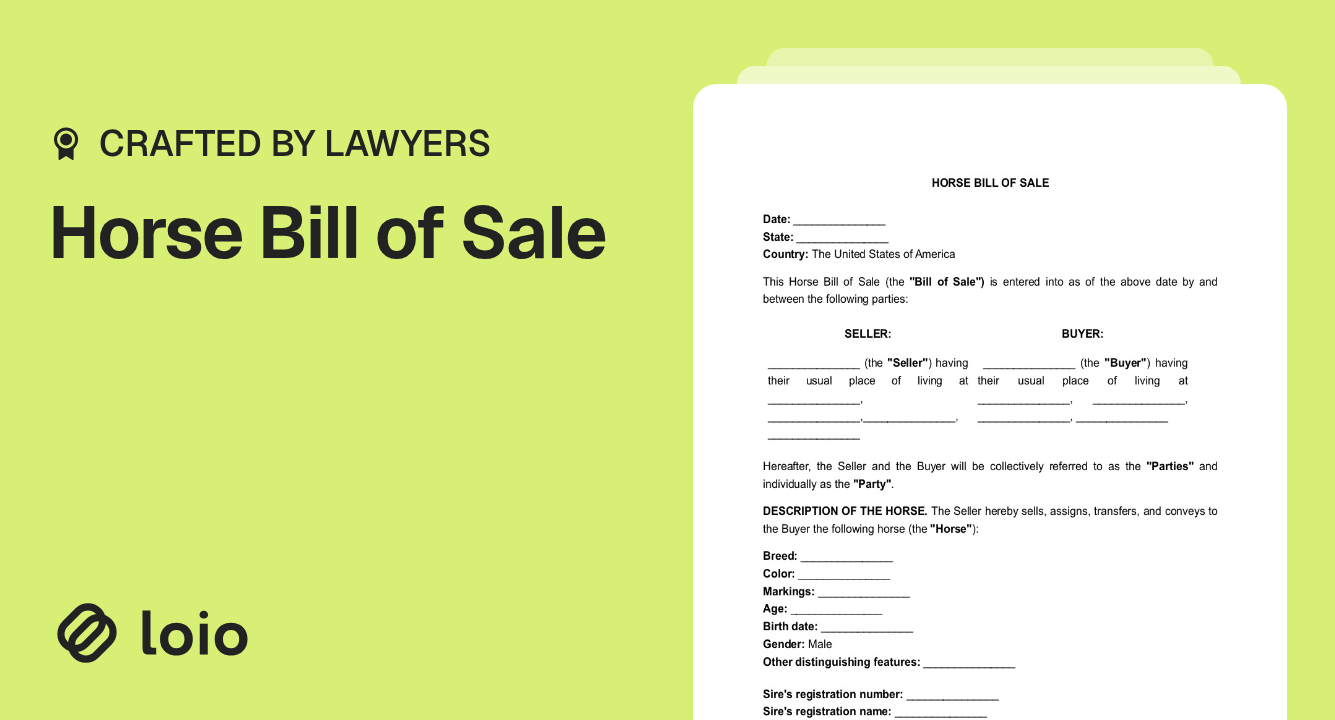
Copy section linkA horse bill of sale template, or an equine bill of sale form, can be used to create a legal document that proves the purchase of a horse between a buyer and a seller. A simple bill of sale for horse template can be used to confirm the transferred ownership of the horse from one party to another.
Any breed of horse can be sold through a horse selling contract. However, as a seller, you should guarantee that the animal is healthy and trained as expected by the buyer.
Parties of the Horse Bill of Sale
Copy section linkAs with other types, a horse bill of sale involves only two parties:
- Buyer — the person who is interested in purchasing the horse in question.
- Seller — the person who is transferring ownership of the horse in exchange for money.
It is a common practice in an equine transaction for the buyer and the seller to have agents or a dual agent, who will receive commissions on the sale, representing their interests. For instance, in California, a properly written bill of sale for these transactions will specify the price of the horse and to whom commissions are paid.
Key Terms
A horse bill of sale example serves as a legal document that details the sale and offers a guarantee of the horse’s condition at the time of signing. The document puts the seller and the buyer on the same page. The following key terms may be included:
- Description of the horse — The description should include some general information about the horse, such as the horse’s name, date of birth, breed, and training, if any. It should also include information about the horse’s health and condition, thus serving as a guarantee for the buyer.
- Purchase price and deposit — The purchase price is the final price that is being exchanged for the horse. The deposit is the amount that the buyer agrees to put down immediately if the parties have agreed to installments. A deposit is not necessary if the buyer chooses to pay the whole amount on the date of the sale.
- Pre-purchase examination — If both parties agree, the horse can be examined before the sale. The contract can be amended on the basis of the examination results.
- Commissions — If there is a third party involved, such as a trainer or a veterinarian, the bill of sale should include who will be responsible for covering any fees and commissions resulting from the sale.
- Risk of loss — The risk of loss or injury needs to be allocated to either the seller or the buyer depending on the circumstances of the sale. If a shipping or delivery service is used, the risk is usually allocated to the party that chooses the shipping company.
What Should a Horse Bill of Sale Include?
Copy section linkA horse sale contract should include the following information:
The parties’ contact details: full names, email and mailing addresses, and phone numbers;
The horse’s description: name (if applicable), age, breed, bloodline, gender, date of birth, current health conditions, and any extra information that a buyer should know;
The purchase price and deposit;
The date of the sale and the due dates for fees; and
The parties’ signatures.
How To Write a Horse Bill of Sale
Copy section linkThe following are detailed instructions for creating a standard printable horse bill of sale form. You can refer to a sample and build your general equine bill of sale template and have it ready to download in a printable PDF.
Negotiations
Both parties should meet so the buyer can see the horse. The seller should ensure that all appropriate health checkups have been completed and that the animal is ready to serve its new owner. The buyer has the right to ask questions about the horse’s lineage, health, registration, competition experience or training, if any, etc. The details of this discussion should be documented so the agreed terms can be saved for creating a horse purchase agreement.
The parties should also discuss the price of the horse. Usually, a seller’s asking price is based on the horse’s features, age, bloodline, behavior, training, experience, and medical history. Because buyers will always negotiate for a better deal, the seller should always be prepared with an initial asking price and the lowest price he or she would be willing to accept.
In many US states, there are certain legislative requirements regarding the availability of a certificate of veterinary inspection and/or other similar documents, proving a record of negative equine infections, such as equine infectious anemia, equine lyme disease, etc.
Filling Out the Horse Bill of Sale
Filling out stallion breeding contract templates with adding essential information about the horse, the parties, the fees, and the sale date. Make sure that all names are written (or typed) correctly, numbers are also written out in words, and the fees and dates are as agreed to during negotiations.
Revising the Contract
After drafting a blank sales contract for horses, both parties should check the accuracy of the information included. If the document is error-free, it can be printed for both parties to sign.
When Should I Use a Horse Bill of Sale?
Copy section linkAny purchase and sale deal regarding horses should be supported by a signed horse bill of sale form. This document gains its legal force immediately and enables the new owner to take possession of the animal to use for farming, showing, riding, etc., depending on the horse.
A horse purchase contract proves that the parties agree about the animal sale and prevents any confusion if the horse’s lineage, health, or qualifications are questioned. Buyers will need the signed equine bill of sale to register their horses and claim ownership. Sellers can legally transfer their liabilities to care for the animal to the purchasers through the use of a bill of sale.
Common Use Cases
Some common reasons for signing a horse bill of sale include when:
- You are buying a horse or a pony for riding, farming, or showing;
- You want to ensure that the horse is as healthy as the seller claims;
- You want to protect yourself, as the seller or the buyer, from being liable for whatever happens to the horse when it’s not your legal responsibility.
When Not To Use the Horse Bill of Sale
A horse bill of sale is a prerequisite for most horse and pony purchases in most states. The following are some situations that do not require a horse bill of sale:
- The sale and purchase of another farm animal, such as a cow or a pig, requires its own bill of sale;
- According to UCC Article II, a sale of a horse that does not exceed $500 does not require legal documentation.
How To Sell a Horse: Tips & Tricks
Copy section link
Following a few valuable recommendations will help you to sell your horse quickly and legally.
Get Your Horse Ready for a Presale Health Inspection
Arrange an appointment with your veterinarian to get a complete medical checkup for the horse. Review the horse’s record to see if its vaccinations are up to date. Based on the vet’s determinations, you can proceed to your sale. Be ready to provide potential buyers with the relevant health information for the horse.
Create Your Price for the Horse
Your fee for the animal should be based on the horse’s age, bloodline, health conditions, and training to find the best price on the market. When buyers know what they are paying for, it will be easier for sellers to complete their deal and release their responsibility for the horse to its new owner.
Post Your Horse Sale Announcement
Take new photos of the animal and list it locally or on any of these specialized horse-selling platforms:
Ehorses
EquineNow
Equine
HorseClicks
DreamHorse
For more reviews and replies, share videos of your horse’s routine, such as its training sessions. With this dynamic content, potential buyers will get to know your horse better and be better able to make their decisions.
Communicate With Buyers
When interested buyers leave messages for you, be sure to get in touch with them as soon as possible. Ask them why they need a horse. Will it be for competitions or to teach their children horseback riding? Do they have any horse breeding experience? The questions you will ask or answer depend on the horse and its background and training.
If you are unsatisfied with the answers, you can move on to the next potential buyer. Through careful communication, you can understand whether your horse will be a good fit for the buyer.
State Law
Copy section linkThe purchase of a horse is considered the purchase of a “good” like any other valuable item. Any sale beginning at $500 needs to be documented with a bill of sale. Thus, a horse bill of sale may be required for sales of horses and ponies if the purchase price is more than $500. Laws differ from state to state, here are a few to consider:
A bill of sale is required in the transfer of livestock. Upon the sale or transfer of livestock, except dairy calves under thirty days of age, delivery of the animals shall be accompanied by a written and acknowledged bill of sale from the vendor to the purchaser.
2024 Arizona Revised Statutes, Title 3, § 3-1291.
The state of Arkansas doesn’t require a bill of sale for a horse or livestock sale. However, the parties may want to consider completing a bill of sale to document the transfer of ownership.
Note that all Equidae (horses and their relatives) entering Arkansas must be accompanied by a record of a negative current official equine infectious anemia test, a certificate of veterinary inspection, the name and address of the consignor and consignee, the number of animals in the shipment, and a description that accurately identifies each animal.
2023 Arkansas Code, title 2, subtitle 3, chapter 35; chapter 40, § 2-40-822.
A bill of sale should be in writing, contain the purchase price, and be signed by both parties or their authorized agents. Any commission paid to an agent in an amount over $500 must be disclosed in the written bill of sale.
2023 California Code, Business and Professional Code, division 8, chapter 4, article 5.5, Section 19525.
A duly executed bill of sale is an instrument in writing by which the legal owner or authorized agent transfers to the buyer the title of livestock. It should include the following information about the animal sold: for horses or mules, age, color, and sex, with special markings; for registered cattle, registration number tattooed in ear, name, sex, breed, brand, and marks, if any; for range cattle, sex, age, breed, brands or earmarks, wattle or dewlap.
Both the seller and the buyer shall sign the bill of sale, giving the post-office address of each, in the presence of a witness, who also signs with his name and address and who is a legal resident of the county where the transfer of the described livestock takes place. The bill of sale shall be dated the day of the transaction.
2024 Colorado Code, Title 35, article 54, § 35-54-103.
A bill of sale should be in writing, contain the purchase price, and be signed by both parties. It should also include the names and addresses of both parties or their duly authorized agent, as well as the purchase date and a statement of confirmation from the seller. It should include the following information about the horse: name, sire and dam, breed, registry status, and age.
Rule 5H-26.004 of the Florida Administrative Code.
A horse bill of sale is required for purchases starting at $10,000. However, US law requires all sales starting at $500 to be in writing, which also applies to horses and ponies. A bill of sale should be in writing, contain the purchase price, and be signed by both parties.
2024 Kentucky Revised Statutes, chapter 230, § 230.357.
Texas
If a person sells or transfers a horse, mule, jack, jennet, ox, or head of cattle, the actual delivery of the animal must be accompanied by a written transfer to the purchaser from the seller. The written transfer must give the marks and brands of the animal and, if more than one animal is transferred, must give the number transferred. A person may dispose of livestock on the range by sale and delivery of the marks and brands, but in order to acquire title, the purchaser must have the bill of sale recorded in the county clerk’s office.
Texas Statutes, Agriculture code, subtitle B, chapter 146, § 146.001.
You should carefully review the legislation of the state governing your horse purchase and the sale contract before entering into any agreement. You may want to ask an attorney either to prepare your sales agreement or to review your draft of a sales agreement before signing.
Related Documents
Also read