Free template
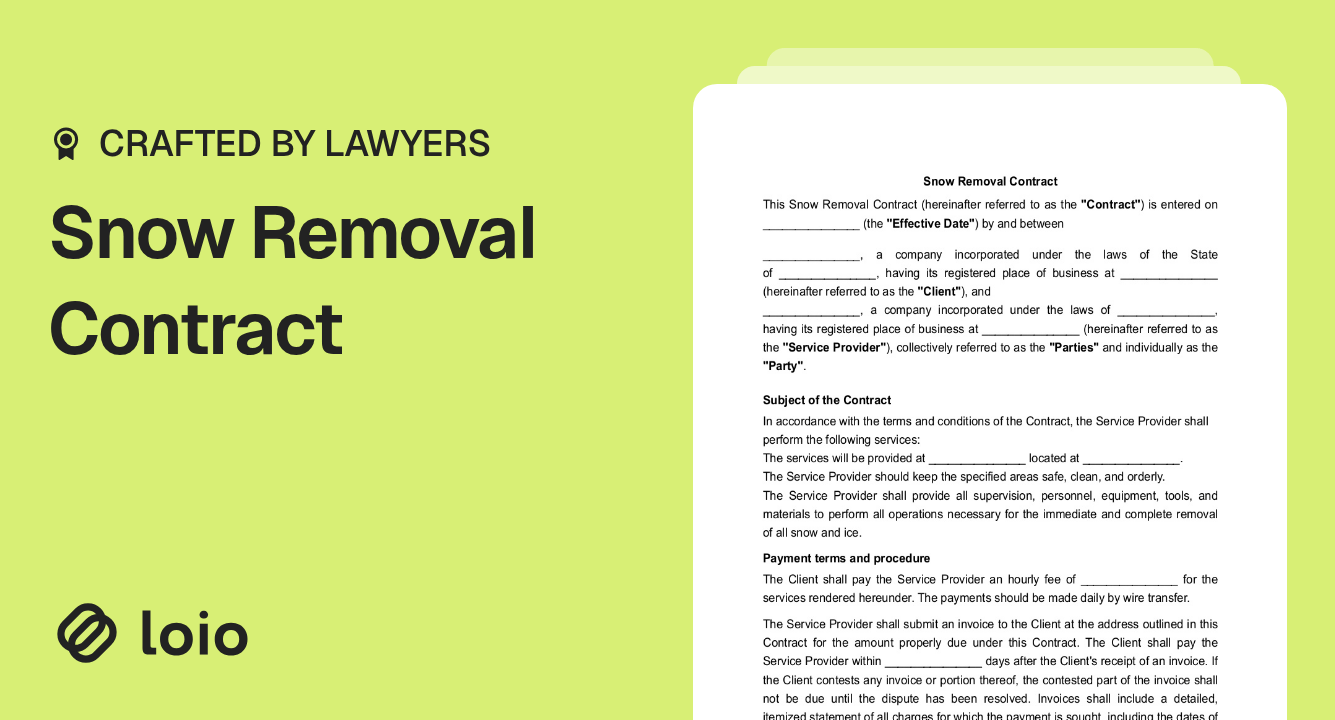
Free Snow Removal Contract Template

A snow removal contract template helps a property owner or manager and a service provider set clear terms for removing snow and ice from a specified property.
Use this template to define the location and scope of services, payment terms, contract duration, termination rules, performance standards, and other conditions before work begins. It can be adapted for recurring or seasonal snow removal arrangements.
The template uses an hourly fee and may include a retainer. If the parties prefer per-visit, per-event, accumulation-based, or flat seasonal pricing, they should adjust the payment terms and specify what each charge covers.
What Is a Snow Removal Contract?
Copy section linkA snow removal contract is an agreement between a client and a service provider for clearing snow and providing any agreed ice-control services in specified areas. It explains what work the provider will perform, where the work will take place, how the provider will be paid, and how long the arrangement will last.
A written agreement is especially useful for recurring services, such as maintaining parking lots, walkways, driveways, or other outdoor areas throughout the winter. A commercial snow removal contract may be used by businesses and property managers, while a residential snow removal contract can cover similar services for a residential property.
Who can use a snow removal contract?
Property owners, property managers, and businesses can use a snow removal contract when hiring an independent provider to maintain their premises. Snow-removal companies and contractors can also use the agreement to document what they have agreed to do for a client.
For a simple, one-time service, a written estimate or work order accepted before work begins may contain the practical terms the parties need. An ongoing arrangement generally benefits from a fuller agreement covering scope, pricing, performance, termination, and related responsibilities.
What should a snow removal contract include?
The details depend on the property and the arrangement. This snow removal service agreement includes provisions covering:
- the client and service provider;
- the property where services will be performed;
- snow and ice removal services;
- personnel, equipment, tools, and materials;
- hourly fees, invoices, and a retainer;
- the contract term and termination;
- inspection and correction of incomplete or defective work;
- taxes;
- default and remedies;
- force majeure;
- governing law and dispute resolution; and
- signatures and party information.
The parties may need to add more specific operational details, such as a snowfall trigger, response time, deicing requirements, or designated snow-storage areas. If you need to customize the completed document further, you can use Loio’s Edit PDF feature to add or adjust these details.
What to Know Before You Sign a Snow Removal Contract
Copy section linkA good contract should do more than state that the provider will “remove snow.” Before signing, make sure the agreement reflects how the service is expected to work at the actual property.
Define exactly what the snow removal service includes
Specify both the areas and the type of work covered. For example, distinguish parking lot plowing from sidewalk shoveling, salting or other deicing, snow relocation, and off-site hauling where applicable. The parties should also designate appropriate snow-storage areas and prohibit placing snow where it could block hydrants, accessible routes, entrances, sight lines, or drainage, or create melt-and-refreeze hazards.
This distinction can matter when a dispute arises. In the Illinois appellate case Allen v. Cam Girls, LLC, the contractor's agreement required plowing after snowfall of at least two inches but did not state that the contractor had to salt the parking lot. The parties’ differing understandings of the plowing and salting obligations illustrate why these services should be addressed separately. The court, however, affirmed summary judgment because the plaintiff could not establish a causal link between the alleged icy condition and her fall — not simply because salting was outside the written contract.
The Loio template states that the provider will remove snow and ice and furnish the necessary personnel, equipment, tools, and materials. If the parties intend a narrower or more detailed service, they should describe it clearly before signing.
Set a clear service trigger and timing
The parties should decide what causes the provider's obligation to begin. A service trigger might be a specified amount of snow accumulation, the end of a snow event, a client request, or another agreed-upon condition.
A contractual snowfall threshold does not override any local rule that requires faster clearance or imposes different requirements. The contract sets when the provider must act, while separate municipal duties may still apply to the property owner or occupant.
Also clarify expected response times, whether service continues during prolonged snowfall, and whether the provider must return after plowing. These details are particularly important for properties that must remain accessible during business hours.
The current template does not contain a dedicated field for an accumulation threshold or response time. If these terms matter to the arrangement, add them to the description of services or another appropriate provision.
Clarify snow and ice responsibilities
Do not assume that “snow removal” automatically covers every form of ice treatment. State whether the provider must apply salt, sand, brine, or another deicing material and whether material costs are included in the fee.
If the client does not want deicing services, the contract should make that limitation clear as well. This reduces the risk that each party has a different understanding of what the provider must do after the snow has been plowed.
Check local snow-removal rules
Snow-removal obligations can differ significantly by city and state. Local rules may address who must clear an adjoining sidewalk, how quickly it must be cleared, how wide a path must be, or where removed snow may be placed.
For example, New York City requires owners, lessees, tenants, occupants, and other persons having charge of a building or lot to clear adjacent sidewalks within specified timeframes. Depending on when snowfall ends, the deadline may be within four hours, within 14 hours, or by 11:00 a.m. the following morning. The city also prohibits pushing snow into the street and lists penalties of $100 for a first offense, $150 for a second, and $250 for subsequent offenses.
Portland provides a different example. Portland City Code § 17.28.025 makes owners and occupants responsible for removing snow and ice from adjacent sidewalks and addresses liability for failure to do so. The code itself does not set a three-foot clearance width. A separate Portland Bureau of Transportation winter-weather guide recommends clearing a path at least three feet wide as soon as possible after a storm.
Check the rules that apply to the specific property instead of assuming one city's requirements apply elsewhere.
Understand how hiring a contractor can affect liability
Hiring a snow-removal provider does not necessarily eliminate every responsibility that applicable law places on a property owner or occupant.
For example, New York City law can impose a nondelegable duty on certain owners to maintain an abutting sidewalk. As the court explained in Zamora v. David Caccavo, LLC, an owner may arrange for someone else to perform the maintenance work without necessarily transferring the statutory duty.
A contractor's potential liability to people who are not parties to the contract also depends on state law. In New York, the general rule described in Espinal v. Melville Snow Contractors is that a service contract alone generally does not create a tort duty to a third party. New York recognizes exceptions when the contractor creates or exacerbates a dangerous condition, a third party detrimentally relies on the contractor's continued performance, or the contractor entirely displaces another party's duty to maintain the premises safely.
These are New York rules, not nationwide standards. Liability can be treated differently elsewhere, which is another reason to define the parties' contractual responsibilities carefully.
Review liability and indemnification language under state law
If the parties add an indemnification, defense, or hold-harmless provision, state law may restrict how liability can be allocated.
Under Illinois law, certain indemnification, hold-harmless, and defense provisions are void if they require, or have the effect of requiring, one party to assume liability arising from the other party's own acts or omissions.
The Illinois Snow Removal Service Liability Limitation Act covers agreements for plowing, shoveling, other snow removal, deicing, and certain incidental services. It applies to covered contracts entered into on or after August 25, 2016, subject to statutory exclusions. It does not establish what indemnification language is valid in every other state.
Consider insurance requirements
Depending on the provider's business, employees, vehicles, and location, appropriate coverage may include commercial general liability, commercial auto insurance, or workers’ compensation insurance.
Government snow-removal contracts provide examples of these coverage types; for instance, Bristol Township requires snow-plowing contractors to maintain general liability, commercial auto, and workers' compensation coverage and provide proof of insurance.
The parties can also decide whether the provider must supply proof of coverage or name the client as an additional insured where appropriate. The current template does not include a detailed insurance provision, so add one if insurance requirements matter to the arrangement.
Plan for extreme conditions
The template includes a force majeure provision for circumstances outside a party's reasonable control. This should not be read as excusing the provider merely because of ordinary winter weather — the very condition for which the service was contracted.
Instead, consider how the agreement should work if extraordinary conditions make performance impossible or materially delay it. Examples include an unusually severe storm, government restrictions, or loss of access to the property. The contract can address notice and how performance dates will be handled in those situations.
How to Fill Out a Snow Removal Contract
Copy section linkIf you're wondering how to write a snow removal contract, start by gathering the details of the property, services, pricing, and parties involved. Then complete the agreement using information that matches the actual service arrangement and review any custom terms before signing.
1. Identify the client and service provider.
Enter each party's full legal name and address. For a corporation, LLC, or other registered entity, include its state of formation where the template requests it. Enter the agreement’s effective date.
Use each party’s legal name and add any relevant trade name so it is clear who is entering the contract.
2. Describe the property and service areas
Enter the address or other clear description of the property where the work will take place.
Be more specific if only part of the property is covered. For example, identify the parking lot, entrances, loading areas, sidewalks, walkways, or other locations included in the service.
3. Define the snow and ice removal services
Describe what the provider must do at the property. Specify whether the work includes plowing, shoveling, ice treatment, or other agreed services.
4. Add the service trigger and timing if needed
Decide when the provider must begin work. If the parties use an accumulation threshold, state the agreed depth rather than leaving the trigger unstated.
You can also add a response time, rules for service during an ongoing storm, and any expected follow-up visits. These points are not provided as dedicated fields in the current template, so add them where they fit the parties' agreement.
5. Complete the fees and payment terms
Enter the hourly fee and any retainer. If the parties instead use per-push, per-event, accumulation-based, or seasonal pricing, customize the payment provision accordingly. State which services and materials are included or billed separately, when invoices are due, and how disputed charges will be handled.
6. Set the term and termination rules
Enter the contract's End Date. Review how much advance notice either party must give to terminate the agreement without cause.
The template also addresses amounts owed for work already performed and the return of any refundable retainer after termination. Make sure these provisions reflect the parties' intended arrangement.
7. Review performance, default, and weather provisions
The template allows the client to inspect completed services and require correction of incomplete or defective work. It also sets out notice and remedies if a party defaults.
Review the confidentiality, tax, and force majeure provisions as well. The confidentiality provision should match the information the parties actually exchange; a broad confidentiality clause may be unnecessary for a straightforward residential arrangement.
If a clause does not match the actual business relationship, customize it before signing rather than relying on language that does not fit the service.
8. Choose the governing law and sign the contract
Enter the state whose law will govern the agreement and review the dispute-resolution provision.
Finally, complete the names, titles, addresses, and signature fields for both parties. Each signatory should have authority to enter into the contract on behalf of the named client or service provider.
The parties may also sign electronically where applicable law permits. Under the E-SIGN Act, a contract generally cannot be denied legal effect solely because an electronic signature or record was used, although a person is not required to agree to use electronic records or signatures. Each party should keep an accessible copy of the completed agreement.
This template is intended for general use across all 50 U.S. states+DC. Local procedures — such as notarization, witnessing, or filing requirements — may still apply, so check your state's specific rules before signing.