Free template
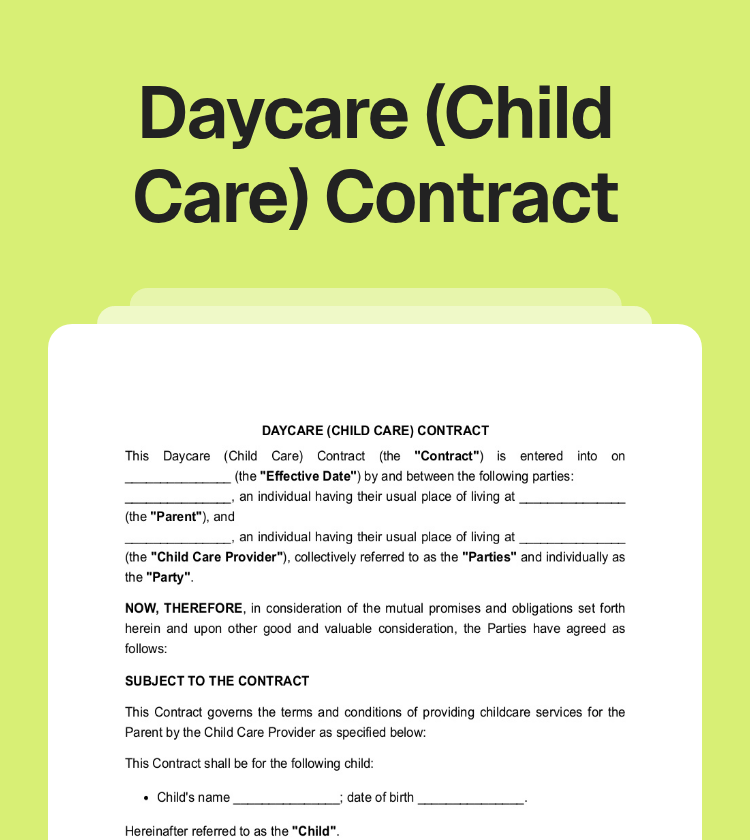
Free Daycare Contract Template

A daycare contract sets clear expectations between a parent and a child care provider before regular care begins. It can document the child’s schedule, the services the provider will perform, compensation, late pickup and overtime rules, time off, termination, confidentiality, and other terms the parties agree on.
Use Loio’s daycare contract template as a starting point for a recurring child care arrangement and customize the terms to match your family’s needs. A written agreement can help both sides understand what is expected and reduce disagreements about schedules, payment, absences, or ending the arrangement.
What Is a Daycare Contract?
Copy section linkA daycare contract is a written agreement between a parent and a child care provider that establishes the terms under which the provider will care for a child. Depending on the arrangement, it may also be called a childcare contract or child care agreement.
The contract does more than record a payment rate. It can define when care will be provided, what the provider is expected to do, how schedule changes are handled, what happens when a parent is late, whether holidays or vacations are paid, and how either party may end the arrangement.
When should parents and child care providers use one?
A written daycare contract is particularly useful when care will be provided regularly rather than as an occasional babysitting arrangement.
The Loio template is structured as an agreement between a Parent and an individual Child Care Provider, so it is well suited to arrangements in which a family hires a person to provide recurring child care.
The same document may also provide a useful starting point for a home daycare contract, but additional terms may be necessary when a provider operates a child care business from their own home. State licensing, capacity, health and safety, and other regulatory requirements may apply.
A commercial child care center may need a more extensive enrollment agreement covering center-specific policies, tuition, licensing disclosures, pickup procedures, disciplinary policies, and other operational rules. ChildCare.gov explains that center-based programs and family child care homes are subject to different licensing frameworks, which vary by state and territory.
What does a daycare contract cover?
This sample daycare contract addresses the main terms of a recurring child care arrangement, including:
- the parent, child care provider, and child;
- the services the provider will perform;
- the weekly care schedule;
- hourly compensation and payment terms;
- late pickup and overtime care;
- vacations, holidays, and sick leave;
- the contract term and termination;
- confidentiality and formal notices;
- governing law and dispute resolution;
- additional terms; and
- signatures.
Some families may also want to add emergency contacts, allergies, medication instructions, authorized pickup persons, transportation permissions, or other child-specific information.
What to Know Before You Use a Daycare Contract
Copy section linkA contract can clarify the parties’ agreement, but it does not by itself determine whether the provider is an employee, whether a child care license is required, or which wage, tax, and safety rules apply. Those issues depend on how the arrangement actually operates and on applicable federal, state, and local law.
Determine whether the provider is an employee or independent contractor
Do not assume that calling someone an “independent contractor” in a contract automatically makes them one.
For federal tax purposes, the IRS looks at the actual relationship. A household worker is generally an employee when the person hiring them has the right to control both what work is done and how it is done. The IRS gives the example of a babysitter who works in the family’s home, follows the parent’s specific instructions, and uses household supplies; that worker is treated as a household employee.
By contrast, a self-employed worker generally controls how the work is performed, supplies their own tools, and offers services to the public through an independent business. The IRS also states that a worker who provides child care for a family in the worker’s own home generally is not the family’s employee.
This distinction matters because employee status can affect taxes, payroll responsibilities, wage requirements, and other legal obligations.
Check tax and wage obligations before setting payment terms
If a parent directly employs a child care provider as a household employee, the provider is not necessarily solely responsible for handling employment taxes.
For 2026, Social Security and Medicare taxes generally apply when a household employer pays one household employee $3,000 or more in cash wages during the year. The IRS explains that the employer may need to withhold the employee’s share, pay the employer’s matching share, obtain an EIN, issue Form W-2, and report household employment taxes on Schedule H. Different thresholds and exclusions apply in certain situations.
Wage-and-hour rules may also matter. The U.S. Department of Labor identifies babysitters and nannies who work in private homes as domestic service workers. Covered, nonexempt domestic service employees generally must receive at least the federal minimum wage and overtime of at least 1.5 times their regular rate for hours worked over 40 in a workweek. Specific exceptions apply, including a narrow casual-babysitting exemption and an overtime exemption for certain live-in domestic service employees.
For this reason, a daycare contract can state the parties’ agreed hourly and overtime rates, but contractual terms cannot replace minimum-wage or overtime requirements that legally apply to the relationship.
Check state child care licensing requirements
Whether a child care provider needs a license depends heavily on the state or territory and on where and how the care is provided.
Many informal arrangements involving a nanny, babysitter, relative, friend, or neighbor caring for a child in the child’s home do not require a child care facility license. However, ChildCare.gov notes that states and territories may regulate some in-home arrangements, and exemptions differ by jurisdiction.
Rules can be different when the provider cares for children in the provider’s own residence. A family child care home may need to be licensed, registered, or certified once state-specific conditions are met. For example, states use different thresholds based on the number of children and whether they are related to the provider.
Before signing the agreement, check the licensing rules where the care will take place.
Decide what child-specific information should be added
The template records the child’s name and date of birth, but families may need more detailed information for day-to-day care.
Depending on the child and the services involved, consider adding:
- emergency contacts;
- allergies and dietary restrictions;
- medication instructions;
- medical conditions or special care needs;
- people authorized to pick up the child;
- transportation permissions;
- illness and emergency procedures;
- meal or screen-time instructions; and
- any routines the provider is expected to follow.
These are practical additions rather than universal federal contract requirements.
Do not assume that every private babysitter must meet the same requirements as a licensed child care program. Licensed programs generally must comply with state health and safety standards that may include background checks, CPR or first-aid training, emergency planning, and staff training. Some legally license-exempt providers are not subject to all of these requirements.
How to Fill Out a Daycare Contract
Copy section linkA daycare contract template is most useful when the details reflect how care will actually work. Review each part together before signing rather than relying on general assumptions about hours, payment, or responsibilities.
1. Identify the parent and child care provider
Enter the effective date and the full names and addresses of the parent and child care provider.
Use accurate legal names so that both parties are clearly identified. Remember that the title “Child Care Provider” describes the provider’s role under the agreement; it does not by itself determine whether the person is an employee or independent contractor for tax or employment-law purposes.
2. Add the child’s information
Enter the child’s full name and date of birth.
If the provider needs information about allergies, medications, emergency contacts, authorized pickup persons, or other special needs, consider adding it to the Additional Terms section or using a separate written care-information sheet.
3. Describe the child care services
State what the provider is expected to do.
Services may include general supervision as well as agreed responsibilities such as preparing meals, helping with homework, organizing activities, handling bedtime routines, taking the child to scheduled activities, or providing transportation.
Be specific when a responsibility is important to either party. A clear description can prevent disagreement about tasks that were never discussed.
4. Set the weekly schedule
Complete the schedule with the days on which care will be provided and the expected start and end times.
If hours may vary, the parties can also explain how schedule changes will be requested and approved.
For household employees covered by the FLSA, actual working time may matter for wage calculations. The Department of Labor explains that a domestic worker who must remain on duty and ready to provide care may still be working even while waiting or while a child is sleeping.
5. Set compensation and payment terms
Enter the agreed hourly compensation and confirm when and how the provider will be paid.
Before relying on the tax language in the contract, determine whether the provider is actually a household employee or self-employed. A household employee may trigger employer tax obligations rather than being solely responsible for reporting and paying all employment taxes. For 2026 federal household employment tax rules, consult IRS Publication 926.
State payroll, unemployment, workers’ compensation, or other requirements may also apply.
6. Set late pickup and overtime terms
- The template allows the parties to specify:
- how many minutes late a parent may be before a late pickup fee applies;
- the amount of that fee;
- the rate for overtime care approved in advance; and
- the rate for overtime care that was not approved in advance.
Choose terms that are clear enough for both parties to calculate what is owed.
A contractual late pickup or overtime rate is not necessarily the same thing as statutory overtime pay. If the provider is a covered, nonexempt employee, applicable wage-and-hour law still controls the minimum overtime compensation that must be paid.
7. Agree on vacations, holidays, and sick leave
Specify how much vacation and sick leave the provider receives, how much notice each party should give before vacation, and whether compensation continues during:
- the parent’s vacation;
- the provider’s vacation;
- listed holidays; and
- the provider’s sick leave.
These provisions should reflect what the parties actually intend. The template provides space for negotiated terms, but applicable state or local employment laws may create additional leave obligations for an employee.
8. Set the contract term and termination rules
Enter when services start and, if applicable, when the agreement ends.
The template also allows early termination when one party violates the contract and does not correct the violation within a reasonable period after being asked to do so.
The parties may use Additional Terms to create a separate rule for termination without breach — for example, requiring advance written notice or payment instead of notice. There is no single federal notice period that automatically applies to every private child care contract, so applicable state law and the parties’ agreed terms should be checked.
9. Review confidentiality and notice provisions
The confidentiality clause protects information disclosed in connection with the child care arrangement and restricts its use to purposes connected with the contract.
It also contains an important exception for disclosure required by law. A private confidentiality agreement cannot eliminate disclosure duties imposed by applicable law.
Next, add the parent’s and provider’s email addresses for formal notices and confirm that the listed mailing addresses are correct.
10. Choose governing law and add additional terms
Enter the state whose law will govern the contract and the state in which disputes will be resolved.
Then use the Additional Terms section for arrangements that are important to the family but are not already covered. This may include:
- emergency procedures;
- medication administration;
- authorized pickup people;
- transportation;
- meals and dietary rules;
- screen time;
- overnight care;
- expense reimbursement; or
- procedures for changing the regular schedule.
If care takes place in the provider’s home, this is also a good point to confirm whether state licensing or registration rules apply. ChildCare.gov notes that requirements for family child care homes differ significantly by state.
11. Review and sign the agreement
Both parties should read the completed contract before signing and confirm that blank fields have been filled in or intentionally left unused.
The parent and child care provider should then sign and date the document and keep a copy for their records. If the arrangement later changes — for example, the schedule, compensation, or duties change — the template provides that amendments should be made in writing and signed by both parties.
A written daycare contract works best when it matches the parties’ actual arrangement. Revisit it when the child’s schedule or needs change, the provider takes on new responsibilities, or applicable employment or licensing requirements change.
Parents who pay for child care so they can work or look for work may qualify for the federal Child and Dependent Care Credit if the IRS eligibility requirements are met. For 2026, the maximum credit rate increased to 50%, while qualifying expenses used to calculate the credit remain limited to $3,000 for one qualifying person or $6,000 for two or more.
Related Documents
Also Read