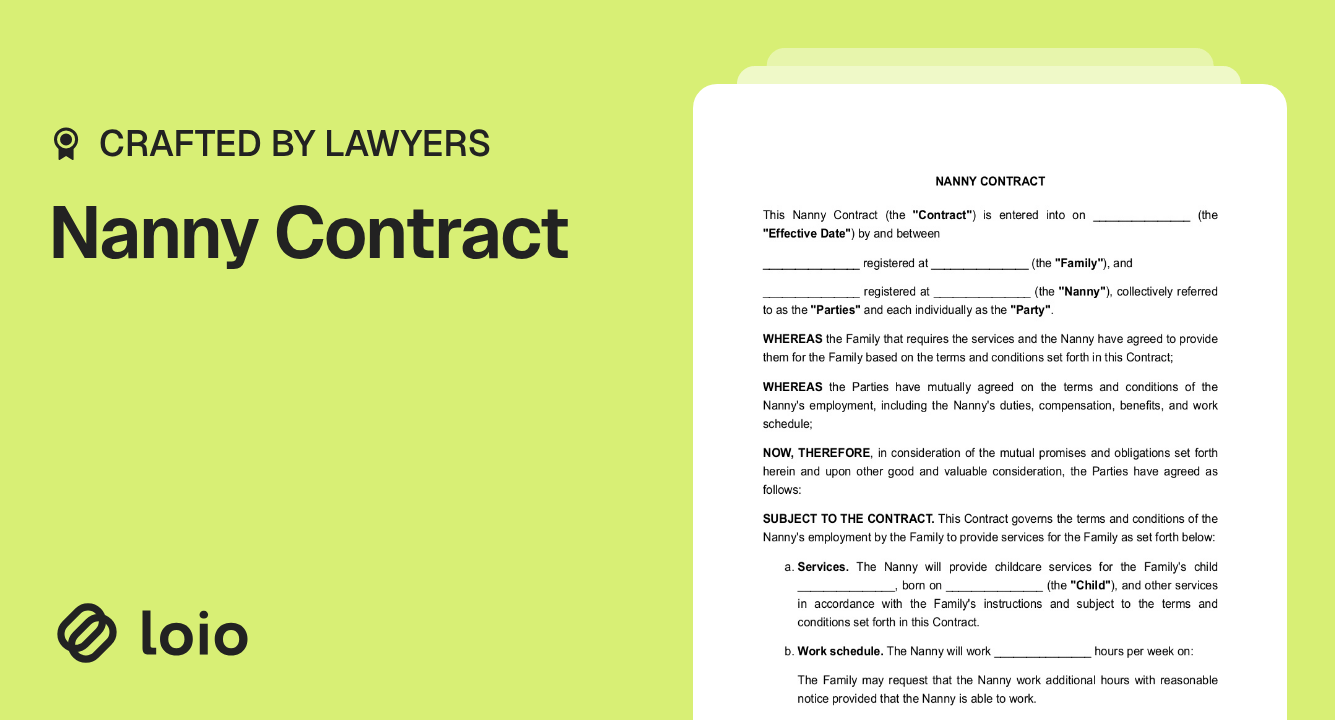
Free template
Free Nanny Contract Template

What Is a Nanny Contract?
Copy section linkA nanny contract is a formal agreement between a family (the employer) and a nanny (the employee). This document outlines the terms of the employment, such as work schedule, pay rate, job duties, and household policies. Unlike casual babysitter arrangements, a nanny position typically involves regular hours, ongoing responsibilities, and legal obligations.
So, a nanny employment contract provides clarity in the working relationship and gives both parties legal protection if problems arise.
A well-drafted nanny contract template also addresses child-specific needs such as allergies, medical conditions, emergency procedures, and discipline guidelines. It may include confidentiality clauses to protect family privacy and rules about phone use, visitors, or transportation of children.
When to Use a Nanny Contract?
Copy section linkUse a nanny agreement template when you:
Hire a nanny for regular, ongoing child care in your home.
Employ a live-in or live-out caregiver on a part-time or full-time basis.
When not to use a nanny contract:
If you hire an occasional babysitter for date nights or short-term care (use a babysitter contract instead).
If you use a licensed daycare center or family child care provider (use a daycare contract instead).
Parties to the Nanny Contract
Copy section linkParent/ Family: The individual or household that hires the nanny. As the employer, they are responsible for wages, tax withholding, and compliance with labor laws.
Nanny: The caregiver hired to provide child care services in the employer's home.
Placement agency: A third-party service that connects families with nannies. The agency may handle background checks, payroll, or guarantee periods.
What to Include In a Nanny Contract?
Copy section linkParties information: Full names, addresses, and contact details of the employer (parent or family) and the nanny.
Services: A general description of the type of care the nanny will provide, such as child care, meal preparation, or light housework.
Work schedule: The days and hours the nanny is expected to work, including any flexibility or overtime requirements.
Start date: The official date when employment begins.
Worksite address: The location where the nanny will perform their duties, typically the family's home.
Compensation: The pay rate (hourly or salary), payment frequency, method of payment, and overtime rate if applicable.
Job кesponsibilities: A detailed list of specific duties such as school pickup, bath time, homework help, meal preparation, and child-related errands.
Vacation: Terms for vacation time, sick days, holidays, personal time, and how unused time is handled (carryover, payout, or forfeiture).
Termination of employment: The notice period required by either party, grounds for immediate termination, and any severance terms.
Confidentiality: A clause that protects family privacy and prohibits the nanny from sharing personal information about the household or children.
Governing law: The state whose laws will apply to the contract in case of a dispute.
Force majeure: A clause that addresses unforeseeable events (such as natural disasters or public health emergencies) that may prevent either party from meeting their obligations.
Severability: A provision that keeps the rest of the contract valid if a court finds one section unenforceable.
Signatures: Spaces for both the employer and nanny to sign and confirm their agreement to all terms.
Date: The date when both parties sign the contract.
What Are the Key Terms in a Nanny Contract?
Copy section linkHousehold employee: A worker hired to perform services in the employer's home.
Overtime: Under the Fair Labor Standards Act, most household employees must receive overtime pay (1.5 times the regular rate) for hours over 40 per week. Live-in employees may be exempt in some states.
Kin-care: Some states, like California, allow employees to use their accrued and available sick leave to care for a family member.
At-will termination: An employment arrangement where either the employer or the employee may end the relationship at any time, for any lawful reason, without prior notice — unless the contract specifies otherwise.
How to Fill Out a Nanny Contract?
Copy section link- Enter the date of the agreement.
- Add the employer's full name and address.
- Add the nanny's full name, address, and contact information.
- State the employment start date and whether the term is ongoing or fixed.
- Define the work schedule: days, hours, and any flexibility expected.
- Enter the pay rate (hourly or salary) and frequency of payment.
- Specify overtime compensation in compliance with FLSA and state law.
- List benefits such as paid time off, sick leave, and holidays.
- Describe job duties in detail: child care tasks, meals, errands, light housework (if any).
- Document child-specific needs, such as allergies, medications, routines, and emergency contacts.
- State household rules: discipline approach, screen time limits, visitor policy, smoking prohibition.
- Add confidentiality terms to protect family privacy.
- Define termination terms, including the notice period and grounds for immediate dismissal.
- Have both parties sign and date the contract.
What is nanny tax, and do I have to pay it?
Nanny tax refers to Social Security, Medicare, and unemployment taxes for household employees. If your nanny is hired as an employee and earns above the IRS threshold ($3,000 for 2026), you must withhold and remit these taxes.
Is my nanny entitled to overtime pay?
Under the FLSA, household employees must receive 1.5 times their regular rate for hours over 40 per week. Meanwhile, live-in domestic service employees, including nannies, are exempt from overtime pay under Section 13(b)(21) of the FLSA. Still, some states, including California, New York, Hawaii, and Maryland, override this exemption and require overtime pay for live-in workers. So check your local laws before signing the nanny contract.
What is the difference between a live-in and live-out nanny?
A live-in nanny resides in your home and may have different overtime and minimum wage rules under federal and state law. A live-out nanny works set hours and returns to their own residence.
Do I need to provide paid sick leave to my nanny?
It depends on your state. Many states, and even some cities, require employers to provide paid sick leave for household employees. Check your state's labor laws for specific requirements.
Should I run a background check on a nanny?
Yes. A background check helps verify criminal history, driving records, and references. If you use a consumer reporting service, you must follow FCRA rules and obtain written consent from the nanny.
Can I terminate my nanny at any time?
If the contract states at-will employment, either party may end the relationship at any time. However, nanny contracts should specify a notice period and any severance terms. Immediate termination may be allowed for serious misconduct.
Requirements for this document vary by state. Review your state's laws and procedures — or consult a licensed attorney — before using this template to ensure it's valid and enforceable where you live.
Sources
Related documents
Also read