Updated September 13, 2026
11 min read
How to Hire a Nanny in 2026: The Full Legal Process Explained

How to Hire a Nanny in 2026: The Full Legal Process Explained
- Why do Families Need an EIN Before Formal Screening and Payroll Setup?
- When is a Nanny Treated as a Household Employee for Taxes, Insurance, and Legal Pay Rules?
- When Should You Run a Nanny Background Check and Reference Check Before Making an Offer?
- What Should a Legal Nanny Work Agreement Include Before Day One?
- How Do You Set up a Nanny Payroll and Pay Legally as a Household Employer?
- Quick-Start Guide: How to Hire a Nanny Legally
- Summing Up
Content
Hiring a nanny is an important occasion in the life of every family. It can be stressful to people who don’t have any previous experience of such delegation. But hiring a caretaker also means that you will have good, dedicated, and personalized care in your own home, which lifts a lot of weights off the tired parents’ shoulders.
If you are a first-time employer, you have to remember that hiring a nanny is a professional contract, not a personal agreement. So, besides just being a parent, you become a household employer.
Understanding how to legally hire a nanny works well for both sides. It helps you protect your family from legal disputes and making mistakes that might cause tax audits. And, for a nanny candidate, it helps them get the professional benefits they deserve (such as Social Security and unemployment insurance, for example).
That’s why we have created this guide. To give you a full picture of what to know before signing your first nanny work agreement and provide you with step-by-step instructions on how to hire a nanny.
Why do Families Need an EIN Before Formal Screening and Payroll Setup?
Any family employer should obtain the Employer Identification Number (EIN). Basically, it is a so-called social security number for your household business. That’s why it is important to register one before you get a nanny. Even though you are not running a huge corporation and only aim to hire a caretaker, the IRS (Internal Revenue Service) treats your home as a place of business when you hire someone as staff.
Thanks to EIN, you will be able to report the taxes you withhold from your nanny’s paycheck to the IRS. Most states require it to register for state unemployment insurance, so it’s better be done on time.
Besides, without an EIN, you won’t be able to legally file Form W-2 at the end of the year that summarizes annual wages and tax withholdings.
Remember that it is only safe and free to apply for your EIN on the official IRS website, so avoid third-party filling-in services.
When is a Nanny Treated as a Household Employee for Taxes, Insurance, and Legal Pay Rules?
Families who want to hire a nanny sometimes get confused about whether their new caretaker is an "employee" or an "independent contractor" (someone who would receive a Form 1099).
For federal tax purposes, the IRS generally treats a nanny as a household employee if you control not only what work is done, but how it is done. This is part of the IRS common-law control test. By contrast, under the FLSA, the Department of Labor uses an economic reality test to determine whether a worker is an employee or an independent contractor. These tests serve different legal purposes and should not be confused.
Also, in 2026, if you pay your nanny $3,000 or more in a calendar year, you need to withhold and pay Social Security and Medicare taxes.
Live-out nannies generally must receive overtime pay at 1.5 times their regular rate for hours worked over 40 in a workweek. However, qualifying live-in domestic service employees hired directly by an individual, family, or household are exempt from the federal FLSA overtime requirement. State law may provide greater protections.
When Should You Run a Nanny Background Check and Reference Check Before Making an Offer?
The best time for a background check is after you conduct a successful interview with a nanny candidate, but before signing a work agreement with them. You can tell the candidate that you are ready to offer them a contract, but only if their background and references come back clear. This method is known as the "Conditional Offer" Strategy and is widely used in many working areas. Keep in mind that there are some limitations to the conditions you can require (often related to the Fair Credit Reporting Act (FCRA) and Americans with Disabilities Act (ADA)).
The FCRA rules for references and background checks when hiring a nanny
If you obtain a background report from a consumer reporting company, the FCRA requires a clear written disclosure in a stand-alone document and the candidate’s written authorization before the check. If the report may lead you not to hire the candidate, provide a pre-adverse action notice together with a copy of the report and “A Summary of Your Rights Under the Fair Credit Reporting Act” before making the final decision.
Keeping things formal here protects both you and the nanny, so it is a win-win.
What Should a Legal Nanny Work Agreement Include Before Day One?
When bringing someone so important into your home, it is not enough to go for a “handshake deal.“ Take your written employment contract (or work agreement) seriously: set clear expectations and make sure it can prevent future conflicts. Before your nanny starts to work, define the following:
Duties: what your nanny is going to be responsible for while working at your place—childcare, meal prep, light housekeeping, whatever you agree on. Your nanny can even be authorized to perform certain actions like medical decisions via Child Care Authorization Form. If you consider hiring a live-in nanny, state the live-in arrangements in your work agreement, too.
Compensation: state the hourly rate clearly. Remember that you must talk in "gross" terms, which means the amount of money before taxes. Check the applicable federal, state, and local minimum wage and overtime rules, and state the pay frequency in the agreement.
State or local minimum wage requirements may be higher than the federal rate, so check the rules that apply where the nanny works.
Benefits and PTO: include how many days of vacation, paid holidays, and sick leaves your nanny earns. If you want to provide your caretaker with extra benefits like an annual performance bonus, this, too, has to be stated in your contract. Adding extra points to the work agreement is especially convenient with the editing PDF tool.
Termination details: ending an employment agreement can happen via resignation, mutual consent, or employer dismissal (with or without cause). Make sure that you cover the terms in your contract to protect your nanny and yourself from any unexpected reasons for finishing your professional relationship.

How Do You Set up a Nanny Payroll and Pay Legally as a Household Employer?
If you are determined to pay your nanny legally, there are three main steps you will need to take: taxes, records, and insurance. Let's take a closer look at each of them.
Tax withholding
This is the thing you have to handle first. This includes Social Security and Medicare, which add up to 15.3% of the nanny’s pay. You pay half of that (7.65%) as their employer, and the other half is usually taken out of the nanny’s check.
You may also owe Federal Unemployment Tax (FUTA) if you paid household employees a total of $1,000 or more in any calendar quarter of 2025 or 2026. FUTA is 6% of the first $7,000 of wages per employee, but a credit of up to 5.4% can reduce the effective rate to 0.6%.
To know exactly what you are obliged to pay, take a look at our guide, The 2026 Tax Checklist.
Recordkeeping
The Fair Labor Standards Act (FLSA) requires you to keep the records of your nanny's work. What it means, precisely, is how many hours they worked for you and how much they got paid for it. You have to be able to provide such info about your nanny for at least three years of her work.
Worker’s compensation insurance
Workers’ compensation requirements for household employers vary by state, including coverage thresholds and exemptions. Check your state workers’ compensation agency to determine whether coverage is required for your nanny.
And if you want to take good care of your own health, don’t forget to check the Top 5 Healthcare Documents You Need.
Quick-Start Guide: How to Hire a Nanny Legally
Feeling a bit overwhelmed by all of the information above? Here is a short step-by-step instruction on how to manage hiring a nanny.
- 1
Figure out your budget and needs. Check out the minimum wage for different kinds of employment to answer how much is it to hire a nanny in your state. Decide if you would like to go for full-time care or if you need to know how to hire a part-time nanny.
- 2
Register as an employer. For that, you will need to obtain a Federal Employer Identification Number through the IRS. This will work as your "tax ID" further on.
- 3
Search and interview. You can look for your candidate on job search websites, ask your friends and acquaintances for advice, or use specialized agencies to meet your perfect nanny. Don’t be shy to ask questions, vaccination certificates, or anything else you find important to know before the nanny meets your kid.
It can be a truly time-consuming process, especially if you are looking globally and researching how to hire a nanny from overseas instead of the US. If you are considering childcare through an overseas exchange participant, review the State Department’s J-1 Au Pair program. Au pairs must participate through designated program sponsors and are subject to specific eligibility, work-hour, and host-family requirements.
Get to know how much does it cost to hire a nanny in advance so you have all the necessary information before the actual hiring process starts.
- 4
Verify eligibility. In the US, it is legally required that you confirm your nanny’s right to work here. Within three days of their start date, you need to complete the Form I-9 (Employment Eligibility Verification). This ensures compliance with the Immigration Reform and Control Act (IRCA).
- 5
Conduct a thorough screening. If you choose to obtain a third-party background report, make sure the nanny has no criminal background before signing the contract. For this, you will need your candidate's written consent under the Fair Credit Reporting Act (FCRA). Conduct interviews with candidates to find your perfect match for the role. Also, it is preferable to call at least three professional references—this usually is enough to get the opinions you need for making your decision.
- 6
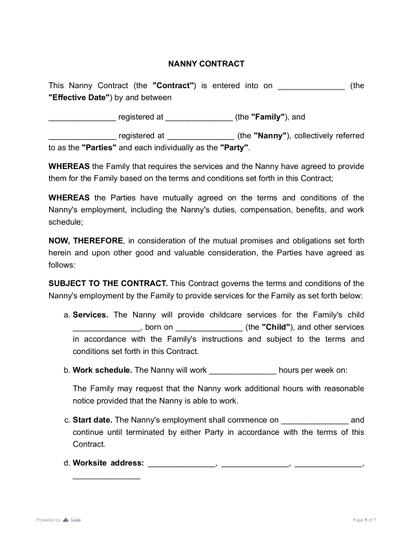
Draft and sign your work agreement. You can use the ready-to-use Nanny Contract template. Remember that the Employment contract has to define your nanny’s payment, duties, paid time off, and schedule, so make sure to add all of these details to your Work Agreement. To make the process fast and smooth, use an electronic signature.
- 7
Use a specialized household payroll for convenience. This step is optional, yet widely used. There are options for automating your payroll to conveniently handle the withholding of Social Security and Medicare taxes.
Household employers generally report federal household employment taxes annually on Schedule H (Form 1040), rather than filing quarterly employment tax returns. For 2026, qualifying employers must provide Form W-2 to the employee and file Forms W-2 and W-3 with the SSA by February 1, 2027; Schedule H is generally filed with the 2026 federal income tax return by April 15, 2027.
And remember that you can check any document or agreement without reading it from A to Z with the AI summary function.
Remember that you also need to check out IRS Publication 926 to be aware of the ongoing financial thresholds and reporting laws.
Summing Up
Learning how to hire a nanny is a process that requires a lot of patience and specific knowledge, so you have to be prepared. But you can create a stable and professional environment for your family and your new caretaker if you follow the legal requirements carefully.
Whether you are figuring out how to hire a live-in nanny or a part-time caretaker for just a few hours weekly, it is best to support them with all the legal support so they can take good care of your kids.
Following the tips above can lead you to a smooth and clear hiring process and bring the best nanny to your house.
More guides
October 16
7 min read
What Is OCR (Optical Character Recognition)? How It Works & AI Uses
September 11
4 min read
What to Look for in an Employment Contract
September 11
5 min read
Employment Contract Red Flags to Check Before You Sign
September 15
The Difference Between First, Second, and Third-Degree Murders
September 4
Living Will vs Last Will: What’s the Difference?

August 31
4 min read
Living Will vs Power of Attorney: Understand What You Need

One home for your
agreements
Edit PDFs seamlessly
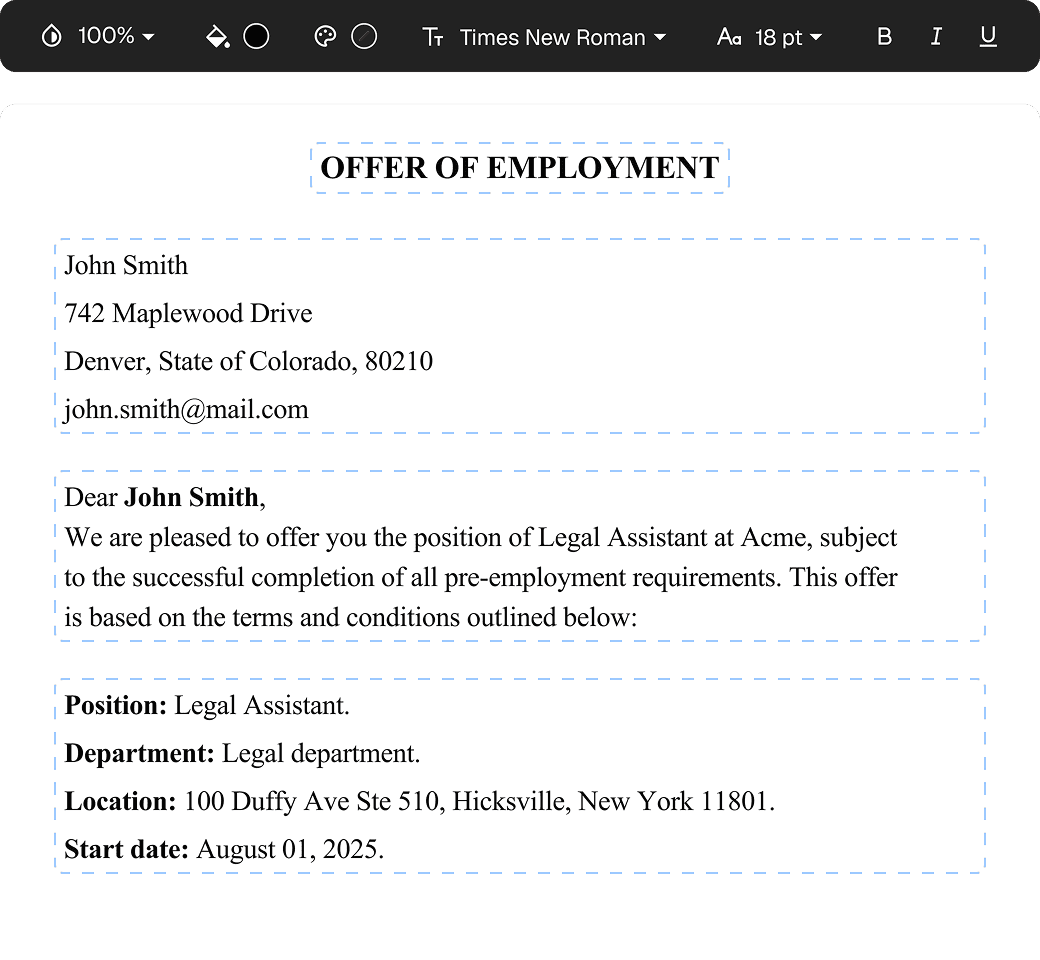
Tweak agreements before signing or sending for signatures. Update details, add or remove clauses, adjust formatting, and redline changes instantly.
eSign legally and securely
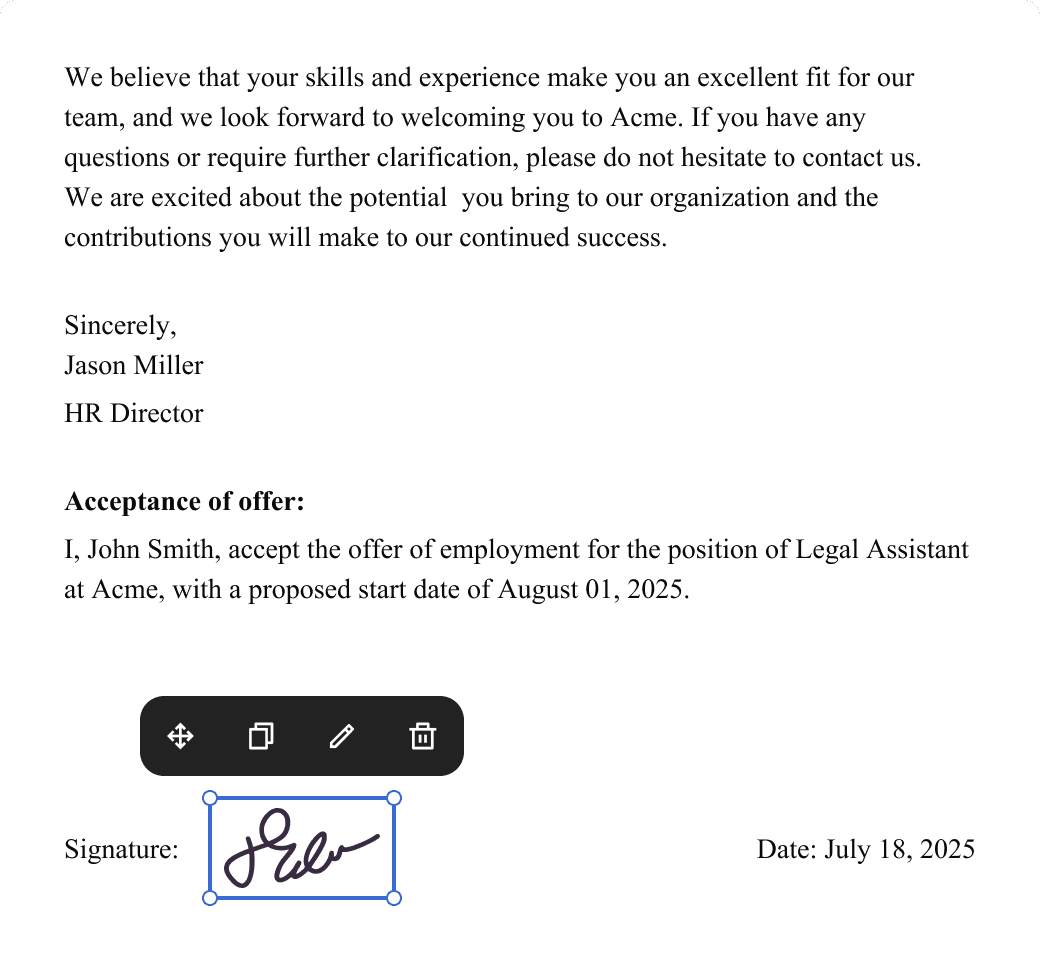
Sign documents and collect legally binding signatures. Invite up to ten people to sign in any order, track the progress, and send reminders.
Request legally binding signatures
Invite up to ten people to sign your document in any order. Get a finalized, audit-ready copy without chasing signatures.
Skip the drafting.
Choose from 2,500+ templates
Browse templatesChoose a template
Fill in details
Sign and download