Updated September 11, 2026
4 min read
What to Look for in an Employment Contract
When you see a long contract with plenty of complex words, the knee-jerk reaction is to sign it and be done. It can feel like too much hassle after long negotiations and interviews. But an employment contract is one of the key documents that may impact when you wake up, whether you can keep your weekend side project, and how much freedom you have within your position. When you know how to read a contract and look at how it holds up against your plans, you prioritize yourself and learn how to negotiate a contract to your advantage in the future. This article explains what to look for in an employment contract and how to make sure it represents your interests, your lifestyle, and what you expect from a job.
Although how each contract looks depends on the company that drafts it, these are usually the main elements of one:
- Job duties and title.
- Compensation and benefits.
- Work location and schedule.
- Termination and notice terms.
- Restrictive covenants and IP.
Forced Travel or Office Moves
Do you want to work fully remotely, or do you perform better in the office? What about travel for work? Consider what works for you.
In a contract, a red flag is a suspicious clause that might harm one of the parties signing it. Some red flags are blatantly demanding and expect too much of a person, while others are too broad and vague — too open to interpretation. If you’re not sure about the document in front of you, using Loio’s AI contract review can help you notice things you might have otherwise missed.
Phrases to look for
Search your document for these phrases — check whether these suggestions suit your working goals:
- 1
“Position located in [city], or such other location as the Company may reasonably designate…”
This clause suggests the company can decide where to move you if relocation is needed. If you’re open to moving to a different city (and being paid for it), it fits you. - 2
“Duties include travel up to X%, or as deemed necessary by management to fulfill operational needs.”
This offer is best for people who don’t mind traveling — though if you do, make sure your travel expenses are reimbursed. - 3
“Hybrid and remote work arrangements remain subject to modification or revocation at the sole discretion without prior notice.”
In this case, whether you work remotely or not depends on a manager’s decision.
Demands on Your Evenings and Weekends
We all work overtime sometimes, but when it becomes an expectation, things can feel far less comfortable. A lot depends on the type of position you’re applying for and your own preferences. While negotiating or discussing a contract draft for your time off, you can always use our PDF editing feature instead of working with paper versions.
Phrases to look for
Scan your contract for these specific clauses to see how much control you retain over your free time:
- 1
“Exempt status... salary covers all hours necessary to fulfill assigned duties, regardless of schedule.”
This means you’re paid for outcomes, not hours, and you’re not compensated for overtime. Exempt employees genuinely aren't entitled to overtime under the FLSA, but a contract clause can't make you exempt. That depends on your actual duties plus a salary floor ($684/week federally, higher in some states), and the Department of Labor is clear that job titles never determine exempt status. If the clause is doing the classifying, ask what duties they think qualify. - 2
“Expected to remain accessible and responsive as reasonably required by global operations.”
This phrase suggests that you may be working on someone else’s clock. If someone else has a different shift, you might be expected to respond even when it’s late at night on your end. - 3
“Duties may require non-standard working hours, including nights, weekends, and holidays, without additional compensation.”
This statement clarifies that unconventional working hours aren’t an emergency, but you’re expected to be available almost all the time. The employer may present it as greater flexibility than a typical 9-to-5, but the truth is you’ll most likely be busy around the clock.For more clarity about your pay prospects, check our article on pay transparency laws by state.
Marcus saw the clause “flexible availability required for global team syncs” as common. He preferred to have more time to himself when he wasn’t needed for calls. Within two months, he was assigned to a high-priority integration with a team based 12 time zones ahead. Flexible availability turned into mandatory 9:00 PM sync calls four nights a week, followed by 6:00 AM Slack check-ins with stakeholders in his own time zone. Because his contract bound him to global operational needs without defined core hours, Marcus felt he couldn't refuse.
Claims on Your Side Hustles and Weekend Projects
This is where you may need to be careful if you plan to use the company’s resources (e.g., a laptop they provide) for your side hustle. Double-check whether you plan to use any available resources for other projects.
Phrases to look for
Look at these phrases to check if they apply to your activities and side projects:
- 1
“All inventions, developments, improvements, and works of authorship created during the period of employment…”
Because it doesn’t say “created for the company,” it basically covers all of the things you make or come up with while employed. - 2
“...whether or not made or conceived during regular working hours, or using Company equipment, facilities, or trade secrets…”
The phrase “whether or not” strips away the boundary between your personal laptop/weekends and your employer’s office. - 3
“Employee shall not engage in any other business activity, compensated or uncompensated, without prior written consent…”
“Uncompensated” in this case means that even something like volunteering technical advice to a non-profit or maintaining open-source projects requires formal agreement from your boss.
Questions to ask yourself before signing
If you want to know whether the contract suits your lifestyle, ask yourself these questions:
- 1
Do I keep my personal creative work 100% physically separate from company laptops, company Wi-Fi, and work hours?
- 2
Is my side project or hobby closely related to the industry, clients, or technologies my employer deals with?
- 3
Do I plan to earn money, raise capital, or publish personal work while working here?
Payment Models
People who work for a base salary and those who prefer to be compensated for their performance prefer entirely different approaches to work — and the contract, too.
Phrases like “Bonuses are entirely discretionary… and subject to financial performance” typically indicate that your income will be highly dependent on how the employer sets the requirements for the bonuses to be obtained. It is common in industries like sales; if you know how to earn money through this model, it can yield far higher results than a typical base salary approach. But if you want a stable and predictable source of income, avoid contracts that link a significant piece of your salary to discretionary bonuses.
Once you’re confident about your payment focus, you can begin the signing process. Today, using electronic signature tools instead of traveling to the office just to sign is much easier — an eSign tool can help you seal the deal in a few clicks.
Maya accepted a sales role with a $90,000 base salary and a 30% target bonus. She planned to use the expected bonus as a down payment on a new car. Because the company missed its overall revenue goal, the bonus promise didn’t translate into actual money — her bonus was slashed to 0. And because Maya counted on the bonus for her down payment, she has to delay her plans now.
Your Exit and Financial Buffers
Always account for your long-term plans. Do you want to stay at a new job for an extended period, or are you not sure you’ll stay more than half a year? That’s why you need to check your contract for specific conditions that match your plans.
Phrases to look for
Check for these clauses to make sure they align with your approach to work:
- 1
“Employee agrees to repay 100% of the Signing Bonus / Relocation Assistance if voluntary separation occurs within X months…”
If you were given a lump sum for relocation and then leave before time’s up, you’ll have to repay that money. But if it fits your plans, there’s no reason not to go for it. - 2
“For a period of X months post-termination, Employee shall not directly or indirectly provide services to any competitor within an X-mile radius…”
If you plan to transition into a completely different industry, this non-compete won’t interfere with your next steps. But if you want to stay in the same field, this clause may not be for you. Though the enforceability of post-employment non-competes varies substantially by state, the Federal Trade Commission (FTC) warns that in some cases they can restrict worker mobility and wage growth. - 3
“Notice of resignation must be provided X days in advance; failure to do so results in forfeiture of accrued benefits…”
This clause suggests that you cannot resign and start a job in a week — usually, you’ll be asked to work for some time on top. In fact, you can resign without notice, but it can trigger consequences, like losing benefits. A lot of this depends on the type of job you have. If it’s something fast-paced, this clause just won’t let you get hired anywhere else. But if you’re in a senior role, extended notice periods are pretty common.
Taylor accepted a role in a new city and received a $10,000 signing bonus. The contract stated that Taylor had to repay 100% of the signing bonus if he left the company voluntarily within 24 months. Taylor used the money immediately to cover moving expenses and security deposits. As he worked, the job environment became hostile, and it became psychologically unbearable to stay there. However, because of the signing bonus, Taylor had to stay for more months to leave without financial repercussions.
Rules Around Time Off and Burnout
Although no one says no to a good time-off clause, we all expect different things. There’s no single perfect approach to PTO — what one person finds restrictive, another considers secure. If you value predictability, a traditional accrued or fixed lump-sum PTO policy is best for you. But if you need flexibility and know you can change your plans fast, an open-ended policy is far more useful.
Phrases to look for
- 1
“Employee shall be entitled to X paid vacation days per calendar year, accrued at a rate of X hours per pay period…”
If you prefer to gradually accumulate your guaranteed paid vacation days, you’ll want to have this clause in your contract. Although contractual PTO guarantees accrued time off, the U.S. Department of Labor notes that the Fair Labor Standards Act does not mandate payment for time not worked. - 2
“Unlimited/flexible paid time off is provided, subject to prior manager approval and operational demands…”
Your ability to take time off depends entirely on your workload and your agreement with your manager. With this clause, you get schedule freedom that is not restricted as long as you get your work done.
Questions to ask yourself before signing
Look through these questions and ask yourself how they relate to your dream time off approach:
- Will I actually take my vacation if there isn’t a fixed number of days counting down that I am “supposed” to use before December 31st?
- Did I ask my future direct manager how many weeks of time off they personally took last year? (If managers don’t take time off, they may not allow for “flexible” vacation requests either)
- Do I prefer taking long, continuous 2- to 3-week vacations, or do I naturally take quick 1-day long weekends throughout the year? (Fixed accrued PTO protects long vacations better, while unlimited PTO is more forgiving with short breaks).
How to Approach an Employment Contract?
None of this means you should walk into a negotiation looking for a fight. Most contracts aren't traps — they're written from the company's side of the table, and it's on you to check that the terms still work for you.
If a clause doesn't fit your life, say so before you sign, not after. A clear, well-reasoned request to adjust travel expectations, availability, or bonus structure is usually easy for a company to say yes to. And if you're still unsure what a clause actually commits you to, a quick AI contract review before you sign could save you a much longer conversation later.
More guides
September 11
5 min read
Employment Contract Red Flags to Check Before You Sign
September 1
7 min read
How to Provide Proof of Employment: Documents and Steps

July 28
4 min read
What Is the Difference Between a Reference Letter and a Recommendation Letter?

October 16
7 min read
What Is OCR (Optical Character Recognition)? How It Works & AI Uses
October 6
14 min read
How to Make a PDF Searchable: 5 Tested OCR Methods in 2026
September 11
6 min read
Employment Contract Mistakes Small Business Owners Often Make
One home for your
agreements
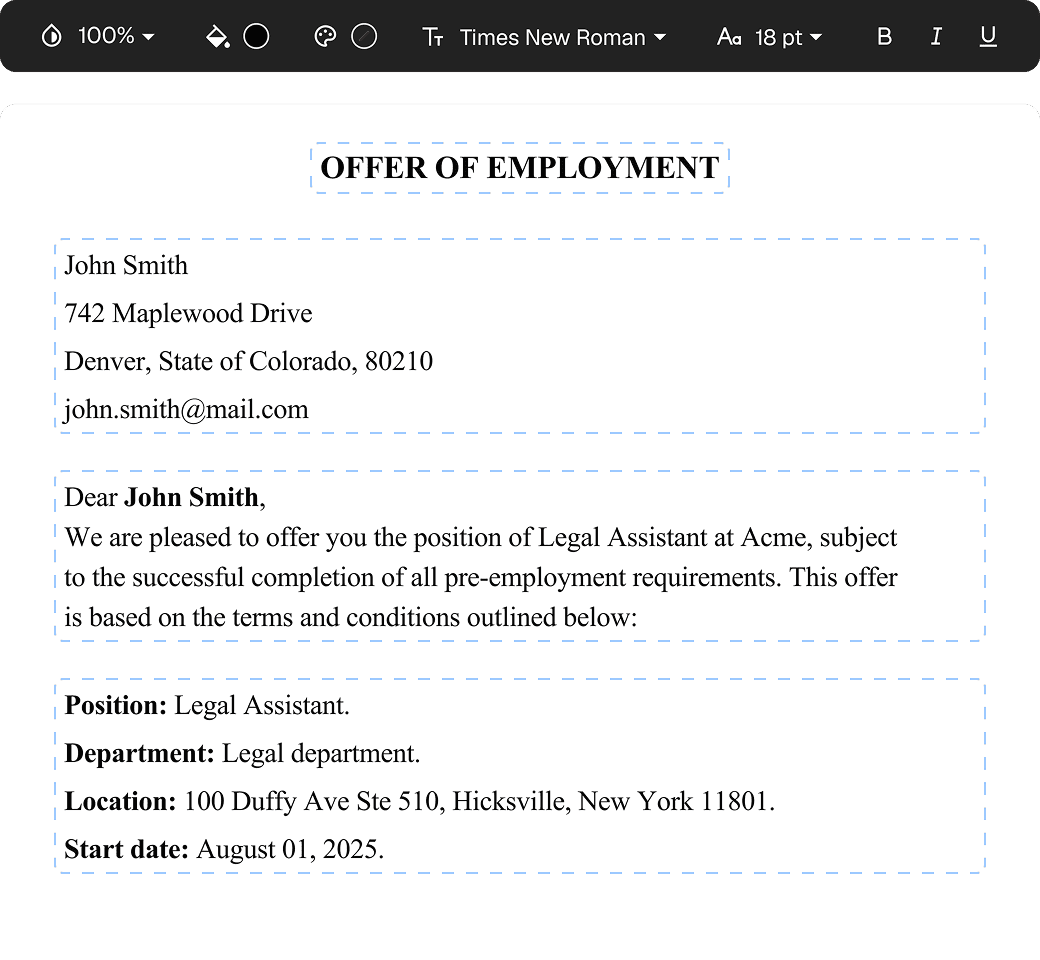
Edit PDFs seamlessly
Tweak agreements before signing or sending for signatures. Update details, add or remove clauses, adjust formatting, and redline changes instantly.
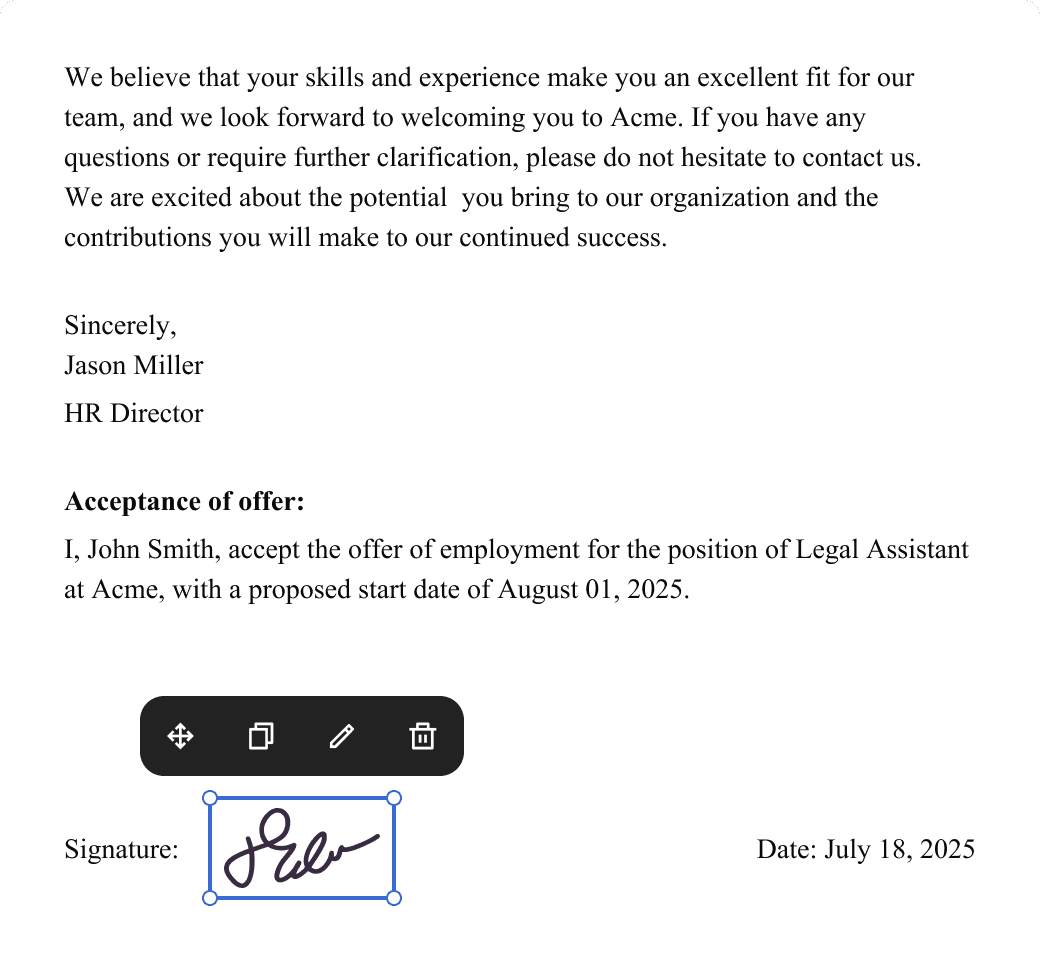
eSign legally and securely
Sign documents and collect legally binding signatures. Invite up to ten people to sign in any order, track the progress, and send reminders.
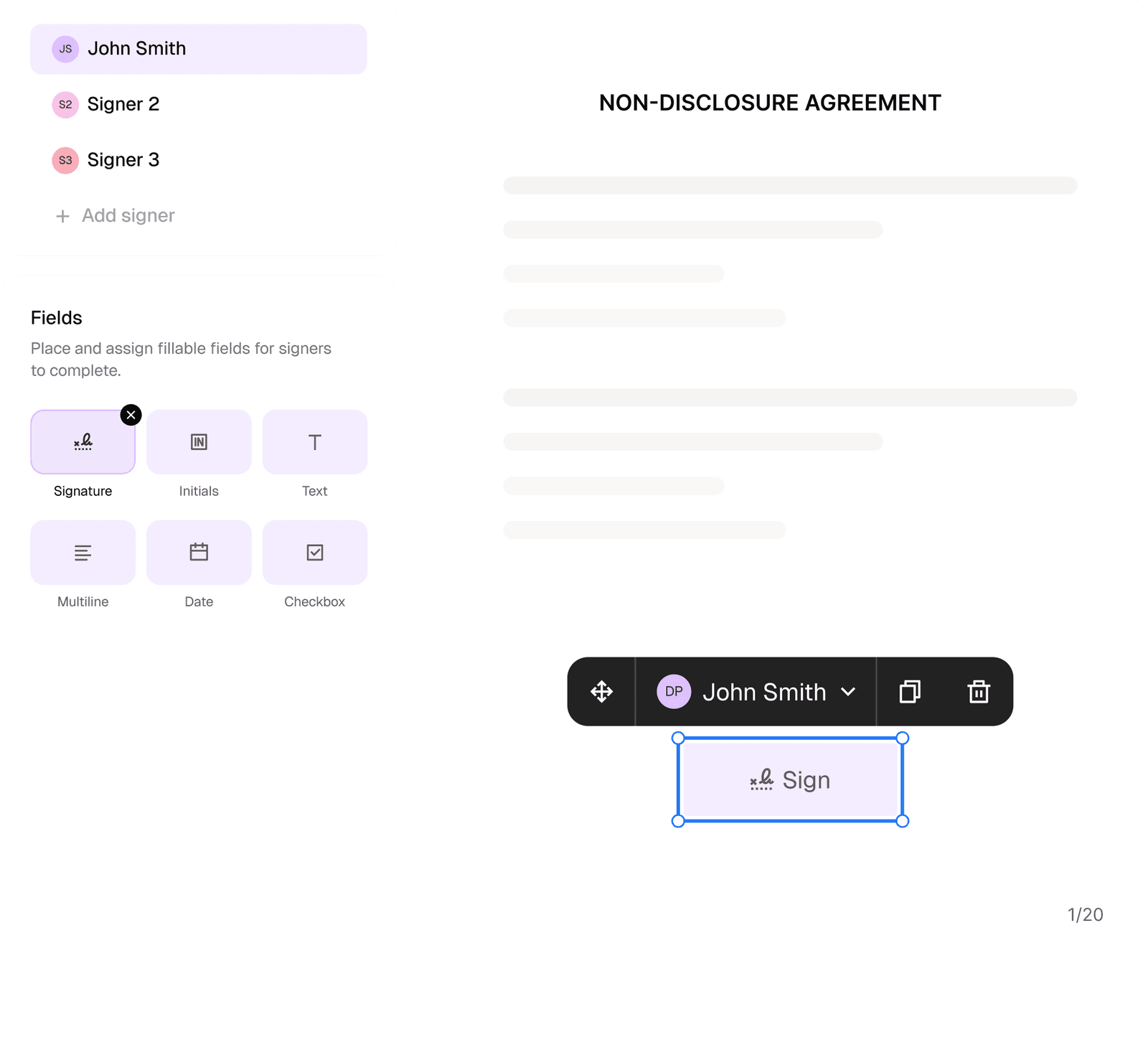
Request legally binding signatures
Invite up to ten people to sign your document in any order. Get a finalized, audit-ready copy without chasing signatures.
Skip the drafting.
Choose from 2,500+ templates
Browse templatesChoose a template
Fill in details
Sign and download