Updated September 11, 2026
5 min read
Employment Contract Red Flags to Check Before You Sign
Employment Contract Red Flags to Check Before You Sign
- Overbroad Geographic and Scope Non-Compete Expectations
- Demand to Own Your Side Projects & Prior Inventions
- Forfeiture of Compensation or Benefits at Termination
- Uncapped Mandatory Binding Arbitration & Legal Fee Shifting
- Clawback Clauses on Sign-On Bonuses & Relocation
- Unilateral Right to Change the Agreement
- Erasing the Verbal Promises
- The Trap of Indemnification
- Be Ready to Stand Up for Your Boundaries
Content
Overlooking a red flag in your employment contract can have lasting consequences. After all, you’ll be living with the job conditions you agree to, and it’s always nerve-wracking not to know if you’re being treated unfairly. Once you learn to spot the warning signs, you can better protect yourself. This article discusses key employment contract red flags and explains how to negotiate a contract to safeguard yourself from unfair practices.
Overbroad Geographic and Scope Non-Compete Expectations
“Employee agrees not to engage in any business that competes, directly or indirectly, with the Company anywhere in North America for a period of 24 months post-termination.”
One of the biggest red flags is excessive control over your activity — employers can use the non-compete clause to severely restrict employees’ related activities. When a clause is broad enough, it effectively bans you from working in your entire industry across an entire continent. Non-compete enforceability varies substantially by state. Previously, the FTC enforced Section 5 of the FTC Act; now, although Section 5 is still used to sue specific companies for anti-competitive contracts on a case-by-case basis, individual employees cannot use Section 5 to sue their employers. Check the law in your state before assuming a non-compete will or won't hold up.
What to do
- 1
Before doing anything, check if the geographic radius exceeds where you actually perform work, or if the word “competes” covers the entire industry rather than your specific role.
- 2
Once you know that the non-compete is unfairly broad, take action. Ask the employer to narrow the clause to the specific activities, customers, or competitive interests that genuinely need protection. This gives you a far fairer opportunity.
How to frame your request
“Since my entire career focus is in this industry, I want to ensure I can continue earning a living if things ever unexpectedly don’t work out. Could we update this section to an X-month window limited strictly to direct competitors in my immediate metro area?”
Aside from typical issues we’ll cover below, watch out for a contractual asymmetry — a situation when there are more rights on one side than the other. For example, if your employer can easily act in their interest with little cost (e.g., seek a court injunction or withhold pay) while you need to go through a lengthy process of negotiation or enter a slow arbitration. You can spot this by reviewing the entire contract and comparing how fair both sides are (or by using an AI contract review feature for a quicker analysis). Just because you’re an employee doesn’t mean you have fewer rights or have more obligations than your employer.
Demand to Own Your Side Projects & Prior Inventions
“Company owns all intellectual property, inventions, and ideas developed by Employee during the term of employment, whether during working hours or on personal time.”
Don’t underestimate the importance of your own intellectual property and how it is decided. Many companies create clauses that essentially claim anything you make as theirs — if you use their laptop, their code, or their time. Moreover, even work you do on your own time can still be assignable if it relates to the employer’s business.
What to do
- 1
Search your new contract for terms like “personal time” and “off-hours.” That’s where such a clause typically hides.
- 2
Address the underlying expectation and ask the employer to add a clear carve-out for personal projects using personal equipment.
How to frame your request
“Can we narrow the IP scope to work done using company resources or directly related to the company’s business, and attach Exhibit A to highlight my existing projects?”
Remember, it’s okay to offer suggestions — companies have their own ways to ensure contract compliance, and you need to focus on protecting yourself.
Employment contract red flags: What HR says vs. what to ask instead
When you push back on a contract clause, HR’s goal is to close the deal without sending it back to corporate legal. It’s true that sometimes HR wants to finish the paperwork quickly — but they can do so in other ways, such as using an electronic signature tool or shortening parts of the hiring process. Here’s what HR commonly says and what you should ask instead. By doing so, you move toward a solution that both of you can agree on.
“Oh, don’t worry about it — it’s just standard legal language.”
“Can you explain how this clause would apply in this situation?”
“Legal requires this exact wording for every single employee. We aren’t allowed to make custom edits.”
“Could legal review a written exception addressing my concern?”
“You have my word that we will handle X fairly when the time comes.”
“Can we record that understanding in the offer letter?”
“We need to get this offer finalized by the end of the day, so there really isn’t time to run new stuff through legal.”
“Can I get additional time for legal review?”
Forfeiture of Compensation or Benefits at Termination
“In the event of termination for any reason, Employee forfeits all rights to unvested equity, accrued discretionary bonuses, and accrued unused paid time off.”
Handling compensation at termination requires separating it by type:
- Forfeiting unvested equity upon departure is standard practice across the U.S.
- Discretionary bonuses are typically lost if you leave before payout
- Earned commissions or performance bonuses for completed milestones should be protected
- Accrued PTO payout depends on location, as states like California and Illinois treat unused PTO as earned wages that must be paid out.
What to do
- 1
Look for “termination” and “compensation” clauses together. Scan your contract for language that converts your earned pay into “discretionary” pay upon departure.
- 2
Check your state’s department of labor rules regarding PTO payouts and earned commissions before negotiating. This is a relatively common practice — many states (e.g., California or Nebraska) consider accrued PTO earned wages.
How to frame your request
“I want to make sure my compensation for work already completed is protected. Can we agree that accrued PTO will be paid out if I am terminated?”
Uncapped Mandatory Binding Arbitration & Legal Fee Shifting
“Any dispute arising out of employment shall be settled by binding arbitration. The prevailing party shall be entitled to recover all legal fees from the non-prevailing party.”
While relatively rare, legal conflicts at your job aren’t extinct. Mandatory binding arbitration forces you to resolve disputes behind closed doors with a private arbitrator, and legal review of their award is usually much narrower than a standard court appeal, though federal law provides limited grounds to challenge one. The EEOC provides official guidance on mandatory binding arbitration of employment discrimination claims and employee rights under federal civil rights laws. Importantly, signing an agreement does not prevent you from filing an EEOC charge, and federal law allows you to opt out of mandatory arbitration for sexual assault or harassment claims. Uncapped fee-shifting means that if you lose, you are required to pay all of the company’s expensive legal bills.
What to do
- 1
Look for “arbitration” in your contract and check three key things: who pays the arbitrator’s fees, whether you could be forced to pay the company’s legal bills if you lose, and if you are giving up your right to join a group lawsuit.
- 2
If possible, edit the PDF of a contract and ask HR to look at your draft and modify the clause so the company pays all (or at least its own) arbitration costs/fees.
How to frame your request
“To make sure any potential dispute stays fair and manageable for both of us, can we remove the fee-shifting clause so each side covers their own lawyer fees? Can we also specify that the company handles the main administrative costs for arbitration?”
Clawback Clauses on Sign-On Bonuses & Relocation
“If Employee voluntarily resigns or is terminated for any reason within X months, Employee must repay 100% of the signing bonus within X days.”
If state laws and the clause allow it, companies can take back sign-on or relocation money if you leave before the defined timeline. You essentially end up with a perk turned threat. If the company lays off your entire team a month before the agreed-upon term, you will be hit with a huge bill. This is a situation where you cannot win unless you’re lucky (or you’re the employer).
What to do
- 1
Watch for the phrase “terminated for any reason” (this includes lay-offs/no-fault firings) and rigid 100% repayment windows (e.g., 30 days). Check the conditions under which this repayment is required.
- 2
Ask the employer to rewrite it as “resignation without good reason or termination for cause only,” and appeal for a monthly pro-rata reduction (e.g., the potential debt decreases by 1/12th each month).
How to frame your request
“I’m thrilled to accept the offer and fully committed to making a long-term impact here! However, I noticed this clause. If the company initiates a layoff through no fault of my own, I shouldn’t be penalized financially. Can we update this so clawbacks apply only if I resign voluntarily or am terminated for cause?”
What is the 3-month rule for jobs?
A 3-month rule is a typical 90-day probationary period that allows employers to evaluate your performance. During these initial 90 days, benefits like health insurance or 401(k) matching may not yet be active — this prevents extra paperwork if you don’t match in the end. It’s generally a good adjustment period for both parties, since you also get to see whether you like the company and what it offers.
Unilateral Right to Change the Agreement
“The Company reserves the right to alter, modify, or terminate any terms of this Agreement, including duties, work location, compensation structures, and benefits, at its sole discretion at any time without prior notice.”
This clause is dangerous when written too broadly. While at-will employers can adjust day-to-day policies, duties, or future benefits, a blanket clause like this could allow them to cut your base pay, alter commission formulas after you’ve already completed the work, or relocate your job with zero advance notice.
What to do
- 1
Check your contract for “reserves the right to modify,” “at sole discretion,” or references to employee handbooks “as updated from time to time” that can override your core contract terms.
- 2
Ask that this agreement be modified so that both parties are involved in any amendment or modification.
How to frame your request
“I want to make sure our core agreed-upon terms remain secure. Can we update this sentence to clarify that any changes to this contract require mutual written consent?”
Erasing the Verbal Promises
“This Agreement constitutes the entire understanding between the parties and supersedes all prior oral or written discussions, representations, offer letters, or promises.”
If HR promised you something verbally, or if you agreed on a specific clause with your new manager, an integration clause can make it much harder to enforce earlier promises that didn’t make it into the signed document. It becomes a problem if you see that an agreement you previously had (a bonus, a particular shift) isn’t mentioned in the contract. But are verbal agreements legally binding? Our article explains this in detail.
What to do
- 1
Check for words like “entire agreement,” “supersedes,” or “integration clause.”
- 2
Write down the verbal promises and add them as an addendum/exhibit, or add a sentence with specific offer letter promises into the main contract.
How to frame your request
“During our interviews, we agreed on X and X. Just so that everything we discussed is captured, can we attach those specific points as an addendum or explicitly reference the offer letter in this section?”
The Trap of Indemnification
“Employee agrees to indemnify, defend, and hold harmless the Company, its officers, and directors from any and all third-party claims, liabilities, losses, or damages arising out of Employee’s performance of their duties under this Agreement.”
This is one of the most dangerous clauses because it makes you financially responsible for the company’s risk management. If a client sues the business because of a software bug you coded or a project delay you managed, the company can simply turn around and demand that you pay for their corporate defense lawyers and cover lawsuit damages.
What to do
- 1
Look for the words “indemnify,” “defend,” or “hold harmless.”
- 2
Ask to delete the clause — there’s little to discuss or argue about. If they insist on keeping something, add a qualifier: “...but only to the extent the claim results directly from the Employee’s willful misconduct or gross negligence, as finally determined by a court or arbitrator, and only to the extent permitted by law.” However, it’s best to avoid contracts with such demands completely.
How to frame your request
“Although I’m excited to join the team, there’s a clause I’d love to address before signing the contract. Standard employment relationships usually rely on corporate liability insurance, not personal employee indemnification. Can we strike this section entirely, or limit it strictly to gross negligence and intentional illegal acts?”
Be Ready to Stand Up for Your Boundaries
In the end, advocating for yourself when checking for red flags is also a chance to establish a respectful and balanced professional relationship. Can it feel intimidating? Probably — after all, it’s scary to push back when you’re almost there, with a job in your pocket. But, as they say, it is that serious; your employment contract decides how you’ll be treated and protected, and it’s not the time to stay quiet. However, it also helps to remember that most of the time, you can have constructive and friendly communication with the people on the other side, so enter any dialogue with a positive outlook. Who doesn’t like a win-win situation?
More guides
September 11
4 min read
What to Look for in an Employment Contract
September 1
7 min read
How to Provide Proof of Employment: Documents and Steps

July 28
4 min read
What Is the Difference Between a Reference Letter and a Recommendation Letter?

October 16
7 min read
What Is OCR (Optical Character Recognition)? How It Works & AI Uses
October 6
14 min read
How to Make a PDF Searchable: 5 Tested OCR Methods in 2026
September 11
6 min read
Employment Contract Mistakes Small Business Owners Often Make
One home for your
agreements
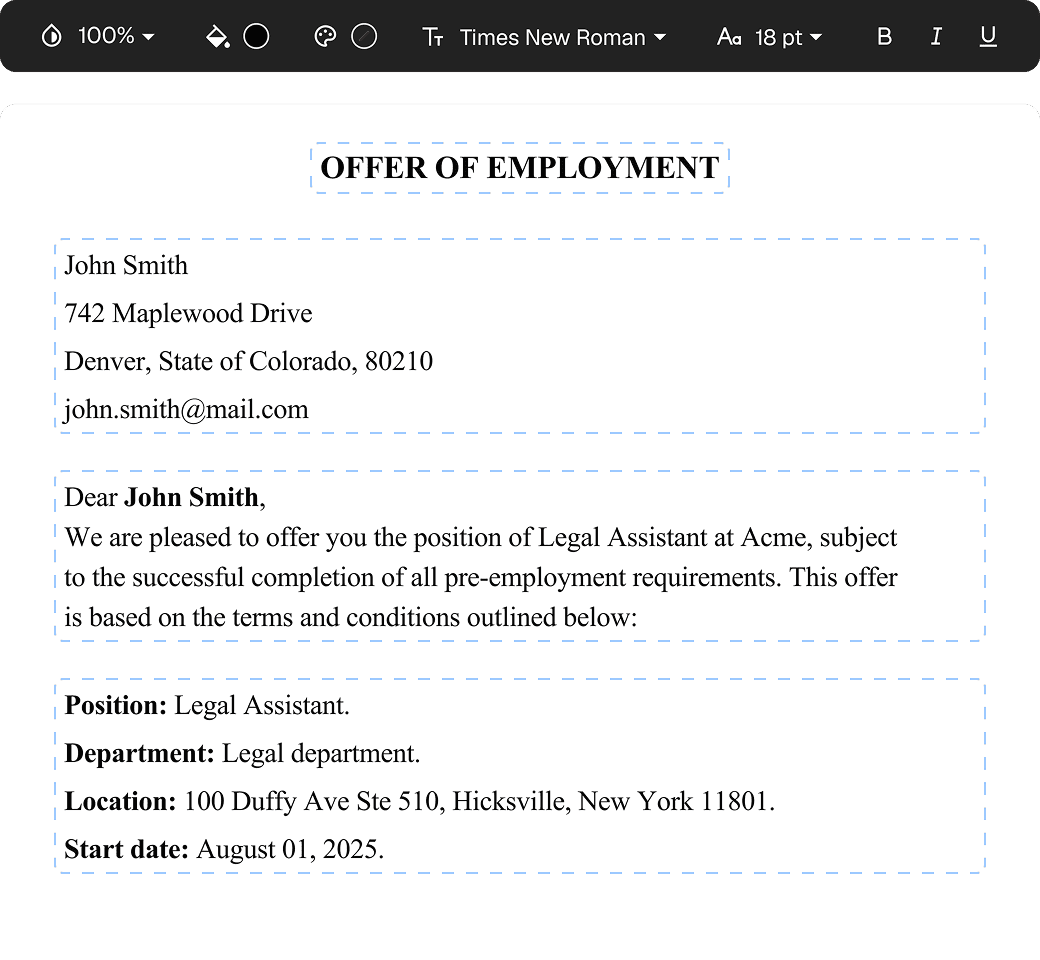
Edit PDFs seamlessly
Tweak agreements before signing or sending for signatures. Update details, add or remove clauses, adjust formatting, and redline changes instantly.
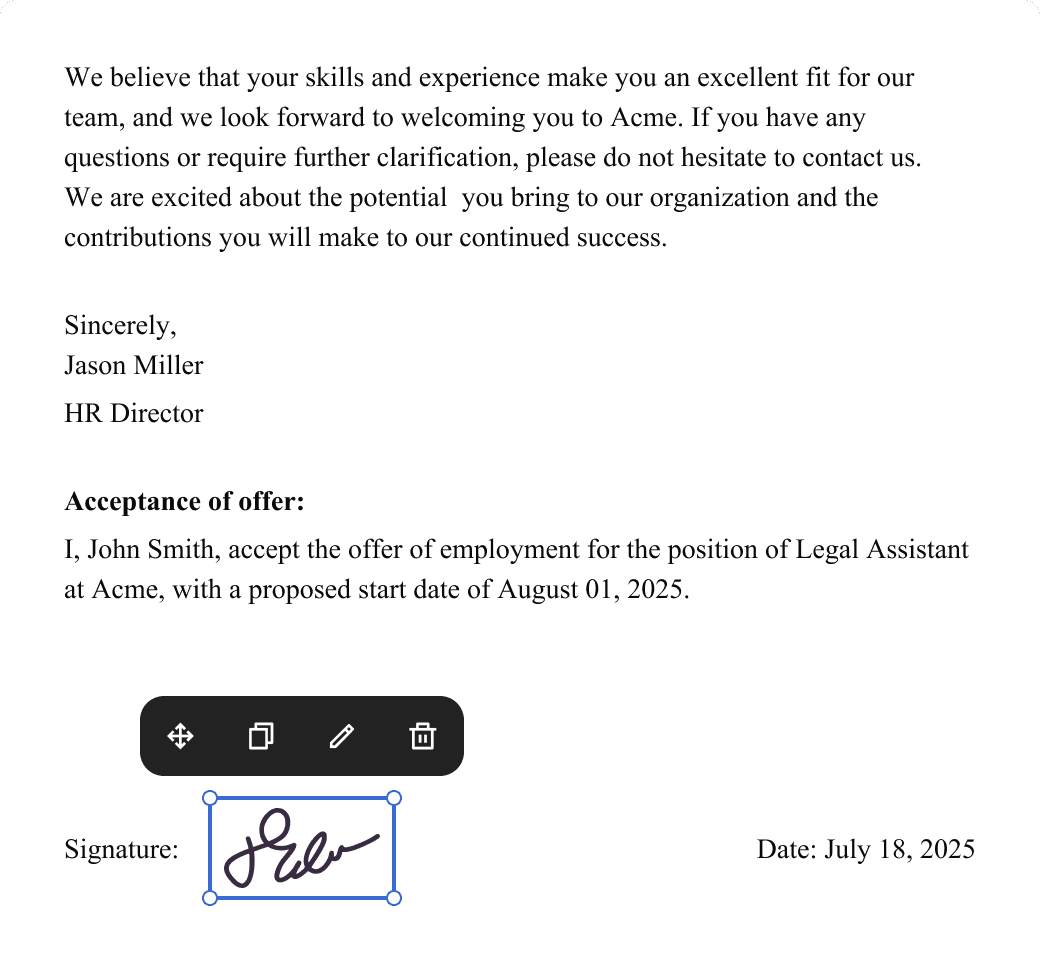
eSign legally and securely
Sign documents and collect legally binding signatures. Invite up to ten people to sign in any order, track the progress, and send reminders.
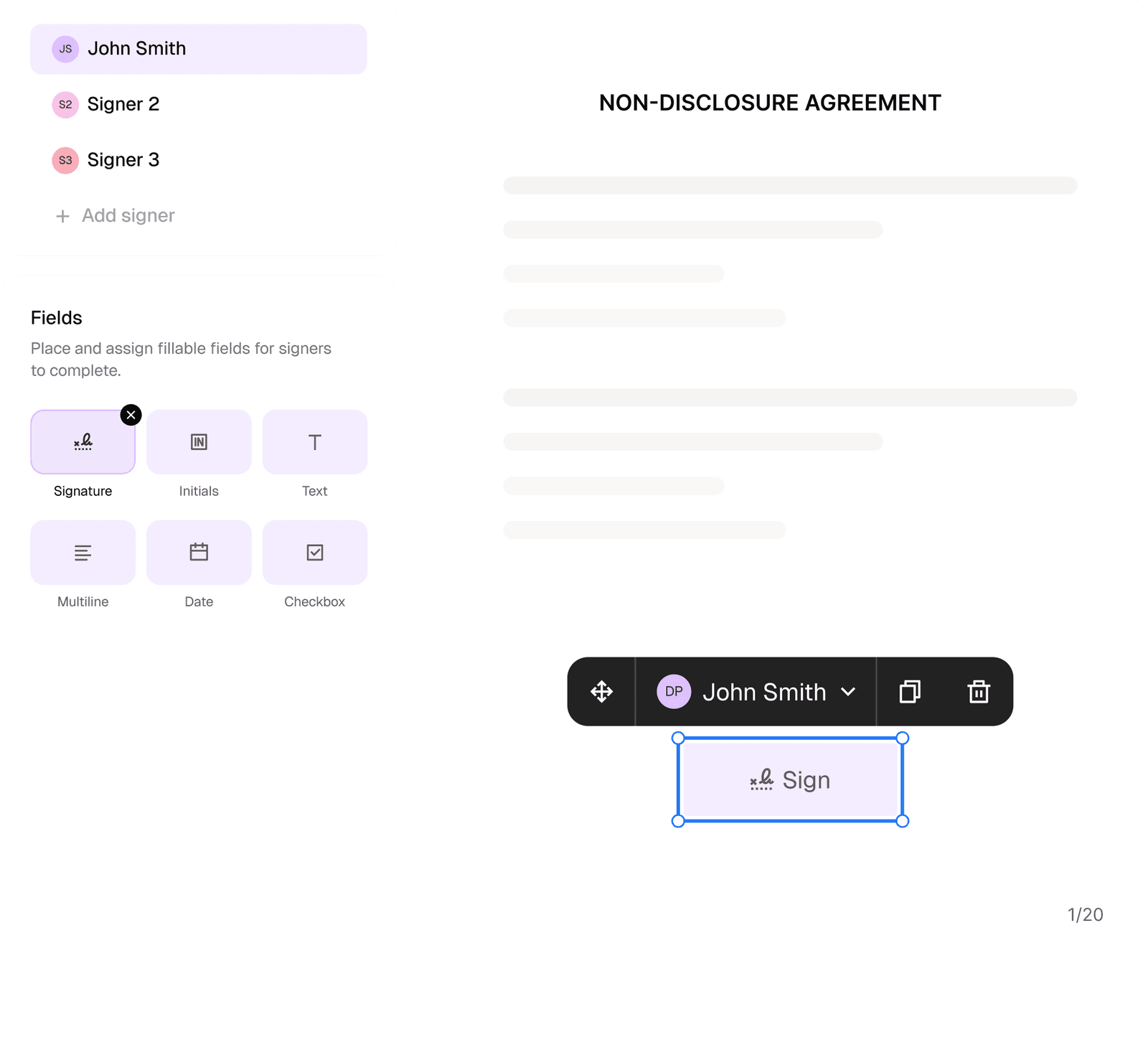
Request legally binding signatures
Invite up to ten people to sign your document in any order. Get a finalized, audit-ready copy without chasing signatures.
Skip the drafting.
Choose from 2,500+ templates
Browse templatesChoose a template
Fill in details
Sign and download