Free template
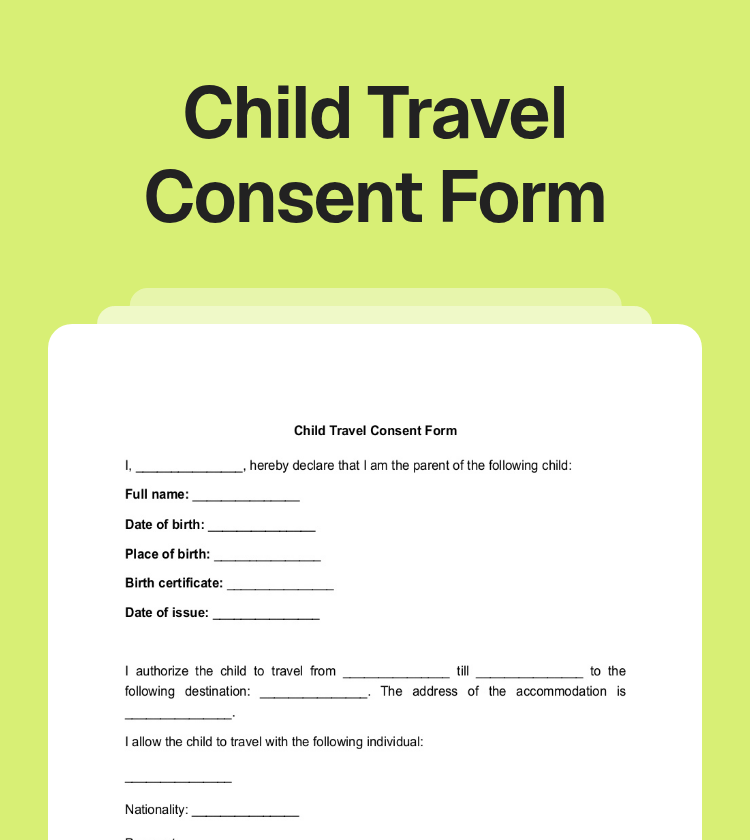
Free Child Travel Consent Form Template


What Is a Child Travel Consent Form?
Copy section linkA child travel consent form is a document that confirms a parent or legal guardian permits a minor child to travel. It usually identifies the child, the consenting parent or guardian, the accompanying adult, the travel dates, the destination, and emergency contact details.
This form is commonly used when a child travels internationally, crosses a border, joins a school or sports trip, travels with relatives, or travels with only one parent. It can help customs officers, airlines, consulates, and border control authorities confirm that the trip is authorized.
A minor travel consent form is especially important when child custody, shared parenting, or different living arrangements are involved. It does not replace a court order or custody agreement, but it can support child welfare by documenting that the trip was approved by the appropriate parent or legal guardian.
When to Use a Child Travel Consent Form
Copy section linkUse a travel consent form for minor travel when:
A child is traveling with only one parent;
A child is traveling with grandparents, relatives, family friends, teachers, coaches, or another adult;
A child is traveling as an unaccompanied minor;
A child is traveling internationally;
A child’s parents have different last names;
Parents share custody and one parent needs to show permission from the other;
A school, airline, cruise line, or travel group asks for written consent;
The destination country requires written or notarized parental permission.
When not to use this document
Copy section linkDo not use a child travel consent form to:
Transfer custody or guardianship;
Change a parenting plan or custody order;
Authorize long-term living arrangements;
Replace a passport, visa, birth certificate, or other identity document;
Give broad medical decision-making authority by itself.
If the accompanying adult also needs authority to approve medical care, consider preparing a separate child medical consent form.
Parties to the Child Travel Consent Form
Copy section linkThe main parties to a minor child travel consent form are:
Parent or legal guardian: The person giving permission for the child to travel.
Child: The minor who will travel.
Accompanying adult: The adult authorized to travel with the child, such as a relative, teacher, coach, or family friend.
Emergency contact: A person who may be contacted if the parent or guardian is unavailable.
Notary public: A state-authorized official who verifies the signer’s identity and acknowledges the signature, if notarization is used.
Witness: A person who may observe the signing if required by state rules, school policy, airline policy, or destination-country requirements.
What to Include in a Child Travel Consent Form
Copy section linkParent or guardian name: Identifies the person giving permission.
Child’s full name: Confirms which minor the consent applies to.
Child’s date and place of birth: Helps match the form to the child’s identity documents.
Birth certificate information: Provides an additional way to verify the child’s identity and parent-child relationship.
Travel dates: Shows when the permission starts and ends.
Destination: Identifies where the child is allowed to travel.
Accommodation address: Helps authorities or the parent locate the child during the trip.
Accompanying adult’s name: Identifies the person allowed to travel with the child.
Accompanying adult’s nationality and passport details: Helps match the adult to their travel document.
Parent or guardian contact details: Allows airlines, customs, or authorities to contact the consenting adult.
Emergency contact details: Provides a backup contact if the parent or guardian cannot be reached.
Signing date: Shows when the consent was issued.
Parent or guardian signature: Confirms that permission was given.
Notary acknowledgment: Adds identity verification and may be required or preferred for international travel.
Key Terms
Copy section linkMinor: A person who has not reached the legal age of adulthood, usually 18 in most states.
Parent: A child’s biological or adoptive parent with legal rights and responsibilities.
Legal guardian: A person legally authorized to care for a child and make decisions for the child.
Child custody: Legal rights and responsibilities for caring for a child, including decision-making and living arrangements.
Unaccompanied minor: A child traveling without a parent or guardian, often under special airline rules.
Customs: Government authorities that control the movement of people and goods across borders.
Border control: Officials who review travel documents and entry or exit permissions at a country’s border.
Notary public: A state-authorized official who verifies identity and acknowledges signatures.
International child abduction: The wrongful removal or retention of a child outside their country, often involving custody or consent issues.
Non-disclosure agreement: A privacy agreement used to protect confidential information. It is different from a child travel consent form and does not authorize a child’s travel.
How to Fill Out a Child Travel Consent Form
Copy section link- Enter the parent or guardian’s full name. Add the name of the adult who has legal authority to give consent.
- Add the child’s full name. Use the child’s legal name as it appears on their passport, birth certificate, or other identity document.
- Enter the child’s date and place of birth. This helps confirm the child’s identity.
- Add birth certificate details. Include the birth certificate number and date of issue if available.
- Specify the travel dates. Enter the first and last date of the authorized trip.
- Identify the destination. Add the city, state, country, or full destination details where the child will travel.
- Add the accommodation address. Include the hotel, host family, camp, school, or other address where the child will stay.
- Name the accompanying adult. Write the full name of the adult allowed to travel with the child.
- Add the accompanying adult’s nationality. Use the nationality listed on the adult’s passport or travel document.
- Enter the accompanying adult’s passport details. Include the passport number, date of issue, and issuing authority.
- Add the parent or guardian’s contact details. Provide a phone number and email address where the parent or guardian can be reached.
- Add an emergency contact. Name a backup person and include their phone number and email address.
- Date the form. Enter the date when the parent or guardian signs the document.
- Sign the form. The parent or legal guardian should sign in the signature space.
- Complete the notary acknowledgment if needed. If the form must be notarized, sign it in front of a notary public and allow the notary to complete the acknowledgment section.
After notarization, parents often scan the signed form to email to an airline, school, or consulate — if the scan has no selectable text, make it searchable first.
Rules for Traveling Alone
A child traveling alone may need more than a completed consent form. Airlines often have separate unaccompanied minor rules, including age limits, check-in procedures, extra fees, and requirements for the adult dropping off or picking up the child.
Parents should check the airline’s policy before booking travel. For international trips, they should also review passport, visa, entry, and exit requirements for the destination country. Some countries may require a notarized minor consent to travel form, proof of custody, or additional documents from a parent or legal guardian.
Traveling with One Parent
A child may be able to travel with one parent, but some countries, airlines, or border officers may ask for proof that the other parent has given permission. This is especially important when parents are divorced, separated, share custody, or have different last names.
The traveling parent may need to carry a notarized consent letter from the non-traveling parent. If one parent has sole legal custody, the parent may need to carry a custody order or similar family law document showing that the other parent’s consent is not required.
State-specific and country-specific rules can vary. Before travel, parents should check custody orders, state family law requirements, airline policies, and destination-country rules through the relevant embassy or consulate.
Medical Decisions
A child travel consent form mainly gives permission for travel. It does not always give the accompanying adult authority to approve medical treatment for the child.
If the child will travel without a parent or legal guardian, parents may want to prepare a separate medical consent document. This can help the accompanying adult respond in an emergency, contact doctors, or approve urgent care when the parent cannot be reached.
State-Specific and Destination-Specific Rules
Copy section linkEven when a child travel consent form is not state-specific, parents should still check the rules that apply to their situation. Requirements can depend on the state, custody order, airline, travel provider, and destination country.
Before the trip, review:
- State notarization rules;
- Any custody order, parenting plan, or court restriction;
- Airline or cruise line requirements;
- Passport and visa requirements;
- Destination-country entry and exit rules;
- Embassy or consulate guidance;
- Rules for children traveling alone, with one parent, or with another adult.
For international travel, a notarized consent form is often recommended because it helps confirm that the signer’s identity was verified. Some countries may require notarization, while others may request additional documents, such as a birth certificate, custody order, or proof of legal guardianship.
Common Mistakes to Avoid
Copy section link- Using vague travel dates: Add clear start and end dates.
- Leaving out the destination: Include the country, city, and accommodation address when possible.
- Forgetting passport details: Add the accompanying adult’s passport information for international travel.
- Ignoring custody orders: Make sure the trip follows any court order or parenting plan.
- Skipping notarization when it may be needed: Check airline, state, and destination-country requirements.
- Assuming one form works everywhere: Customs, consulate, and border control rules can differ by country.
- Using the form as a custody document: A travel consent form documents permission for a trip; it does not change custody or living arrangements
Where can I get a child travel consent form notarized?
You can get a child travel consent form notarized by a notary public at a bank, law office, shipping store, courthouse, or online notary service where allowed by state law. The parent or legal guardian usually must sign the form in front of the notary and show a valid identity document.
Can a child travel internationally with just one parent?
Yes, a child can often travel internationally with one parent, but the traveling parent may need a notarized consent letter from the other parent. Some countries also require proof of sole custody if the other parent’s consent is not available.
Does a child travel consent form need to be notarized?
Notarization is not always required, but it is often recommended for international travel. A notarized form can help airlines, customs officers, border control officials, and foreign authorities confirm that the consent was signed by the correct parent or legal guardian.
Do both parents need to sign a minor travel consent form?
Both parents should sign when they both have legal custody and the child is traveling without them. If the child travels with one parent, the non-traveling parent may need to sign. If one parent has sole legal custody, proof of that custody may be needed instead.
How long is a child travel consent form valid?
A child travel consent form is usually valid for the travel dates stated in the document. It is better to create a new form for each trip so that the destination, dates, accompanying adult, and contact details are up to date.
Is a birth certificate enough for a child's travel?
A birth certificate may help prove the parent-child relationship, but it may not be enough on its own. For international travel, a child may also need a passport, visa, notarized consent letter, custody documents, or destination-specific entry documents.
Can I write a child travel consent form myself?
Yes, a parent or legal guardian can write a child travel consent form, but the form should include all essential travel, identity, contact, and consent details. For international travel, check whether the destination country, airline, or consulate requires specific wording or notarization.
This template is intended for general use across all 50 U.S. states+DC. Local procedures — such as notarization, witnessing, or filing requirements — may still apply, so check your state's specific rules before signing.
Sources
Related documents
Also read